President Obama Addresses Q Conference
President Obama Welcomes Q from Q Ideas on Vimeo.
• Culture Wars, Public Square •
President Obama Welcomes Q from Q Ideas on Vimeo.
• Culture Wars •
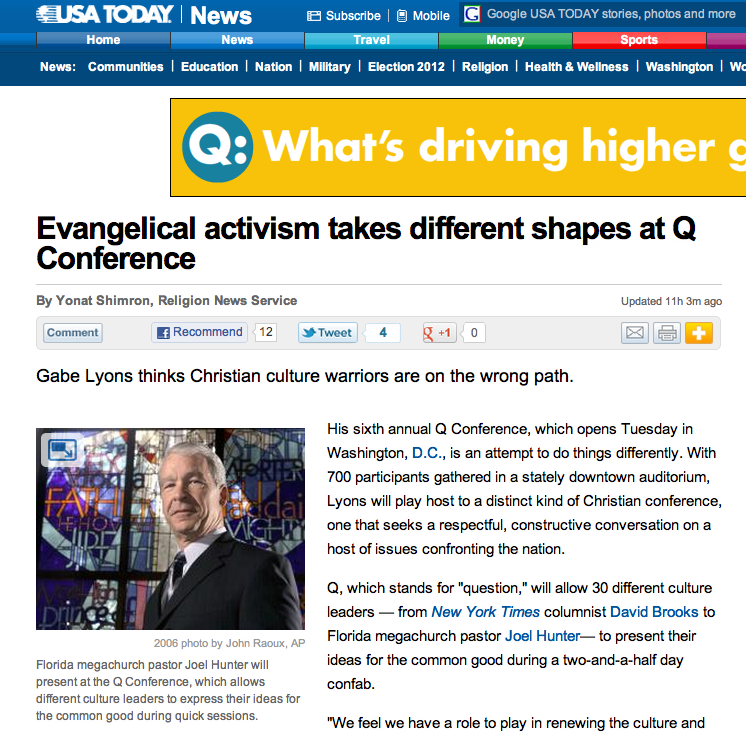 Gabe Lyons thinks Christian culture warriors are on the wrong path.
His sixth annual Q Conference, which opens Tuesday in Washington, D.C., is an attempt to do things differently. With 700 participants gathered in a stately downtown auditorium, Lyons will play host to a distinct kind of Christian conference, one that seeks a respectful, constructive conversation on a host of issues confronting the nation.
Q, which stands for "question," will allow 30 different culture leaders — from New York Times columnist David Brooks to Florida megachurch pastor Joel Hunter— to present their ideas for the common good during a two-and-a-half day confab.
"We feel we have a role to play in renewing the culture and holding back the effects of sin," said Lyons, founder of Q, a nonprofit organization based in New York City. "We're not to do it in an antagonistic way. We hope to do it in a hopeful way that gives witness to the rest of the world in how things ought to be."
Part Clinton Global Initiative, part TED Talk, the conference is designed to highlight the best ideas rather than condemning the nation's ills. Presenters are allocated three, nine, or 18 minutes to talk. Participants sit at round tables instead of rows, and time is built in for participants to reflect and talk about what they've heard.
That kind of format allows Q to include both Richard Land from the religious right and Jim Wallis from the religious left; both will share the stage Tuesday to discuss areas of potential agreement.
Lyons, a Liberty University graduate, said he realized nine years ago how little most Americans respected Christianity. That realization prompted him to acknowledge that the nation's religious pluralism was here to stay, and that if Christians wanted their views to be given a thoughtful hearing, they had better quit resisting and start creating a culture that allows God's love to break though.
His 2010 book, The Next Christians: The Good News About the End of Christian America, was a kind of manifesto calling Christians to quit cursing the darkness and start lighting a candle.
Land, who heads the Southern Baptist Convention's Ethics and Religious Liberty Commission, said he appreciates Lyons' point, but thought it was overly simplistic. "Jesus called us to do both; He called us to be salt and light," Land said. "We can walk and chew gum at the same time."
Land said his own denomination, which is often cast as a judgmental culture agitator, is also among the nation's largest providers of emergency disaster relief. In addition, its members give a higher proportion of their incomes to charity.
But Q participants are not about to compromise their evangelical convictions. On Thursday, participants will fan out across Washington to press Congress, the White House and the State Department on issues they deem important.
The difference, Lyons said, is the tone.
"It's more civil, less fear-based," he said. "There's more appreciation for the intellect and a commitment to let the best ideas win out."
The Q Conference will provide a free video stream of its opening day sessions from 9 a.m. to 10:30 a.m. and from 7 p.m. to 8:45 p.m. at www.qideas.org/live/
FIND THIS ARTICLE AT: http://www.usatoday.com/news/religion/story/2012-04-09/q-conference-christian-evangelical/54135672/1
• Public Square •
 President Obama meets with Pastor Joel Hunter and Josh DuBois, director of the White House Office for Faith-Based and Neighborhood Partnerships, in the Oval Office.
FIND THIS PHOTO AT: http://www.washingtonpost.com/conversations/the-white-house-behind-the-scenes/2012/03/23/gIQAGNCCWS_gallery.html#photo=1
• Peace •
Pastor Hunter speaks to a gathering of more than 600 local and international Christians in Bethlehem. Organized by Bethlehem Bible College, the conference addressed the issue of how to find hope in the midst of conflict. Conference organizers challenged the evangelical community to join in following Jesus in the prophetic pursuance of justice, peace and reconciliation.
• Poverty •
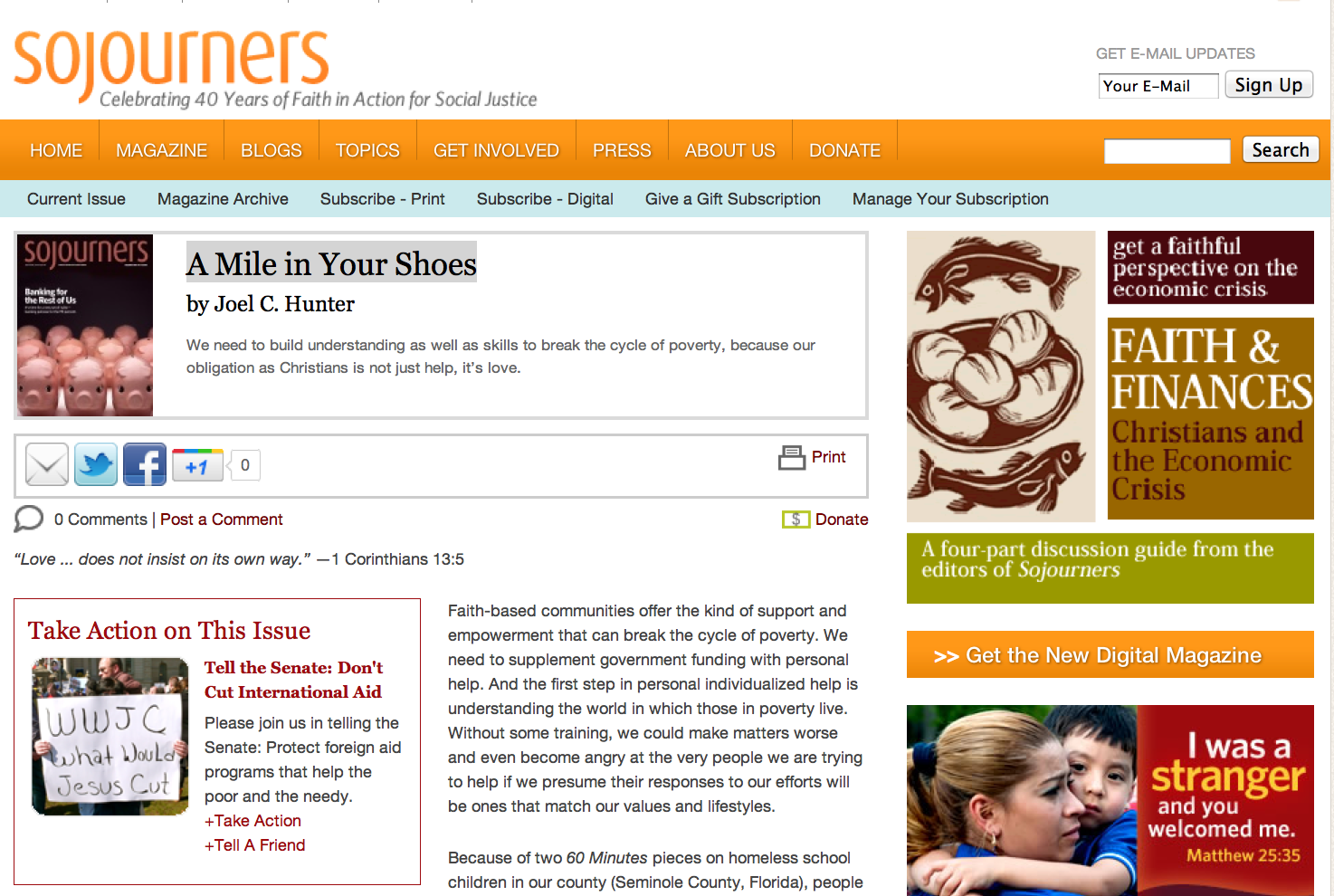 “Love ... does not insist on its own way.” —1 Corinthians 13:5
Faith-based communities offer the kind of support and empowerment that can break the cycle of poverty. We need to supplement government funding with personal help. And the first step in personal individualized help is understanding the world in which those in poverty live. Without some training, we could make matters worse and even become angry at the very people we are trying to help if we presume their responses to our efforts will be ones that match our values and lifestyles.
Because of two 60 Minutes pieces on homeless school children in our county (Seminole County, Florida), people in our congregation and other county groups got fired up to help those families transition out of poverty. It seemed wise to our church leaders that we train our congregation members in understanding poverty and some of the thinking of those who are poor. We adopted a course from the Billy Graham Institute for Prison Ministries on transitioning out of generational poverty.
Part of the course alerts those of us who have never been poor to our lack of knowledge on what it takes to survive without adequate income. Would you know where to get help if you had little or no money? What places offer food and how do you get there without a car? Which agencies offer which kind of services—housing, medical attention, job training, child care—in addition to any financial help you can get? Additionally—and this is key in being able to love well—how do those in poverty think differently than those in the middle or upper class?
This training is enlightening for many of its middle-class participants, who often are able to come to the point where we can see ourselves as likely to have the same response in various situations as do people living in poverty. Let me give a few examples. When you are in poverty, you ask a different question about meals than when you are in the middle class. In the middle class, people might ask, “Did you like it?” In poverty, the question might be, “Did you get enough?”
Those in poverty see resources differently. In the middle class we are more likely to turn to possessions in times of need. “Do you have savings? An emergency fund? An IRA?” For those in poverty, relationships are often the most valuable source of aid—“Who do you know that can help?”
When you are in the middle class, bills come first and vacations are optional. When you are in poverty, living with the constant pressure of survival, fun is so much more important—there may be nothing more coveted. The story is told of an elementary school girl who let it slip to her teacher that her family did not have a refrigerator. The good-hearted teachers pitched in from their already-meager salaries and surprised the family with a refrigerator. The next few days the girl was missing from school. When she returned, she again thanked the teacher and told her that they had sold the refrigerator and gone camping. They needed the break more than they needed the appliance! The way they chose to use this gift illustrates a difference in thinking that would make many who have plenty to share angry enough to stop engaging, if we are limited to our own perspective.
Both those in poverty and those who are not need training. We need to build understanding as well as skills to break the cycle of poverty, because our obligation as Christians is not just help, it’s love.
Dr. Joel C. Hunter is senior pastor of Northland Church in Orlando, Florida.
FIND THIS ARTICLE AT: http://sojo.net/magazine/2012/04/mile-your-shoes
 Christ at the Checkpoint, a conference sponsored by Palestinian evangelicals took place this week at Bethlehem Bible College.
According to the conference's press release:
For the first time, a broad spectrum of evangelical believers met literally at the “checkpoint,” and engaged biblically on issues that have historically divided them. Subjects included, Christian Zionism, Islamism, justice, nonviolence, and reconciliation. These themes were intended to create an ongoing forum for Christian peacemaking within the context of the Israeli Palestinian conflict. These issues were discussed in the form of inspirational messages, Bible study, interactive workshops, panels and site visits.
Defying the temptation to despair, Palestinian Christians demonstrated renewed hope to continue to stand against the injustice of occupation nonviolently and forms of Christian Zionism that marginalize them. They also acknowledged the right of the State of Israel to exist within secure borders.
Speakers included John Ortberg, Bishara Awad, Chris Wright, Doug Birdsall, David Kim, Tony Campolo, Lynne Hybels, Munther Isaac, Shane Claiborne, Joel Hunter, Ron Sider, Salim Munayer and Colin Chapman. Participants from 20 nations and a sizeable delegation of university students including Wheaton College and Eastern University, were moved by the testimony of Palestinian men and women who shared the pain and suffering they experience on a daily basis caused primarily by the continuing occupation.
A unique aspect of the conference was the presence and presentations by members of the Messianic community including Richard Harvey, Evan Thomas and Wayne Hilsden, who provided an integral contribution to the dialogue.
Conference organizers challenged the evangelical community to cease looking at the Middle East through the lens of “end times” prophecy and instead rallied them to join in following Jesus in the prophetic pursuance of justice, peace and reconciliation.
The conference organizers included: John Angle, Alex Awad, Bishara Awad, Sami Awad, Steve Haas, Munther Isaac, Yohanna Katanacho, Manfred Kohl, Salim Munayer, Jack Sara, Stephen Sizer. They also published the following manifesto:
FIND THIS ARTICLE AT: http://www.examiner.com/methodist-in-national/christians-palestine-hope-for-reconciliation-despite-occupation
• Public Square •
 The conventional wisdom is that the political left in America is suspicious of stories of presidential faith and the political right is suspicious of stories of presidential faith that involve Barack Obama. What we often lose in the crush between the two are those tender, endearing episodes that sometimes arise from a presidency and become treasured in American memory.
There is such a tale and it deserves to be told. It does reveal something of the spirituality of the current American president but it will not impact an election or change political opinions. Obama's critics may deny it. His supporters may exploit it. The cynical may doubt it. Yet, the tale is true and it belongs to us.
It begins with Dr. Joel Hunter, the pastor of Northland Church in Orland, Fla., a man unlikely to be part of a story like Barack Obama's. Hunter was a political conservative who had once been asked to head the Christian Coalition, the advocacy group founded by Pat Robertson. Yet, when Hunter responded publicly and favorably to Obama's "A More Perfect Union" speech in 2008, Obama heard of it and sent the pastor a note. "I'd like to catch up with you someday," he said.
A friendship developed. Hunter found himself praying with Obama before a campaign debate and then, later, praying at the Democratic National Convention. When Obama was elected, Hunter also agreed to be on a team of spiritual advisors for the new president. He may not have been entirely aligned with Obama's politics but he knew when he felt God's call and he certainly felt the call to minister to this young leader. Not everyone was pleased. Opposition came. Still, Hunter knew what he was meant to do.
This story, though, is not about Hunter's ministry to Obama. Instead, it centers on Ava, Hunter's granddaughter. In June, 2010, when she was only 5, Ava was diagnosed with a rare form of brain tumor -- glioblastoma multiforme. It is extremely rare in children -- and deadly. Losing Ava became a haunting possibility.
The day after Hunter learned the news, his phone rang. It was the White House operator. "Dr. Hunter, will you stand by for a call from the president."
"Yes."
And then, in a moment, "Joel, this is Barack. I just heard about Ava. I just had to call and tell you that Michelle and I are praying for you. If there is anything we can do we want to do it."
Unable to meet Obama's informality, Hunter replied, "Thank you, Mr. President. That's very kind. We have checked and there is no traditional treatment that has proven effective. We're at a loss. But I appre......."
"No. Stop that." Obama interrupted impatiently. And then, gently, "I really mean it, Joel. Anything I can do I want to do."
Hunter could take no more, and began to weep.
Then began the reversal. The man who had pastored the president now sat silently in tears as the president became, for a few moments, the pastor Hunter needed. "Joel, I want you to remember that God has got you here. He's not going to let you go. He will walk all the way through this with you. You remember this. God isn't going to let go of you. We've got to hold on to our faith in God." This continued for many minutes and then, finally, Obama said, "Please tell your family that Michelle and I are praying for them and our heart goes out to them."
"Thank you, Sir," Hunter said, and the two hung up.
What followed were some of the worst weeks of Joel Hunter's life. His granddaughter underwent a grueling surgery to remove the tumor. There was hope for a season and then the tumor grew back larger than before. On Sept. 4, the little girl died. Hunter was undone.
That same day the phone rang. "Dr. Hunter, will you stand by for a call from the president." The pastor was surprised. He was sure the president could not already know.
"Yes, I will stand by," he told the operator.
Soon, the president came on the line, obviously brokenhearted. "Joel, this is Barack. I've just heard. I'm so sorry. You will be in my prayers. Michelle and I are with you. We are trusting God to go through this with you."
"You are so kind, Mr. President. Thank you. This means a great deal to me."
Then, as before -- as Hunter's words failed him -- the president began to encourage. Again, the bits of scripture and assurances of God's grace. Again, the faith of a president offered to his friend.
Finally, "Your concern touches me, Mr. President. Thank you for calling."
"We are praying for you, Joel," Obama said before hanging up. "I am with you in this. You are not alone."
Hunter was grateful for what had been said, grateful that it helped to lift the pain. He would never forget how a president became, for a moment, a pastor and a grieving pastor could only receive and the lines between the political left and right were dissolved by the greater force of faith.
It will not impact an election or change political opinions, but it is a story we ought to know.
FIND THIS ARTICLE AT: http://www.huffingtonpost.com/stephen-mansfield/president-obama-pastors-joel-hunter_b_1311348.html
• Public Square •
 The summer before Senator Obama was elected president, he invited 30 Evangelical and Catholic leaders to meet with him in Chicago. The purpose of the meeting was transparency about his faith journey. All of us, including Franklin Graham, heard him share his testimony of how he had come to trust Christ as his Lord and Savior.
Months before that, in a personal conversation with Senator Obama, he asked me what I thought was a good direction for faith communities when it came to government activities. He knew that I am a pro-life evangelical that believes the less need for government the better. That’s why he was talking to me. I said, “The faith communities of this nation have way more resources and relationships than are being engaged right now to address our nation’s problems.” He agreed. He said, “But there are certain problems that are too great for the faith communities to solve.” I agreed.
After what I assume were many more conversations with other faith leaders, the newly elected president decided to expand the Office of Faith-Based Initiatives started by President Bush and transform it from a fair-funding administrative program to an effort engaging religious communities via their counsel and their service to our citizens.
Cynical people have interpreted this as political positioning, such as Mr. Towey who has called the president's faith-based office a “farce.” Let me tell you why I am of the opposite view.
As a member of the inaugural Advisory Council for Faith-Based and Neighborhood Partnerships, we had a unique opportunity to advise the president in how to best move forward in creating successful faith-based and community partnerships. The president and his staff have gone out of their way time and again to consult with religious leaders and advisors with whom they do not always agree. The Advisory Council was just one example of that.
I have been thrilled to see thirteen agencies in this administration through their Offices of Faith-Based and Neighborhood Partnerships seek the input of and partner with faith communities to serve those in need. Through these efforts the administration has taken significant strides to partner with faith-based communities to assist people most in need, such as helping local congregations put their social capital to work by establishing and expanding employment ministries or “job clubs.”
They have also launched a new program to get faith-based and community groups engaged in disaster response, the first time the government has a comprehensive strategy in this area, effectively teaming with faith groups to provide aid to victims and rebuild communities.
Additionally, the administration has vastly expanded efforts to engage faith-based communities as partners in feeding hungry kids in the summer, when so many who rely on meals they get at school struggle to meet their nutritional needs. The Partnership Center at USDA has boasted of adding 200 additional summer feeding sites at congregations around the country literally feeding tens of thousands of kids due to their efforts.
Recently we were honored to host First Lady Michelle Obama at our church along with over 4,000 diverse faith and community leaders to celebrate the anniversary of the Let’s Move initiative. Through this effort congregations around the country are fighting to reverse the trend of childhood obesity and increase health and wellness activities.
These are just a few of the many examples of engagement and partnership under the Obama administration’s Faith-based and Neighborhood Partnership Initiative.
Many persons during an election season judge the faith of leaders simply by their policy stance. And there always will be issues upon which we disagree.
However, demonizing the president, implying a nefarious conspiracy, and ignoring the tremendous advancement that has taken place in faith communities partnering with the government in answering people’s needs is mis-informed and incorrect.
Just a few months after President Obama was elected, he invited me to write devotions (a passage out of the Bible with a brief explanation) for him every week. I am a pastor, so I am delighted whenever there is an opportunity to help someone more personally engage the Bible and know the Lord better. I have prayed and talked with our President consistently, always privately and without publicity. When we are together, we do not talk about politics or policy. We talk about his life, his family, his faith and serving others.
I can tell you that what President Obama is doing through his Administration’s Offices of Faith-Based and Neighborhood Partnerships, is not about promulgating support for a specific policy initiative or political agenda, instead it is a testimony to his belief in the importance of partnering with religious institutions to improve the lives of families and communities across the country. And that is exactly what his faith-based office is doing.
FIND THIS ARTICLE AT: http://thehill.com/blogs/congress-blog/healthcare/212255-jim-towey-is-wrong-about-president-obama
• Public Square •
On the third and final day of her Let's Move 2nd Birthday tour, First Lady Michelle Obama visited Northland Church in Orlando, Florida, to thank faith and community leaders from 120 congregations and organizations who represented 15 different faiths and denominations. Mrs. Obama praised the group, and their congregations, for their tireless efforts in helping fulfill the core mission of the initiative: eliminating childhood obesity in a generation.
The First Lady talked about the emotional role food plays in our lives, acknowledging that it is more than just nourishment for our bodies, it's how we knit our families and our communities together. But, she told the assembly, finding ways to honor these traditions while making healthy changes is the essence of what Let's Move is working to do:
"We know that government doesn’t have all the answers; know that there’s no one-size-fits all program or policy that will solve this problem. Every family and every community is different. Each of us needs to make the changes that fit with our budgets, our beliefs, and our tastes."
Mrs. Obama called on the group of leaders as role models to children, reminding them that if they get excited about this mission, then kids will embrace it as well. And in an effort to celebrate the great work that faith and community groups have already done to promote healthy lifestyle changes, the First Lady announced a new Let's Move video challenge , telling the crowd, "whatever you do, I want to know about it."
• Public Square •
 First lady Michelle Obama Saturday visited the Florida megachurch where one of President Obama's spiritual advisers is the pastor. She encouraged faith-based groups to join her campaign against obesity, saying "your bodies are temples given to you by God."
"Sometimes folks won't do it if it wasn't said right here," she said, speaking to about 3,000 people from more than 120 congregations and organizations, representing over 15 faiths and denomination s, at Northland, A Church Distributed in central Florida.
The Rev. Joel Hunter, a spiritual adviser to President Barack Obama and who serves as senior pastor of the Northland church, introduced Mrs. Obama as a "talented, caring, a very physically fit first lady" who is most proud of being "Malia and Sasha's mom." She was in Orlando on the last day of her three-day tour to mark the second anniversary of her "Let's Move!" initiative to fight childhood obesity.
"You serve as a beacon for those who are lost, a refuge for those who've been forgotten," she told religious individuals and groups. "And our faith communities don't tend only to folks' spiritual health but to their emotional and their physical health as well," she said. "Think for a moment about the scripture that tells us that your bodies are temples given to you by God. That is a core teaching of so many of our faiths – a teaching that calls us to honor and nourish the bodies we've been blessed with, and to help others do the same."
She said one-third of children in America are overweight or obese and therefore at risk for serious conditions like diabetes, cancer and heart disease "that undermine their health, that diminish their prospects, and they cost our economy billions of dollars each year."
While Michelle Obama might like to keep her campaign separate from politics , her tour, which comes months before the presidential election, boosts the president's image. Reporters asked her about her husband's re-election bid while she was touring in Dallas on Friday, to which she replied, "I want him to be my president for another four years." She added that her approach to campaigning is, "This is the time that I have to give to the campaign and whatever you do with that time is up to you, but when it's over, don't even look at me... No calls. No anything."
While Obama's talk at the church on Saturday drew a lot of cheering and laughter, her arrival at the church campus was marked by anti-abortion protests. Activists held up placards declaring abortion as murder, but didn't mention her husband's administration by name.
The first lady praised Pastor Hunter's megachurch, which has a congregation of 15,000. It's no accident, she said, that the Northland church hosts classes to "help folks lead healthier lives."
"It's no accident that, long before we ever started 'Let's Move,' so many congregations were already sponsoring health ministries and fitness classes, hosting food pantries and summer nutrition programs for our kids."
Obama also mentioned the National Council of Churches, which she said had joined with Ample Harvest, an organization that helps gardeners donate fresh produce to 4,700 of their local food pantries. "The National Baptist Convention is aiming to have health ambassadors at all of their nearly 10,000 churches by September," she added. "And some of their churches have already created "no fry" zones in their congregations."
She said all faith communities were promoting a healthy lifestyle. "Muslim community leaders are hosting sports tournaments to encourage young people to get active," she said. "The Jewish Community Centers Association is working with JCCs around the country to grow gardens, and to get fresh food into underserved areas, and they're [creating] early child wellness programs."
She told the crowd that members of Let's Move Faith and Communities, which was created to partner with faith-based groups, had sponsored more than 1,000 summer nutrition sites providing millions of healthy meals for children in need. "So just imagine what we could achieve if every single organization and every single congregation in America got involved in this way… Imagine how many children we could feed… Imagine how many lives would be transformed."
The first lady recalled the days when she was growing up, saying, "You might not even understand how life was back then. Most of us led reasonably healthy lives. We walked to and from school every day – rain or shine." But the times have changed. "How many of us find ourselves looking forward to that fried chicken and mac and cheese, pound cake, after church on Sunday?" she asked. "Some people come to church just for the fried chicken."
She also underlined the need to revive the tradition of cooking and eating in the kitchen. "We still do that at the White House. It's a little, bitty kitchen – big, old house, everybody sitting in the kitchen. No matter where – you're sitting in the kitchen. I'm not cooking, but … but we still like the kitchen. Dirtying every pot, cooking everyone's favorite dishes, talking, laughing, sharing stories late into the night. That's family."
Obama said the government doesn't have all the answers. "There's no one-size-fits-all program or policy that will solve this problem. Every family and every community is different. Each of us needs to make the changes that fit with our budgets, our beliefs, and our tastes."
By Anugrah Kumar, Christian Post contributor.
FIND THIS ARTICLE AT: http://www.christianpost.com/news/michelle-obama-visits-fla-megachurch-urges-religious-groups-to-fight-obesity-69275
Dr. Joel C. Hunter is the Pastor of Community Benefit at Action Church, a multi-site congregation based in Winter Park and his one-minute daily devotionals can be heard worldwide on Z88 radio. He is the Chairman of the Central Florida Pledge campaign; a call to action for residents of Central Florida who are tired of hateful discourse and want to create a safe and inclusive community for all. The pledge asks residents to commit to treating all people with kindness and respect, especially those with whom they disagree. To learn more: https://www.centralfloridapledge.com/
He is a nationally and internationally known advocate for the poor, the marginalized, and those dealing with disabilities. He served a three-year term as the Chairman of Central Florida’s Commission on Homelessness. And, after 32 years as the senior pastor of Longwood, Florida’s Northland Church’s congregation of 20,000, he spent five years leading a non-profit in networking with churches and local charities to locate available resources and benefit the struggling in our community. Orlando Magazine highlighted his efforts naming him as the #1 most powerful voice for philanthropy and community engagement. And listed him among “Orlando’s 50 Most Powerful” six years in a row.
Approaching today’s challenges in a biblical and balanced manner, Dr. Hunter is neither partisan nor politically oriented, but often relates to public officials in a pastoral role; he served as a spiritual advisor to President Obama during his eight years in office.
Dr. Hunter has served in leadership roles of the World Evangelical Alliance, serving more than 600 million evangelicals, and the National Association of Evangelicals, serving more than 40 denominations and thousands of churches.
Married in 1972 to his wife, Becky, he is the father of three sons, grandfather of seven, and great-grandfather of two.
UPCOMING - AND YOU ARE INVITED!
Sunday, July 5 at 10 AM - Dr. Hunter will be preaching at Grace Convenant Presbyterian Church (1655 Peel Avenue, Orlando, FL 32806)

