•   Pro Life: In the Womb, Religious Freedom   •  

A Bitter Pill?

Screen Shot 2012-02-10 at 4.07.57 PM Joel Hunter was an unlikely ally of Barack Obama’s in the 2008 election. The Christian evangelical, who leads a mega-church in central Florida, had backed fellow pastor Mike Huckabee in the Republican primary that year. At Obama’s inauguration, Hunter found himself sitting next to Muhammad Ali in the 12th row.

Obama’s outreach to the faithful during the 2008 campaign—unprecedented for a Democratic candidate—paid off. He did 8 percentage points better than 2004 nominee John Kerry had among voters who worship weekly or more, although he lost regular worshippers overall to Republican John McCain. With strong support from minorities, Obama beat McCain by 9 percentage points among Catholics (who favored George W. Bush over Kerry by 5 points in 2004) and made smaller inroads among evangelicals such as Hunter.

Those gains are now in jeopardy, according to Hunter and other religious leaders fuming over the Obama administration’s requirement that church-affiliated institutions such as hospitals, schools, and charities cover birth control in their employee health insurance plans.

“The boundaries of religious freedom and identity are being trespassed,” said Hunter, who still writes weekly devotions for Obama and visited the Oval Office last week; he said he keeps his spiritual guidance separate from any policy recommendations he funnels to the president. “I do think this will have political repercussions in the religious community,” Hunter added. “This has the potential to be a breaking point.”

Obama’s Republican challengers certainly hope so. Newt Gingrich has accused Obama of waging a “war against religion.” Rick Santorum, a devout Catholic who has put issues such as abortion and marriage at the center of his campaign, used his victory speech after the Missouri primary to accuse Obama of steamrolling the First Amendment.

Campaigning earlier this week in Colorado, front-runner Mitt Romney, said sharply, “We must have a president who is willing to protect America’s first right, a right to worship God.”

The issue is potentially advantageous for Romney, a Mormon who once held moderate positions on abortion and gay marriage, because it allows him to align himself with the social conservatives who have resisted his candidacy. (Both Gingrich and Democrats, however, have called Romney a hypocrite on the birth-control issue. As governor of Massachusetts, he enforced a rule requiring Catholic hospitals to provide emergency contraception to rape victims, after the Legislature overrode his veto of the measure.)

On Wednesday, House Speaker John Boehner put the dispute at the center of his party’s agenda, taking to the House floor to condemn “an unambiguous attack on religious freedom in our country.” He vowed to overturn the provision stemming from Obama’s sweeping health care reform plan. The fight over that legislation has already sorely tested the president’s relationship with religious leaders, who feared that it would allow taxpayer dollars to cover abortion.

To the extent that Republicans succeed in framing the current debate as one over religious liberty, the controversy over the so-called conscience clause could damage Obama at the polls. A perceived threat to religious freedom could pull more-casual churchgoers, who typically lean Democratic, closer to regular churchgoers, who tend to vote Republican, said John Green, a University of Akron political-science professor who specializes in the intersection of religion and politics.

In 2008, exit polls showed that the more frequently white Catholic voters went to church, the less likely they were to favor Obama. He got the votes of only 41 percent of white Catholics who attended church weekly or more; 47 percent of those who attended a few times a month; and 54 percent of those who attended a few times a year or never.

The relationship of religion and politics could influence the outcome of the 2012 election in battleground states with large Catholic communities, including Iowa, Michigan, Missouri, Ohio, Pennsylvania, and Wisconsin, Green added. “The real problem for the Obama administration would be if the [birth-control] issue moved some of those less religious Catholics,” Green said. “The issue might also move the regular Mass-attending Catholics to vote even more Republican.”

But if Democrats win the message war and frame the issue as a matter of public policy that involves women’s health and access to contraception, Republicans may find themselves on the losing side of the argument. In a survey by the Public Religion Research Institute, 52 percent of Catholic voters agreed that employee health plans should cover birth control. The Obama administration is also touting a Guttmacher Institute study that found 98 percent of Catholic women have used birth control.

“Obviously, this is not a war against the Catholic Church. I’m Catholic, and I don’t find that there’s a war against me at all,” said Kathleen Kennedy Townsend, the former Maryland lieutenant governor and a member of one of the nation’s most prominent Catholic families. “This is about women’s health and protecting the rights of all citizens. If Republicans want to fight about contraception being available for women, I think they will be on the wrong side of history and the wrong side of women’s health.”

A Wall Street Journal column this week by three Democratic senators—Jeanne Sheehan of New Hampshire, Barbara Boxer of California, and Patty Murray of Washington—tied critics of Obama’s policy on contraceptive coverage to the decision by the Susan G. Komen Foundation to cut funding to Planned Parenthood. A massive public outcry forced the breast-cancer charity to reverse itself. “Once again,” the senators wrote, “they are trying to force their politics on women’s personal health care decisions.”

Young voters, women, and independents helped to elect Obama in 2008. If Republicans overreach on contraception, those voters will help offset any support the president loses from religiously devout voters, who lean Republican anyway. But if the GOP succeeds in wrapping the issue in the mantle of religious liberty, Obama will struggle to rebuild the diverse coalition that put him in the White House.

View Post

  •   Public Square   •  

Obama Reflects on Faith in Prayer Breakfast Speech

President Barack Obama spoke of his personal faith Thursday as he delivered remarks for the third year in a row at the National Prayer Breakfast.
In addition, Obama used the platform in front of religious dignitaries and politicians to express his vision of how faith and government intersect and can work together.

President Barack Obama spoke of his personal faith as he delivered remarks for the third year in a row at the National Prayer Breakfast. In his speech the President made specific mention of his calls, visits and prayers with noted pastors Joel C. Hunter and T.D. Jakes.

"From time to time, friends of mine, some of who are here today, friends like Joel Hunter or T.D. Jakes, will come by the Oval Office or they'll call on the phone or they'll send me an e-mail, and we'll pray together, and they'll pray for me and my family, and for our country," Mr. Obama said.

Click To View The Entire Speech

View Post

  •   Culture Wars, Public Square   •  

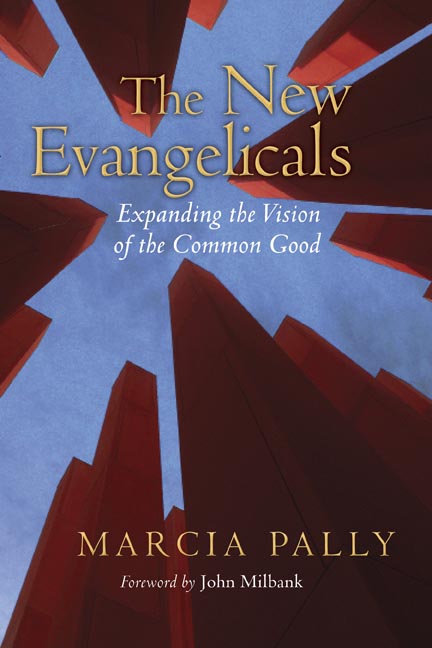
Excerpt From "The New Evangelicals: Expanding the Vision of the Common Good"

new-evangelicals-cover Joel Hunter is an ordained minister and has a doctorate in Culture and Personality in Pastoral Care. He is presently senior pastor at Northland Church, in Longwood, Florida and in 2009-2010 sat on Obama’s Office of Faith-based and Neighborhood Partnerships.

Northland is “a church distributed,” meeting in several locations in mid-Florida to serve a widely dispersed community. This requires several pastors to work together, among them the soft-spoken Amer-Indian Vernon Rainwater, who after time in the military, got a degree in social work, then was ordained, and came to Northland in 1990.

The church was originally built in an old roller-skating rink. The growth of the congregation has allowed it to build a larger building next door, with airy hallways, offices, classrooms, conference rooms, café, book store, and sanctuary that seats 3,100 ... in addition to the thousands who attend online. Several screens throughout the church project the pastor as he preaches and they scroll the words to the songs that have replaced more traditional Protestant hymns—which creates something of a church karaoke. A twelve-voice choir and eight-piece band accompany. Additional services are offered on Saturday night and Monday evening, with about one thousand attending each.

The Sunday after Sept. 11th, Northland held a joint online service with a church in Egypt as a protest against polarization between Americans and Arabs. The church also provided volunteers to protect Muslim women from anti-Muslim attacks as they went around town.

In 2009, Becky Hunter, Senior Pastor Joel Hunter’s wife, stepped down from the presidency of Global Pastors’ Wives Network, where, “We get everything, from training women as public speakers to Muslim women who converted to Christianity and need to know what they should study--quickly.” About Northland she says, “No one is obliged to have any particular confession to pray or become a member at Northland--no denominational version--but agreement to historic creeds of the church are required. But if you do join, you are committing to have a ministry aspect, a service aspect, in your life. There’s no ‘pew gum’ here.”

Northland has ministries in: marriage counseling, divorce, grieving, substance abuse, cancer, applying Scriptural values to business, orphans, foster children, the homeless, free food and clothing distribution, the elderly, the deaf, and “people struggling with homosexuality.” Its prison ministry ranges from running prayer services to helping prisoners develop plans for their lives after release. The church has an employment network, several men’s groups, groups for both men and women post-abortion “without judgment,” and discussion groups on faith and science. One Heart, a Northland partner, works with city and county agencies to repair the homes of the area’s poor. The church also has a bowling club, soccer games, a motorcycle group, and classes for children, including a course in Mandarin.

Overseas, the church works with national and international organizations in Egypt, South Africa, Brazil, Sri Lanka, Argentina, China and the Ukraine. For Catholic or Orthodox Ukranians, the appeal of evangelicalism stems, according to Northland co-pastor, Dan Lacich, from evangelical hope and optimism. “The Ukrainians I’ve met view the Orthodox church as defeatist; it just hung on during the Soviet years—‘we’re going to circle the wagons’ rather than ‘we’re going to make a difference.’”

In South Africa, Northland partners with the Vredlust Dutch Reformed church to build a school and do community development in a small town in Swaziland. The project is run, as Lacich put it, “by people who instead of taking a vacation at the beach volunteer for Swaziland. What started out as two camp fires and a kettle is now several classroom buildings, a medical clinic, and we’re doing micro-loans for business start ups.” The funding comes in large part from a young Vredlust couple who earmarked what they needed each year to live and donate everything else they earn to a trust for ministry. Northland contributed an additional thirty to forty thousand dollars in 2009, and overall spends roughly $1.5 million a year on social justice projects, about 20 percent of church income. “We do not tell a community,” Vernon Rainwater notes, “that we know what their problems are and how to fix them. We try to find out what the perspective of the community is, and we often learn more than they do.” Compassion International, another Northland partner, began in 1952 to bring food, clothing and education to children orphaned in the Korean War; today it serves children throughout the developing world. Another partner, With This Ring, uses funds from the sale of jewelry (and other products) to dig clean wells in Africa. It estimates that it cost “one hundred and eighty thousand dollars to save the lives of thirty thousand people in Yendi. That’s six dollars a life—the cost of a latte and a cookie.”

Hunter recalls that he was the kind of kid whose formative religious experiences included getting caught stealing a “men’s magazine” and whose first church skill was coughing loudly enough to cover the sound of opening candy wrappers. At Ohio University, he became active in the Civil Rights movement.

JH: [I] assumed, as we all did, that if we just got the right power in office, we’d be alright. When Dr. King was assassinated, I was thrown into a crisis. The volatility and polarization of that time—we didn’t have graduation ceremonies because we had eight hundred National Guardsmen on campus—could get you caught up in politics without your knowing why you were doing it. I wanted a more stable foundation for political reform, an eternal reason, a deep kind of equality where all God’s children would be cared for because He cared for them. So I committed myself personally to follow Christ as a result of that search for foundational meaning.. I thought I’d go to seminary—though I was sure they’d throw me out as soon as they found out about me. I wasn’t exactly the religious type.”

JH: Dr. King is partially why I identify with Barack Obama. King integrated faith with social policy in a way that benefits the vulnerable—which is our job. That’s Jesus’ reading of his job description in Isaiah 61. My grandparents were always broke because they were always giving their money away. On the other hand, I lived in an all-white town. So my journey was religious and social; it was part of my faith to learn to understand the common good.

In the next ten years we’re going to see more cooperation between those who form public policy from a secular perspective and those who come to it from a religious one. This is part of the maturation of the evangelical movement and in a way a going back to our roots. Christianity started out as a compassionate movement. It grew because we responded to epidemics and catastrophes. We were for abolition, women’s suffrage, and child labor laws. In maturity, you define yourself by what you’re for, by how you can cooperate with those who aren’t like you. There’s an emerging constituency that, while not leaving behind earlier concerns, is putting a major amount of energy into climate change, poverty, justice issues, health issues. You’re seeing a new evangelical maturity.

The iteration of the 1970s was a political, alarmed reaction to the perceived decadence in our culture, like abortion and the extraction of prayer from the public schools. For a couple of decades, the evangelical movement got stuck in this combative—“we have to win”—stance. There were issues where I agreed with [religious right leader Jerry] Falwell, like being pro-life, but the tone was off-putting. There was a silent majority to the silent majority. There came a time when many people started cringing. The AIDS issue—shouldn’t these people be receiving the most compassion and understanding? There are twenty-five thousand children dying every day from poverty. What are we doing about that?

MP: Is this a generational change?

JH: Younger people are less ideological, care less about Democrat and Republican. They just want to get things done. But there’s a lot now that reminds me of the 1960s—inspirational, idealistic. I have lived a long time to see this come about again.

MP: Is it a response to the Bush years?

JH: Let’s say the Bush-Cheney years. Bush went in a compassionate conservative—at least that’s who some of us voted for. But I’m not sure he had the capacity to handle the issues. So he delegated to Cheney.

There is a sense now among evangelicals that we did not think independently; we did not examine or analyze. We went along with this self-protective mentality that says, ‘let’s get them before they get us.’ September eleventh [2001] reinforced this but there already was a good deal of fodder to shape into fear. We’ve developed a consumerist, self-centered culture. That feeds into pre-emptive war because we fear that ‘they’re going to take away what I have.’ Or ‘Government programs are going to take away my hard-earned dollars.’ There are remnants of that now, in right-wing talk radio-- Limbaugh, Hannity, Michael Savage—just awful.

Here’s what I think the enemy is: the luxury of being simplistic, of not understanding how complex problems are and how much cooperation is required to solve them. Evangelicals went through a period where we formed homogeneous affinity groups. You cloister together and think everybody else is the enemy. One reason I’m thrilled with Obama’s presidency is that he likes a broad spectrum of perspectives. Out of those he will glean a practical solution good for everyone. He’s got the intellectual capacity to handle the job.

MP: Is your congregation bi-partisan?

JH: We’re nearly half and half.

MP: If you want to contribute to society but not marry a political party, how does that work?

JH: If you’re a Christian and want to make a difference in the world you ask: what is the Biblical basis for what I do? What would Jesus do? We can’t bank on winning or losing political battles. That’s not what the kingdom of God depends on.

We, being the humans we are, will always be tempted to make spiritual progress by political means--to use power in order to make others have our values. But Christians have to be careful to exemplify what we believe is right and then let it go. There three hundred million people in this country. I am one voice.

What I saw on the religious right was a lot of religious arrogance. Those who are theocrats—the Reconstructionists who insist that Biblical mandates be law for everybody-- will always believe they’re losing if they don’t get their way. We believe we are winning if we have the freedom to give our opinion along with everybody else. We don’t need to have our way. God doesn’t call us to be “successful”; he calls us to be faithful.

MP: If you are one voice, how do you work with other voices?

JH: We have extensive partnerships in our work on poverty, medical clinics, AIDS, housing. We partner with governments all over the world. Locally, when we have convocations on torture, creation care, and poverty, I ask for broad leadership: the bishop of the Catholic church, the head of the Islamic Society, a rabbi. I ask them to explain, from the perspective of their Scriptures, why this issue is important. Everybody begins to understand that “they” have values like I do and that this issue is too big for any one group to solve.

I was on the board of Jobs Partnership of Central Florida. The state government offered the finances to train the unemployed, and individual church-people became volunteer sponsors for each unemployed person. The sponsors said, “If your kid gets sick, we’ll take him or her to the doctor. If your car breaks down, we’ll get you to work and fix the flat problem.” Since the business community was getting trained employees with backup support systems, they committed to taking the trainees into jobs where they could move into higher-paying ranks. Business people got what they needed. Church people were able to love like they needed to love. Government got people off of welfare into jobs.

Of course, there are still a lot of barriers to working together—not willful ones but we’ve gotten used to operating on our own realms. Having said that, we specifically invite the African American church, other churches and faith communities into much of what that we do. We have a few that are our long-time partners. Same is true for our missions in other countries. We want to form partnerships—long term partnerships with people who are different from they way we are. Westerners have a view of the Gospel that’s very different from someone in South America, China or Africa. We need that kind of cross-pollination.

MP: In cooperative projects, how do you handle the finances?

JH: A church cannot take government funds into the church’s general budget. So for instance, in our partnership with the county to renovate houses in poor areas, they buy the supplies and the churches bring in the [volunteer] craftsmen. The county pays for the materials; the money never comes to us.

MP: What could mess up this picture of inter-group and church-state cooperation?

JH: Militancy from one powerful group. If any group gets too much power, there is a tendency to suppress others. But as we continue listening with respect to multiple perspectives, we will begin to trust each other. I’ve been in conversations with organizations our government can’t even talk to—like Hezbollah. The enemy is never as scary or threatening up close.

What also can sabotage dialogue is a structure where voices present their case to the governing authority but never have to listen to others. If you have a president who says, “give me one group at a time,” the group comes in, presents its case, and if things don’t go down their way, they’re furious. But if all the groups sit together and hear what other people are saying, then they begin to see where others are coming from.

MP: How do you answer those who think churches don’t belong in political discussion?

JH: We could diffuse some of the alarm if we think in terms of cooperation rather than “religion against secularism.” Think more in terms of cooperation on projects rather than compromise on beliefs. We need to get away from the zero-sum game that says, if we allow them their voice, it will take away from what I have.

MP: What’s your response to those who say, “We don’t want to dialogue with certain religious groups, like those that commit honor killings.”

JH: You take care of destructive behavior by law. All law is codified values, of course. But every society must decide what protecting its citizens entails. Yet you don’t disenfranchise an entire faith group because of some of the people in it. You know the saying, you keep your friends close and your enemies closer.

The counter-intuitive wisdom here is that the very people you don’t want to talk to are the people you need to talk to the most. You start out by saying that this is going to be tough. But you never make any progress until you engage in those conversations. At least you’re building relationships and that enhances the probability of reaching consensus.

There’s a very important conversation to be had with secular authorities about Muslims not being able to wear certain types of dress or Christians not being able to wear a cross of a certain size. Dialogue is necessary no matter how tough it is. Boundaries are not just dividing points. They are connecting points. They are not where the conversation ends but where it begins.

Used with permission. By Marcia Pally Copyright 2011, Eerdmans Publishing http://www.amazon.com/New-Evangelicals-Expanding-Vision-Common/dp/0802866409

View Post

  •   Public Square   •  

For Obama, Religion Remains an Issue

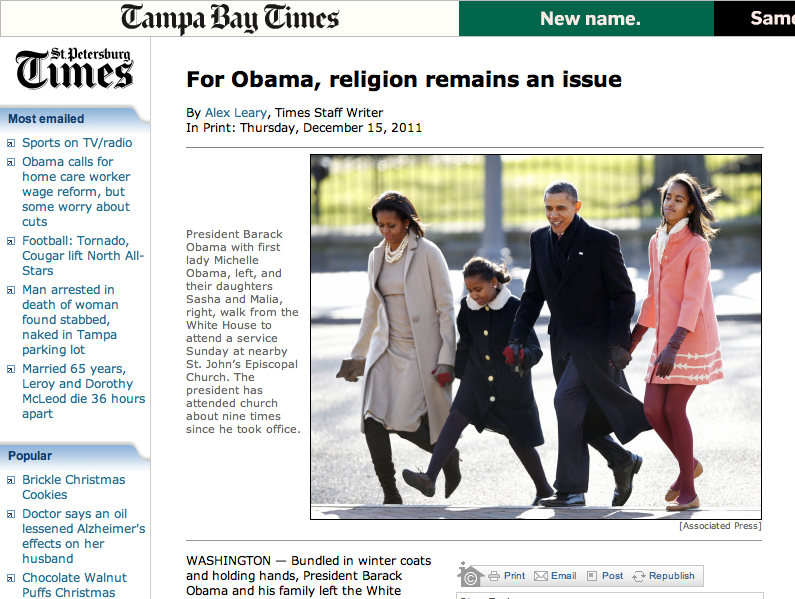
Screen Shot 2011-12-16 at 10.50.35 AM WASHINGTON - Bundled in winter coats and holding hands, President Barack Obama and his family left the White House last Sunday and strolled through a park to St. John's Episcopal Church.

Inside, a pastor preached about John the Baptist and not giving up when things don't work out. He connected the message to Obama, saying people viewed the president as a savior but the nation's problems are not easily solved.

Obama's church visit got attention because it was rare. The last time the president attended Sunday services in Washington was in July. And the family outing came days after a campaign ad by Republican candidate Rick Perry asserted Obama has been waging "war on religion."

Religion is "not always the most important reason people vote, but it never completely goes away," said John Green, a political scientist at the University of Akron who studies the issue.

"I think Obama goes into his re-election period with an opportunity to re-emphasize his faith and the connections of his faith to his policies, partly because he hasn't done it very much," Green said.

But it also presents an opening for critics to question the devotion of a president who as a candidate in 2008 had to go out of his way to refute claims, spread on the Internet and in emails, that he was Muslim. Even now, many Americans seem unaware of Obama's religious background.

...

Obama, who the White House says is a "committed Christian" and prays daily, has followed a winding path.

His Kenyan-born father was brought up Muslim but was a "nonbeliever" according to Obama's telling. He said his mother was skeptical of religion, and when she moved them to Indonesia, he attended a Catholic school and a secular school where Muslims were the majority. While living in Hawaii with his grandparents, Obama went to a Unitarian Universalist church.

As a rising political figure, Obama spoke how he overcame his own reservations and was baptized after college. "I felt God's spirit beckoning me. I submitted myself to his will, and dedicated myself to discovering his truth," he wrote in his book, The Audacity of Hope.

Then came a roiling controversy that threatened to upend his presidential campaign: the publicity around sermons by his pastor, the Rev. Jeremiah Wright of Trinity United Church of Christ in Chicago.

Wright said U.S. leaders caused the 9/11 terrorist attacks by supporting terrorism abroad and claimed the government tried to wipe out African-Americans with drugs and AIDS. God bless America? Wright said it should be "God d-- America."

Obama severed ties with Wright and his campaign recovered. On Inauguration Day, he invited two noted pastors to pray: Rick Warren, the evangelical megachurch leader, and Joseph Lowery, a leader in the civil rights movement.

Since then, Obama's religious life has been little discussed - partly because the economy has dominated talk in Washington, and partly because Obama practices more privately.

Obama has been to church in Washington about nine times, according to a count by Mark Knoller, a CBS News White House correspondent who keeps statistics on presidents. Michelle Obama and her children are not known to attend services on their own, but the first lady has visited churches around the country as part of her effort to combat childhood obesity.

President George W. Bush attended church more frequently but, like Obama, did not join a church in Washington and preferred to worship at the more private Evergreen Chapel at Camp David, where the Obamas sometimes attend. Jimmy Carter continued to teach Sunday school while in the White House. Ronald Reagan took a lower key approach.

Presidential outings are always a heavy affair. Streets are cleared. Traffic is disrupted. Churchgoers must pass through security.

"He regrets causing such a distraction that other people can't worship," said the Rev. Joel Hunter of Northland church in Longwood near Orlando, who writes weekly devotionals for Obama.

But the lack of visibility has clouded public perception. A 2010 Pew Research Center poll found that 18 percent of adults think Obama is Muslim, up from 11 percent in 2009. Thirty-four percent correctly identified him as Christian while 43 percent said they did not know Obama's religion.

"That is the dilemma," Hunter said. "If you are more private in your personal development, then it creates a vacuum. People fill it in with the latest email," a reference to attacks preying on fears of Muslims.

The White House said Obama prays daily and has a circle of pastors, Hunter included, who provide spiritual advice. "The president's Christian faith is a part of who he is, but not a part of what the public or the media is focused on every day," read a statement.

Obama has invoked religion during ceremonies and faith-based events. He said he called an Easter prayer breakfast this spring because "as busy as we are, as many tasks as pile up, during this season, we are reminded that there's something about the resurrection - something about the resurrection of our savior, Jesus Christ, that puts everything else in perspective."

...

As the election approaches, religion will return as an issue. Mitt Romney, one of the top Republican candidates, faces potential problems in the primary because he is Mormon, which some other Christians view with suspicion. Newt Gingrich became a Catholic in 2009 but carries the baggage of two divorces and infidelity. Perry is trying to regain his footing in the race by playing up his faith.

"I'm not ashamed to admit that I'm a Christian," the Texas governor says in his new TV ad. "But you don't have to be in the pew every Sunday to know that there's something wrong in this country when gays can serve openly in the military, but our kids can't openly celebrate Christmas or pray in school. As president, I'll end Obama's war on religion, and I'll fight against liberal attacks on our religious heritage."

Perry was wrong about school prayer. Schools cannot hold Christmas events or prayers that focus on one religion, but children are allowed to pray and openly celebrate Christmas.

The Perry campaign says the "war" extends to Obama's decision not to defend the federal ban on gay marriage in court.

Religious conservatives have found reason to disagree with Obama over some policies, including the insurance mandate under the health care law, which some say violates the rights of those to forgo coverage because they think God is their protector. The law includes religious exemptions that critics say are vague.

At the same time, Obama has been praised for strengthening faith-based government outreach.

"When Michelle and I hear our faith questioned from time to time, we are reminded that ultimately what matters is not what other people say about us but whether we're being true to our conscience and true to our God," Obama said during the February National Prayer Breakfast. "Seek first his kingdom and his righteousness and all these things will be given to you as well."

FIND THIS ARTICLE AT: http://www.tampabay.com/news/politics/national/for-obama-religion-remains-an-issue/1206260

View Post

  •   Creation Care   •  

Caring for the Environment Is a Mandate From God

Screen Shot 2011-12-12 at 1.30.11 PM There are plenty of practical reasons to be concerned about the environment and unchecked growth. Sprawl leads to higher taxes. A drained aquifer could lead to water rationing and higher costs. Pollution affects all manner of living things, from plants to humans.

Still, those reasons aren't enough for everyone.

So the Rev. Joel Hunter offers people of Christian faith another reason to care for our natural resources — because God commands it. "It was our first commandment when we were placed down here: Take care of the garden." Hunter said. "Really, it's a matter of obedience." READ MORE

View Post

  •   Public Square   •  

Thomas Jefferson's Biblical Revisions

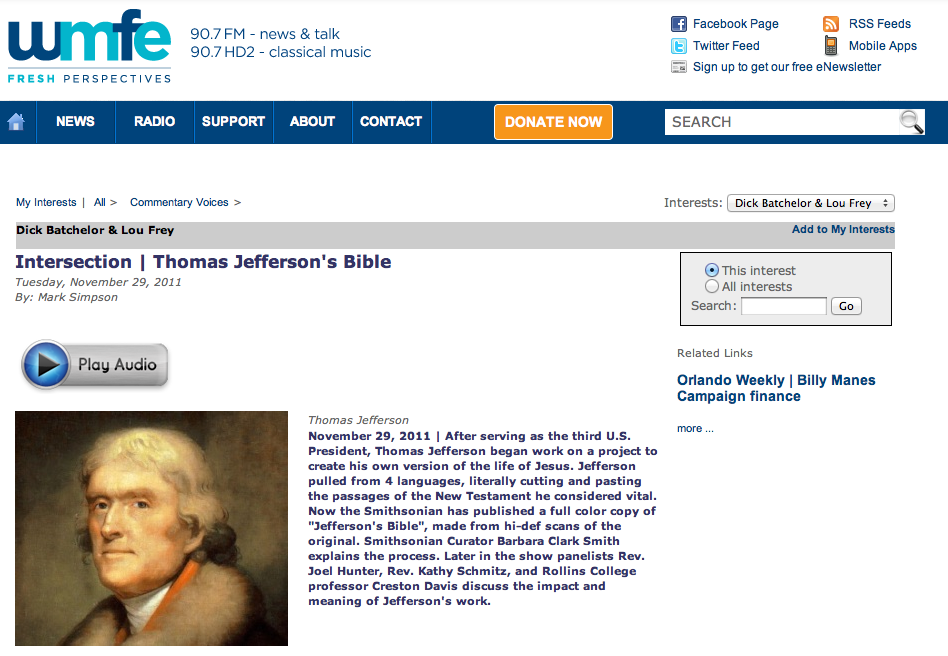
Screen Shot 2011-12-01 at 5.13.49 PM A decade after Thomas Jefferson left office, the nation's third President started working on a project compiling the four gospels of the Bible's New Testament into a book that removed supernatural parts Jesus' life. It came to be known as "The Jefferson Bible." The work was recently published by the Smithsonian Institution. NPR affiliate WMFE invited a panel of religious leaders and scholars to discuss the meaning and impact of Jefferson's biblical revisions. Here, Pastor Joel Hunter talks about what happens to Christianity if miracles like the Virgin Birth and the Resurrection are removed from the faith. CLICK TO LISTEN.

View Post

  •   Public Square   •  

Monster-in-law? Not in this family

Screen Shot 2011-11-15 at 7.25.46 PM As a pastor's wife, Becky Hunter has heard many lamentations over mothers-in-law — particularly as it applies to the relationship with a daughter-in-law.

As her three boys grew up and married, she never wanted to be the reason for any such grief. So Hunter, the wife of Joel C. Hunter, spiritual adviser to President Barack Obama and pastor of Northland, A Church Distributed, outside Orlando, Fla., took what she learned from confidences shared and Scriptures read, and kept this cardinal truth in mind: The primary relationship is the one between son and wife.

"If the mother-in-law or son is not willing to see the primary relationship as the one between son and wife, the relationship between mother-in-law and daughter-in-law will be messed up," she said. "The mother-in-law will constantly be feeling she's playing second fiddle."

And, she added: "Bottom line is, she is second fiddle."

Hunter and her daughters-in-law have gathered the lessons learned in a book, "Why Her? You, Your Mother-in-Law/Daughter-in-Law and the Big Picture" (Northland, A Church Distributed). Half of it is by Hunter, the second half by her daughters-in-law, Lisa, Rhonda and Elizabeth.

Hunter does not think of their book as a how-to as much as a why-to. It's never easy when two women love the same man, she acknowledged, albeit in different ways. The wife often sees her husband as protector; the mother thinks she is supposed to protect him. Being aware of those differences can make all the difference in the two women's relationship.

She offers some counsel for mothers-in-law, most of which daughters-in-law could follow too — not to mention sons-in-law and fathers-in-law:

Do not take sides — your child's or your spouse's. "You need to take the marriage's side," Hunter said.

Pray for your daughter-in-law and not about her. "There's the image of the mother-in-law praying, 'Please fix her. You know what she's like. I just want you to make her better.' As opposed to 'Lord, help her be her best. Help her move forward as a strong partner to her husband.'"

Phrase requests as invitations, not obligations. For example, a mother-in-law may be disappointed when her son's family declines to spend a holiday with her. Rather than pile on the guilt, she said, "You may build a closer family by just letting it go with no strings or grudges. That may set a tone that makes them want to be with you the next time."

Don't force a buddy-buddy relationship too soon. Instead, be willing to invest in the relationship in ways that the other woman would appreciate, and on her terms, not yours.

Relate to her as an equal. Avoid the temptation on either side to adopt a child or parent role.

Avoid setting her up for failure, intentionally or unintentionally. You wish she had a job? Or were home raising the kids? "It isn't like (they're) doing something wrong," Hunter said, "but there is an impression that they're failing" based on the mother-in-law's expectations.

wdonahue@tribune.com

Daughter-in-law offers some advice

Pressed for any momentary lapse of bliss, Elizabeth Hunter, who is married to Joel Hunter Jr., shared an initial struggle she had in relation to her mother-in-law.

"Early in my marriage, I noticed my husband turning to Becky a lot for encouragement. It was hard for me … and I had to take a step back and say, 'It's not her pulling him away from me. It's something I need to do in our marriage.'" So she worked on being more supportive of her husband. "I didn't want to allow any resentment to creep in."

— W.D.

View Post

  •   Poverty   •  

Children That Are Hurting

“Children that are hurting” is a phrase the Seminole county public school district’s board chair Dede Schaffner speaks to describe more than 1,700 homeless students served by the district. Joined by Brenda Carey, chairman of the board of Seminole county government, and Dr. Joel C. Hunter, they have formed a collaboration of faith-based organizations in the county to work side-by-side with the district to confront student homelessness, decrease it and, perhaps, if successful, apply that strategy in the future to address other categories of homeless people in Seminole county. This is the story of their first steps.

Produced, reported and edited by Stephen McKenney Steck at http://cmfmedia.org/2011/11/children-that-are-hurting/

View Post

  •   Creation Care   •  

Whatever Happened to the Evangelical-Environmental Alliance?

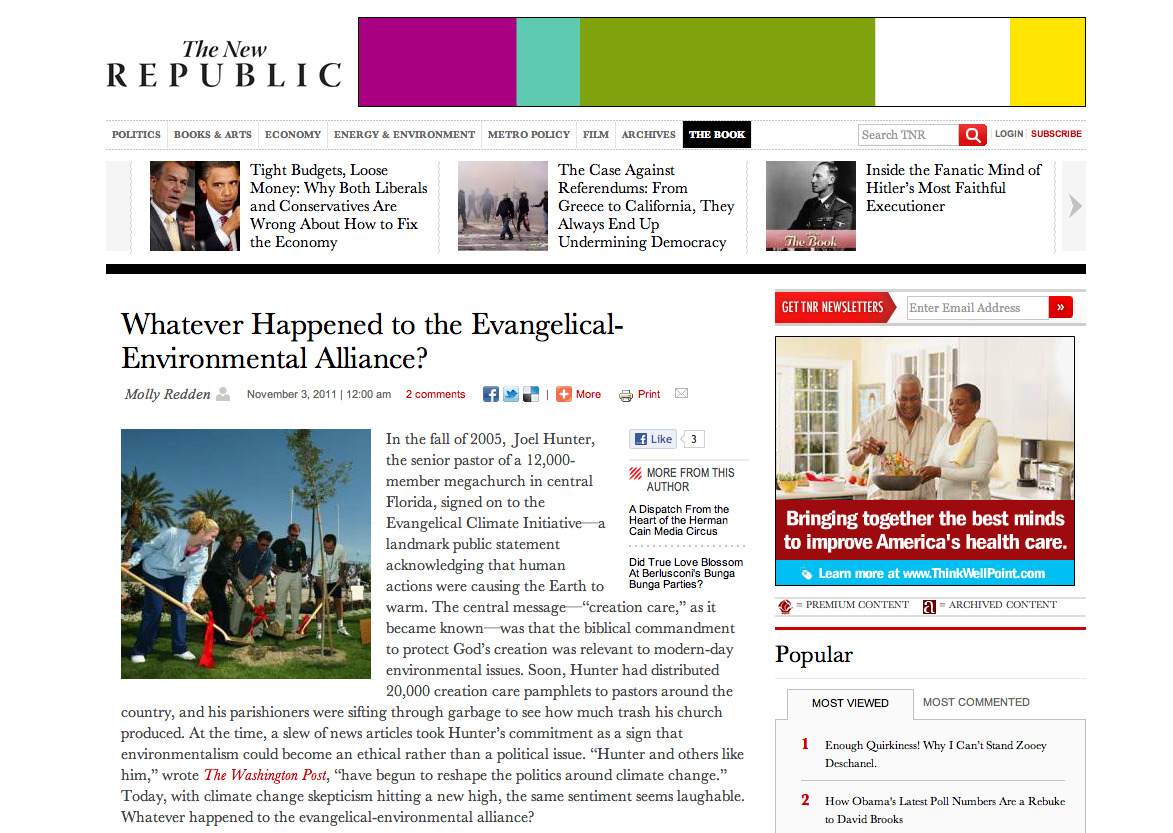
Screen Shot 2011-11-03 at 11.02.36 AM In the fall of 2005, Joel Hunter, the senior pastor of a 12,000-member megachurch in central Florida, signed on to the Evangelical Climate Initiative—a landmark public statement acknowledging that human actions were causing the Earth to warm. The central message—“creation care,” as it became known—was that the biblical commandment to protect God’s creation was relevant to modern-day environmental issues. Soon, Hunter had distributed 20,000 creation care pamphlets to pastors around the country, and his parishioners were sifting through garbage to see how much trash his church produced. At the time, a slew of news articles took Hunter’s commitment as a sign that environmentalism could become an ethical rather than a political issue. “Hunter and others like him,” wrote The Washington Post, “have begun to reshape the politics around climate change.” Today, with climate change skepticism hitting a new high, the same sentiment seems laughable. Whatever happened to the evangelical-environmental alliance?

Between 2006 to 2008, creation care seemed poised to transform evangelical politics. 86 evangelical leaders initially signed the Climate Initiative in 2006—it had more than 100 endorsers by the next year. Rod Dreher, a conservative columnist for The Dallas Morning News and a frequent National Review contributor, published a widely discussed book called Crunchy Cons in 2006; its lengthy subtitle celebrated “evangelical free-range farmers” among other conservative environmental types. In 2008, 45 members of the Southern Baptist Convention signed a statement saying they had been “too timid” on the issue of climate change, Pat Robertson appeared in a commercial about environmental issues with Al Sharpton, and Mike Huckabee—initially the favorite candidate of middle-America evangelicals in 2008—spoke openly about his global warming concerns.

The popularity of creation care was also taken as a sign that evangelicals cared about the environment andthat the GOP’s stranglehold on the evangelical vote might be loosening. Amy Sullivan argued this for The New Republic in 2006, and E.J. Dionne opined in 2007 that creation care was part of a larger reformation “disentangling a great religious movement from a partisan political machine.” In The New Yorker, Frances Fitzgerald argued that creation care advocates might change the GOP “beyond the recognition of Karl Rove.” When Obama captured five points more than John Kerry of the white evangelical vote, it was seen as an additional sign of shifting allegiances.

However, in late 2008, creation care’s momentum slowed, and the evangelical-GOP alliance grew stronger. Perhaps the first sign that creation care was sputtering was the abrupt departure from the National Association of Evangelicals (NAE) of its chief lobbyist, Richard Cizik, the leading force behind the Evangelical Climate Initiative. Cizik was forced out after he voiced support for civil unions between gays and lesbians, but he and his critics both traced the roots of his ouster to his strident support of environmental issues. At the time, Cizik’s departure was regarded as a mere hiccup. But, in fact, it was a sign of a backlash that would be bolstered by the rise of the Tea Party, increased scientific skepticism, and the faltering economy.

The rise of the Tea Party after 2008 was detrimental to evangelical environmentalism for two main reasons: It commanded the attention of the Republican Partyand it made room for climate change skeptics. Although it’s impossible to say if politicians instigated or reacted to the increased climate change skepticism associated with the rise of the Tea Party, by late 2009 evangelical climate skeptics were out in full force—climate change denier Senator Jim Inhofe called it “the year of the skeptic.” Tea Party senate candidates Marco Rubio, Joe Miller, Ken Buck, Christine O’Donnell, Ron Johnson, and Sharron Angle—who called manmade climate change the “mantra of the left”—all proudly advertised their climate change skepticism in the 2010 GOP primaries. Meanwhile, moderate Republican candidates, such as Illinois’s Mark Kirk, renounced their votes for cap-and-trade or were booed by Tea Party throngs for defending them. Today, polls show Tea Partiers are markedly less likely than any voter group to believe that humans were causing global warming—or that the Earth is warming at all.

A new bout of skepticism over the actual science of climate change reinforced these political positions. Creationism and a “God is in charge” belief became prominent again, along with a sense that any attempt to take climate change seriously was somehow unfaithful—even unjust. At a December 2009 Heritage Foundation event, Craig Mitchell, a Southern Baptist theologian, derided cap-and-trade as “immoral,” while other evangelical leaders blasted the evidence for climate change. Measures to address climate change were disfavored for supposedly placing burdens on poorer nations. (Ironically, concern for poorer nations at risk due to climate change had been one of the main selling points for creation care.) The Cornwall Alliance (an influential evangelical group that bills its mission as “the Stewardship of Creation”) released a declaration that claimed the “Earth and its ecosystems … are robust, resilient, self-regulating. … Earth’s climate system is no exception.” A year later, the group put out “Resisting the Green Dragon,” a 12-part DVD series decrying the environmental movement. Scientific skepticism bled into cultural skepticism. Even among moderate evangelicals, creation care struggled against general ambivalence toward environment issues—rooted in opposition to the countercultural identity that American environmentalism gained in the 1970s. As David P. Gushee, one of the authors of the Evangelical Climate Initiative, put it: To them, “it’s Pocahontas talking to spirits in the trees,” and “flower-power.”

Finally, there was the economy. Once it nosedived, it became hard for anyone to talk about policy changes with significant up-front costs. Hunter points to it as one of the main reasons why his message didn’t take among members of his own church—parishioners were just too distracted by the downturn. The circa-2006 hope that pro-business evangelicals might get behind the cost-saving appeal of conservation disappeared in the face of arguments that environmental regulations would freeze economic growth. A recent Nature article points out that the Heartland Institute, a think tank that has spent millions of dollars on coordinated attacks on climate change science, mostly focuses on the economic costs of environmentalism. “I would argue that conservation … is not a luxury, but a moral imperative,” Rod Dreher, the Crunchy Cons author, wrote to me in an e-mail. “I would also get exactly nowhere with that argument among conservatives in this economy.”

It’s true that today the optimism of 2005 is nowhere to be found. The mood has shifted so far that GOP candidates must not only renounce any environmentally friendly policies, they must also explain their past support for them. As Grover Norquist recently put it, formerly environmentally-minded GOP candidates “better have an explanation, an excuse, or a mea culpa.” Despite all the theories that environmentalism might untie the GOP-evangelical alliance, most of the white evangelical vote, for now, remains inextricably linked to the Republican Party. A glum Hunter told me that he holds out hope for the next generation, conceding that his generation probably won’t be shaking up the climate change debate like they’d hoped. The old fault lines, which Cizik told The New Republic in 2006 were “no more,” are still very much alive.

Molly Redden is a reporter-researcher at The New Republic.

Source URL: http://www.tnr.com/article/politics/97007/evangelical-climate-initiative-creation-care

View Post