Is Judgment Day Upon Us?
Pastor Hunter talks to Fox 35 (Orlando) about Harold Camping's predictions that the world will end soon.
• Public Square •
Pastor Hunter talks to Fox 35 (Orlando) about Harold Camping's predictions that the world will end soon.
• Public Square •
Dr. Hunter talks about the meeting between President Obama and the National Association of Evangelicals during the first Evangelical Summit, held at the White House on October 12.
• Public Square •
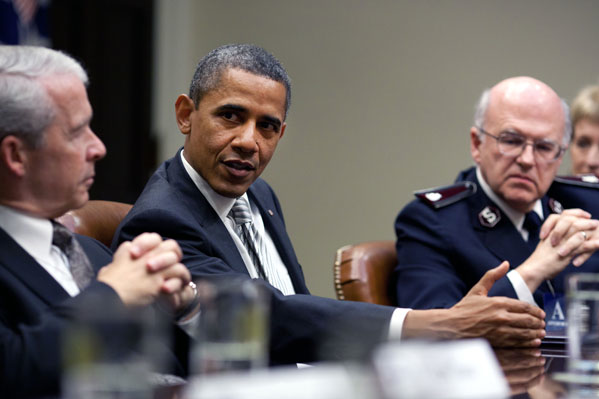 Christian leaders at the first Evangelical Summit held at the White House Wednesday prayed for President Barack Obama and encouraged him to continue talking about his faith, said Joel C. Hunter, a spiritual adviser to the president.
Obama met with the executive committee of the National Association of Evangelicals, which represents 45,000 churches from 40 denominations across the United States, in the Roosevelt Room.
Religious freedom and the Christian stance on traditional marriage took center stage among the topics discussed, Hunter said. Immigration reform and global poverty were also presented as issues during the 30-minute meeting.
Hunter, who sat next to Obama during the meeting, told The Christian Post that the president also talked about his own faith. Although he did not want to quote the president's conversation on the matter, he said Obama “did bring up his faith and spoke from that perspective.”
At the conclusion of the meeting, Leith Anderson, the president of NAE, asked Obama if he would like the members present to pray for him, Hunter said.
“We prayed for him. Leith commended him on his expression of his faith in the Easter prayer gathering and at other times. We told him that we really do appreciate his being clear about his Christian faith at different events. So we just wanted to encourage him in that,” Hunter said.
Hunter, of Northland, A Church Distributed, near Orlando, Fla., was a member of the White House’s Advisory Council on Faith-Based and Neighborhood Partnerships. He told CP that he presently has a pastoral relationship with Obama.
“It was a very constructive meeting. Very honest,” Hunter described. “The president is very good at stuff like that. He wanted to hear our concerns and priorities, and he listened and responded to each one of them.”
The Rev. Samuel Rodriguez, president of the National Hispanic Christian Leadership Conference and a member of the contingent, told Charisma News that the meeting was "very much a conversation among friends. We had about 19 evangelical leaders – all an integral part and members of the NAE – and we had a great conversation with the president."
According to Rodriguez, "Although we may disagree with the president on certain issues, we did it with great deference and civility. Not only was the meeting cordial, it sounded like a conversation amongst believers. The meeting was edifying, to say the least."
Hunter said that members of the NAE wanted to make sure Obama was clear on their views on religious freedom and marriage.
“Certainly, the president’s attention was drawn to religious freedom and our strong advocacy for that. There is a bill in the Senate right now to extend the commission on international freedom,” he said. “We wanted to advocate that we continue that commission because it’s so important.”
Although it is not always clear cut, there appears to be a divide between Obama and many evangelicals on the issue of same-sex marriage. NAE leaders articulated a desire for military chaplains to be able to express opposition to homosexuality, coming on the heels of the repeal of “don’t ask, don’t tell.”
“I think the president was reminded how important the issue of marriage is to us,” Hunter said. “That we don’t ever want to be in a position that we feel like we are having to compromise what we believe because of federal policies.”
Hunter also said the NAE wanted to make sure that there is future cooperation with the White House in regards to immigration laws and that funding for international aid is not cut.
By Alex Murashko Christian Post Reporter
FIND THIS ARTICLE AT: http://www.christianpost.com/news/white-house-summit-christian-leaders-encourage-obama-to-share-faith-58133/
• Disabilities •
 FOR WITTY, FAST-TALKING JEWS there are several marquee occupations: stand-up comic, radio talk show host, trial lawyer, and, arguably, rabbi. Lynne Landsberg (MTS '76) was already a witty, fast-talking Reform rabbi and budding political activist—another genetically programmed profession—on January 10, 1999. That day, her car crashed on an icy, Washington, D.C., street leaving her with traumatic brain injury, her life in the balance, and on the long road to becoming one of the nation's leading religious disability advocates.
Landsberg made a vivid impression on her fellow students at Harvard Divinity School, as well as on her faculty adviser, Harvey Cox. Although she was the first of his students headed for the rabbinate, she was avid in her study of New Testament. "Of the hundreds, maybe thousands, of students I have taught over more than four decades at Harvard, she stands out and is in a class of her own," he recalls. "She was a superb student and a real class act," he says, "dazzling everyone with her looks and her charm and her brains."
Landsberg credits her journey from a near-fatal collision and near-total incapacitation to a grueling regimen of therapy, and to an upbeat outlook. "Brain injury recovery comes in small steps," she says, "like the first time I smiled in two years, which made my family ecstatic. If you keep a positive attitude and work as hard as your therapist tells you to, things will get better—but in smidgens."
In sermons and speeches (which still require rehearsals with her speech therapist), she also emphasizes the role of her religious faith and the support of her Jewish community. The three elements of that process, she explains, are: prayer, attentive visits, and practical support from congregations. It is an approach that is applicable to all faith traditions. On the road a good deal these days for the Reform movement's Religious Action Center (RAC), Landsberg maintains an almost precrash schedule: advocating legislation at Capitol Hill briefings for new members and staffers ("Nothing about Us without Us"); publicizing Jewish Disability Awareness Month, an effort that involves all branches of Judaism; appearing on panels; and writing op-ed columns. The speed of her speech—which now comes in bursts, with asides for wisecracks—can test the ability of a telephone interviewer to keep pace.
Landsberg worked with a Jewish disability coalition to help pass the Americans with Disabilities Act Amendments Act, a more specific bill than the original 1990 landmark law, which deals with employment discrimination against people with disabilities. She is now busy—through the Interfaith Disability Advocacy Coalition (IDAC)—highlighting and defending those provisions of the 2010 Obama health care reform act that apply to people with disabilities. She is also campaigning to reform the way teachers can seclude and restrain children with disabilities through the proposed federal Keeping All Students Safe Act.
"I find her a model of courage, spirit, and humor," Cox says. "She laughs about her 'coma diet' in which she lost several pounds."
Like Landsberg, others have returned to ministry after devastating and debilitating injury and illness. If Chris Maxwell had lived in an earlier time, the viral encephalitis that wiped out his brain's capacity for short-term memory in 1996 would have effectively ended his pastorate. But with the assistance of modern medication and technology, the Assemblies of God pastor was able to return to the pulpit and the podium. In addition to traditional therapy, Maxwell can control his symptoms with drugs, and effectively outsource his memory to his Palm Pilot, which he downloads nightly to his computer's hard drive. Sermons and scriptural citations once delivered from memory are now made possible with the help of PowerPoint.
While technology enabled Maxwell to return to his congregation and most members welcomed him back and accepted his pastoral leadership, he acknowledges that he encountered another barrier. Some in his Pentecostal church thought less of him after he did not respond to healing by faith when hands were laid on him. So in 2006, Maxwell left the pulpit at Orlando's Evangel Assembly of God to become campus pastor and director of spiritual life at Emmanuel College in Franklin Springs, Georgia, his alma mater, and a motivational speaker and broadcaster.
As one blessed (thus far) with a reasonably unimpaired mind and body, I thought myself an unlikely choice to be asked to write a book about faith and disability, both physical and intellectual. But Richard Bass, head of the Alban Institute, the publisher, explained to me that funders wanted a book that would reach a general audience of clergy and people who may have no personal experience with disability, but who make the congregational decisions about accessibility and inclusion. And so I embarked on the research that led me to Landsberg, Maxwell, and many others, whose stories will be featured in the book Amazing Gifts: Stories of Faith, Disability and Inclusion, to be published later this year.
Although many religious leaders led the fight for the landmark Americans with Disabilities Act of 1990, they also managed—for practical reasons, they said—to exempt houses of worship from most of its provisions. A majority of congregations have fewer than 125 members, making the cost of major architectural changes seem prohibitive. Negative attitudes toward people with disabilities create less visible but equally daunting barriers. If members of a small congregation see no one with an obvious disability, they may think there is no need to take action—not realizing who may have been left at home by the family in the next pew, or in a nearby group home, wanting to come if only they were made welcome. A 2010 survey by the Kessler Foundation and the National Organization on Disability found that people with disabilities are less likely to attend religious services at least once per month (50 percent compared to 57 percent for those without disabilities): the greater the disability, the less likely they are to attend.
"They can attend school, hold down jobs and turn the key in the door of their own apartments," wrote Erin R. DuBois in The Mennonite magazine. "They have won the legal battle for inclusion, but by the time they land in the pew at church, they may be too exhausted to fight for something more precious than their rights. Friendship is a gift the law can never guarantee to people with developmental disabilities. Churches across the United States, however, are reaping the rewards of building genuine relationships with those in their midst who are epitomized not by their disabilities but by their rare abilities to deepen the congregation's spiritual life."
Congregations have responded in a variety of ways. Some still wait until renovation or new construction enables them to make their facilities fully accessible. Others are like St. Michael the Archangel Catholic Church in Levittown, which, with the backing of the parish priest and the Archdiocese of Philadelphia, built a coalition of disability activists, seniors, and young families with strollers to raise more than $200,000 to build a new ramp to the sanctuary and an elevator to the basement social hall. At the other end of the spectrum, at East Goshen Mennonite Church in Indiana, all it took was a gifted woodworker to build a pull-out step for Barb Eiler, who was born with a bone disease that caused her short stature, which meant she couldn't be seen above the podium when she served as lector.
Sometimes no economic investment is necessary, and neither class nor race nor history is an insurmountable barrier. In the past year two accounts have appeared chronicling how young white men with disabilities in the South—one in the Mississippi Delta and another in Southside Virginia—found faith homes in black, working-class congregations.1 In each case, the young white men benefited from the African American tradition of accepting people in their brokenness, and the ecstatic Pentecostal worship tradition of people shouting, speaking in tongues, and falling to the floor after being "slain in the spirit." Despite their intellectual, emotional, and physical disabilities, they could fully participate without drawing disapproving stares.
In the course of my research, the biggest revelation has been that there are converging streams of demography, war, and science creating a wave of people in need, a wave that is about to break at the doors of our faith communities. Despite our never-ending efforts to beat the clock, my own huge cohort of Boomers is aging into infirmity—with all the attendant issues of hearing, vision, and mobility, not to mention mental acuity. At the same time, military veterans are returning from Iraq and Afghanistan with missing limbs, traumatic brain injury, and post-traumatic stress disorder. And advances in neonatal treatment mean that babies born with severe and multiple birth defects are—or soon will be—living into adulthood.
No faith tradition or denomination will be immune from these challenges. Increasingly, people with physical and intellectual disabilities are advocating for themselves and others, and asserting their rights to be full participants in every aspect of life, including their faith lives, with family, friends, and caregivers in support. Beyond a catalogue of congregational best practices, what is emerging from my interviews is a mosaic of stories that I hope will inform, instruct, and illustrate what can be done. At the same time, I am trying to focus at least as much on people who cope heroically as I do on those who conquer—as inspiring as those like Maxwell and Landsberg may be. One of the themes of these stories is that accessibility and acceptance have more to do with attitude and effort than with economics. I want people to read these stories and say: "We can do that in our congregation! I can do that!"
"Many religious organizations have yet to learn what many American families have learned," says the Reverend Joel Hunter, pastor of Northland Church, a large, nondenominational congregation in suburban Orlando with an extensive disabilities ministry. "That is, that the extra work it takes to accommodate those with obvious disabilities is the price of experiencing the kind of deep love and fulfillment that only comes with self-sacrifice."
There is a growing body of serious, theological considerations of disability.2 The same issues are also working their way into popular culture, reaching larger and broader audiences in the process. Inspiration is the preferred narrative. In 2000, the Disney Channel aired a made-for-TV movie, Miracle in Lane 2, starring Frankie Muniz. The heart-tugging feature, later released on DVD, is based on the true story of Justin Yoder, a thirteen-year-old boy with spina bifida and hydrocephalus, who prays for some way to triumph and, in the process of doing so, has a vision of heaven that includes people in winged wheel chairs.
Humor can be helpful, although it can also be disquieting. The late John Callahan, who was paralyzed from the neck down in a drunk-driving auto crash at the age of twenty-one, went on to a lengthy and successful career as a magazine cartoonist known for his exceptionally mordant view of life with a disability. He titled one of his collections What Kind of God Would Allow a Thing Like This to Happen?
The theological issue of disability was front and center in a two-part South Park episode titled "Do the Handicapped Go to Hell?" and "Probably." The show's four main characters are upset after hearing a fiery sermon in their Catholic church about hell "for those who do not accept Christ." Timmy, one of their friends, has severe cerebral palsy and is unable to say more than his first name. After consulting their clueless priest, the main characters fear Timmy will not be able to go to confession or participate in Holy Communion, and thus faces eternal damnation. "We can't let Timmy go to hell," says one of them. "We're going to have to do something," which in this case means baptizing their friend in a wintry front yard with a garden hose.
It is unlikely that when the prophet Isaiah wrote (11:6), "A little child will lead them," he had in mind one of South Park's pint-sized, potty-mouthed fourth graders. And yet, congregations may take the lesson about what caring friends can do to include people like Timmy in their faith communities.
Mark I. Pinsky, longtime religion writer for The Orlando Sentinel and the Los Angeles Times, is author of The Gospel According to The Simpsons and A Jew among the Evangelicals. His work appears in USA Today and The Wall Street Journal, and he reports for BBC Radio 4.
FIND THIS ARTICLE AT: http://www.hds.harvard.edu/news-events/harvard-divinity-bulletin/articles/the-how-tos-of-accessibility
• Public Square •
 In 1976, skeptical Jews in the Northeast and on the West Coast had to be convinced by their Southern cousins that Jimmy Carter, a “born-again” Georgia Baptist, was not too strange to support as the Democratic nominee for president. For a time, Jews made their peace with this growing American phenomenon called evangelical Christianity.
A good deal has changed since then, especially after conservative evangelicals amassed unprecedented access and influence under President George W. Bush and a Republican Congress, pushing a political and cultural agenda most Jews found uncomfortable.
As a result, beginning in 2006 and every two years since in the run-up to the presidential and off-year congressional elections, books and articles suddenly appear — often written by Jews — about the menace and weirdness of evangelical Christianity.
Though some of the writers hail from Brooklyn or Washington, D.C., the tone is what I’d call “Upper West Side hysteric,” a reference to the fabled New York City neighborhood. The thrust of the writing is that these exotic wackos — some escaped from a theological and ideological freak show — are coming to take our rights and freedom.
Connecting the dots
Chief among these are books such as Michelle Goldberg’s Kingdom Coming: The Rise of Christian Nationalism, Rabbi James Rudin’s The Baptizing of America, and several titles by Sara Diamond.
These days, it’s hard to turn to liberal websites, public radio or MSNBC without encountering some “investigation” or “exposé” of a splinter, marginal figure, such as David Barton or John Haggee, from the evangelical world — followed by some tenuous if not tortured connect-the-dots link to a presidential or congressional candidate. Most recently, Rachel Tabachnick’s Web piece on the New Apostolic Reformation has generated ink and air.
I’m as left wing a Democrat as they come, and I have lived among and reported on evangelicals for nearly 20 years. Let me tell you, this sensational, misleading mishegas has got to stop.
The truth is, the political center of gravity of American evangelicals is in the Sun Belt suburbs, not in rural Iowa, much less Wasilla, Alaska. Think Central Florida’s vaunted ‘I-4 Corridor,’ critical to carrying this swing state, where the last GOP presidential debate was held in Tampa and the next one will take place this week here in Orlando. These evangelicals are, by and large, middle-class, college-educated and corporate or entrepreneurial.
Yes, they tend to vote Republican and oppose gay marriage — although there is a growing generation gap on these issues among younger evangelicals, according to recent Pew Center studies.
“We evangelicals cringe like everyone else at the prominence given to marginal groups labeled with our name,” says the Rev. Joel Hunter, an influential megachurch pastor in Orlando and an ideological centrist. “We know their numbers are small and their influence is grossly exaggerated, but we are not surprised that the majority of common-sense believers are not given equal attention in a society fascinated by extremes.”
Most evangelicals accept some form of evolution and do not subscribe to arcane doctrines, such as “Christian Reconstructionism” and “Dominionism,” that Christians need to rule the world in order to bring about the Second Coming of Jesus. And, contrary to recent writing by some progressive Jews, most evangelicals are comfortable with the notion of theological tolerance and religious pluralism. “The media have been too eager to feature a simpleton image of evangelicals,” says Hunter. “Our part of the faith community is, on the whole, intelligent, accepting of diversity, and wanting the best practical solutions for the common good.
“When a majority of evangelicals hear about some of these theological oddities, it’s like our crazy Uncle Harry got out of the home and ran into city hall wearing a shirt with the family name,” the pastor. “We love him, but he misrepresents us.”
Not so sure Hunter is right? In 2008, analysis suggests enough evangelicals voted for Obama — or stayed home — for the Democrats to carry key swing states such as Florida, North Carolina and Virginia. They are as likely to vote for Republican women as liberals will vote for Democratic women. Evangelicals may be more likely to accept women in the pulpit of large congregations than those in mainline denominations.
Turning the tables
Ironically, the Jewish left is not alone in its self-serving myopia when it comes to evangelicals. Politically conservative, single-issue Jews embrace unquestioning evangelical support for Israel, brushing aside differences over reproductive and gay rights, stem cell research, and especially the separation of church and state. On the incendiary issue of evangelical support of Messianic Jews whose goal is converting the rest of us, including those in Israel, right-wing Jews put their fingers in their ears and shout, “LA-LA-LA!”
If, as Jews, we replace the old caricature of hayseed fundamentalist mobs carrying torches and pitchforks with one of dark conspirators trying to worm their way back into political power at the highest levels, we run the risk of accusing them of doing to others what we are doing to them: demonizing. We didn’t like it when people said we had horns and tails, ate the blood of Christian children and poisoned the wells of Europe with plague, much less conspired to rule the world through our Protocols.
“Evangelicals in the main want the same kind of common-sense solutions and moral integrity as other Americans,” Hunter says. “We do not want to use political means for our faith’s advancement; we just want to vote our values and leave it at that.”
Mark I. Pinsky, former religion writer for the Orlando Sentinel and Los Angeles Times, is author of A Jew Among the Evangelicals: A Guide for the Perplexed.
READ THIS ARTICLE HERE: http://www.usatoday.com/news/opinion/forum/story/2011-09-18/evangelical-christians-republicans/50457192/1
• •
Dr. Joel C. Hunter, senior pastor of Northland, A Church Distributed comments on Fox 35 Orlando.
• Pro Life: Other •
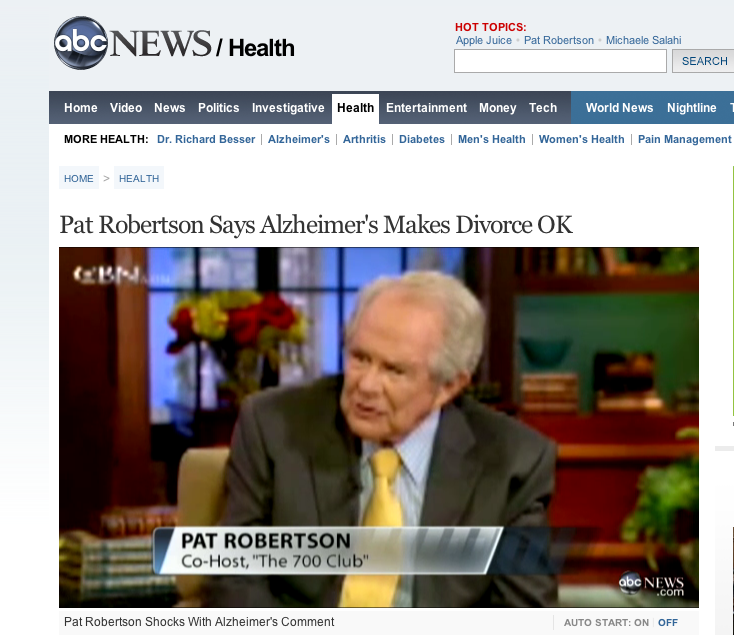 Religious broadcaster Pat Robertson stunned "700 Club" viewers Tuesday when he said divorcing a spouse with Alzheimer's disease was justified.
Robertson, chairman of the Christian Broadcasting Network and former Republican presidential candidate, said he wouldn't "put a guilt trip" on someone for divorcing a spouse with Alzheimer's disease, calling Alzheimer's itself "a kind of death."
The remarks sparked outrage throughout religious and medical communities.
"I'm just flabbergasted," said Joel Hunter, senior pastor of the 15,000 member Northland Church in Orlando, Fla. "I just don't know how anyone who is reading Scripture or is even familiar with the traditional wedding vows can come out with a statement like that. Obviously, we can all rationalize the legitimacy for our own comfort that would somehow make it OK to divorce our spouse if circumstances become very different or inconvenient. ... That's almost universal, but there's just no way you can get out of what Jesus says about marriage."
Hunter, who is also a presidential appointee to an advisory council on faith-based and neighborhood partnerships, said Robertson's words could lead people to interpret typical marital woes as proof that the spouse they married is symbolically dead, and they are therefore free to move on.
"Obviously, you could do this for anything. ... My husband watches and plays video games and so he has left the marriage and it's kind of like a death," he said. "It's not death and so we can't start describing things as death that are really not death and we have to stop trying to mischaracterize what scripture says for our own convenience."
Leith Anderson, president of the National Association of Evangelicals, said marriage is a lifelong commitment between a man and a woman that calls for faithfulness in the best of times and the worst of times. Quoting Corinthians, Kropp said "The wife's body does not belong to her alone but also to her husband. In the same way, the husband's body does not belong to him alone but also to his wife. You can't quit your own body with Alzheimer's so you shouldn't quit your husband's or wife's body either."
Doctors and social workers who work with families affected by Alzheimer's disease were similarly dismissive of Robertson's advice.
"To condone abandoning one's spouse in the throes of this mind-robbing illness is absurd," said Dr. Amanda Smith, medical director at the University of South Florida Health Alzheimer's Center in Tampa. "While Alzheimer's certainly affects the dynamic of relationships, marriage vows are taken in sickness and in health."
An estimated 5.4 million Americans have Alzheimer's disease – a figure expected to rise sharply as baby boomers enter their older years. And about 80 percent of Alzheimer patients who live at home are cared for by family members.
Robertson's comments came after a viewer asked what advice he should give a friend who had been seeing another woman since his wife was diagnosed with Alzheimer's.
"I know it sounds cruel, but if he's going to do something, he should divorce her and start all over again, but make sure she has custodial care and somebody looking after her," Robertson said.
But the Rev. A.D. Baxter, a social worker with Cole Neuroscience Center at the University of Tennessee Medical Center, said care from a loved one is irreplaceable.
"When being cared for by a spouse, the love of that spouse is often what enables a person with Alzheimer's disease to continue on and not feel abandoned," said Baxter, adding that caregivers need support, too. "Many believe a true friend does not abandon in the time of need."
Alzheimer's Strains Relationships
The progressive symptoms of Alzheimer's can put stress on relationships, leaving caregivers to cope with the loss of intimacy and other aspects of adult romantic relationships, said Dr. Jason Karlawish, a professor of medicine and medical ethics and assistant director of the Penn Memory Center in Philadelphia.
"There's no question that this is an issue," said Karlawish. "But to a spouse who's struggling with this kind of issue, I would want to say after the patient has left this world, you want be able to look back and say you treated that person with dignity."
New technologies are making it possible to diagnose Alzheimer's disease earlier, while patients have the ability to understand the road ahead of them.
"I think this highlights the need for couples and families to have discussions early in any illness, and preferably before illness strikes so that person's decisions and preferences are known and respected," said David Loewenstein, a clinical neuropsychologist at University of Miami's Miller School of Medicine.
Robertson's advice was for a male caregiver. But sometimes it's the patient who wants to start a new relationship.
"I have seen both caregivers and patients enter into new relationships during the course of dementia. How they choose to handle it is up to them. All parties dealing with this disease suffer to some extent and deserve to find happiness," said USF's Smith. "Ultimately, the decision for any couple to divorce, for any reason, is a private and difficult one."
Some couples stay married but form new relationships, too.
"There are many spouses who are devoted to the affected person with Alzheimer's, and yet form new relationships as they also care for their spouse," said Darby Morhardt, a social worker and director of education at the Cognitive Neurology and Alzheimer's Disease Center at Northwestern University's Feinberg School of Medicine. "It's hard to negotiate living with Alzheimer's disease but dictating what's good and bad is not useful.
"Every person needs to make their own decisions and to consider all parties involved. I sincerely hope the good reverend never has to have Alzheimer's to experience his advice first hand."
Tim King, spokesman for the Christian organization Sojourners, said Robertson's controversial statement was encouraging in at least one regard.
"I'm actually encouraged to hear someone like Pat Robertson say we're not really in a position to judge another person," King said. "I can't imagine the difficulty that a spouse would have to see someone go through that type of change and transformation. ... I don't know anyone who is in the position to judge another type of person who is having to make those type of decisions. It should never be taking lightly; it should never be an easy decision. Dealing with marriage is serious and making a big decision like that should be hard."
A representative for Robertson's network told the Associated Press that there would be no further comment on the matter.
FIND THIS ARTICLE AT: http://abcnews.go.com/Health/AlzheimersCommunity/pat-robertson-alzheimers-makes-divorce/story?id=14526660
 In an effort to more clearly define and look into possible changes in legislation regarding tax breaks and compensations for churches and nonprofit groups, the Evangelical Council for Financial Accountability (ECFA) has appointed a trio of panels.
The ECFA announced last week that representatives from religious groups, the broader nonprofit sector and the legal community have been appointed to the panels that will work with the Commission on Accountability and Policy for Religious Organizations.
The commission was formed following a report issued by U.S. Sen. Charles Grassley (R-Iowa) in January that focused on the financial practices of six high-profile Christian ministries, ECFA said. Allegations included perceptions of excessive spending on high-end travel, accommodations, and property, according to a commission member.
After Grassley released the findings of his three-year inquiry, rather than seek legal action, the senator asked ECFA to lead an independent national review that includes making recommendations on accountability and policy issues affecting religious and other nonprofit organizations.
Florida pastor and one of President Obama’s spiritual advisers, Dr. Joel Hunter, who is a member of the ECFA commission, told The Christian Post that he would like to see the panels discover that new legislation is not necessary.
“We have been given the opportunity to gather this kind of information so that we could not just automatically go toward legislative resolutions, but rather we could do some self-examination and try to clarify what was reasonable and what was intended for religious exemptions by the IRS and by the customs we now have in the U.S.,” Hunter said.
“Part of this idea [of tax breaks and compensations] is that the churches and other non-profits contribute so much to the public well-being. They contribute so many services, and so much benefit that they more than make up for any exemptions and taxes that they have.”
The ECFA stated that the issues before the commission include whether:
churches should be more accountable to the federal government; legislation is needed to curb perceived abuses of the clergy housing allowance exclusion; the current prohibition against political campaign intervention by churches and other nonprofits should be repealed or modified; the rules for determining the reasonableness of nonprofit executive compensation should be tightened; penalties should be expanded for nonprofits and their leaders who engage in prohibited activities. Hunter said that the commission and panel studies should also include educating people on the positive aspects of giving faith-based groups and nonprofits certain tax breaks.
“Our responsibility is to continue to tell the story of just exactly how much churches, and mosques, and synagogues, and temples are providing in the way of goods and services to those in need in our communities,” he said. “The good things that they are providing would otherwise fall upon the government to provide. We would like people to clearly see that this is a wonderful investment.”
Hunter said he recognizes the potential for abuses, but believes much of allegations are about perceptions.
“There were some perceived violations, some perceived expenditures that people looked upon,” he said. “The lavish houses and jets and all of that kind of stuff that people reasonably look at and say, ‘Wait a minute, are we as taxpayers contributing to that kind of excess and is that right? Was that the intent of a reasonable exclusion (tax break)?’”
The ECFA Commission will also be receiving input from the Internal Revenue Service, town hall meetings and other informal channels. Two law firms will be providing independent technical analysis and research for the commission on a pro-bono basis.
According to ECFA President Dan Busby, a total of 66 members have been named to the panels by Commission Chairman Michael Batts. The three panels include one of Religious Sector Representatives, one of Nonprofit Sector Representatives, made up of 18 individuals, and one of Legal Experts.
Ultimately, Hunter said the panels will make “an effort to put in reasonable boundaries and put in some self-correcting measures that will hopefully avoid legislation.”
“In the end, there may be a mix of self-policing and some necessary legislation. We do not know that yet. It would be preferable to avoid legislation, but we are not that far along the process, yet,” he said.
Alex Murashko Christian Post Reporter
FIND THIS ARTICLE AT: http://www.christianpost.com/news/evangelical-council-church-tax-breaks-compensations-scrutinized-55657/
 The decision by NYC Mayor Michael Bloomberg's to exclude any prayers from clergy at Ground Zero in the upcoming 10th anniversary commemoration of the 9/11 attacks is being categorized as un-American by an evangelical leader and spiritual adviser to President Obama.
Florida Pastor Joel C. Hunter, who also serves as an executive board member for both global and national evangelical associations, said Christians should speak out or protest the decision because the importance of faith in the United States is being neglected.
Bloomberg stirred much controversy recently when he stated, "Everybody would like to participate, and the bottom line is everybody cannot participate. There isn't room. There isn't time. And in some cases, it's just not appropriate."
Hunter told The Christian Post, “The problem with this is, because of his singular decision, this ceremony isn’t really going to be representative of America. It’s going to be exclusionary, secularist only, and we are one of the most religious countries in the world. So, the bottom line is, this is not how we were founded. This is not who we are.”
The pastor of Northland church continued, “This is a national time of mourning and healing. I think it is particularly offensive to explicitly exclude any religious expression.”
Hunter said the 9/11 terrorist attacks were an “event that changed the face and the countenance of our nation.” He said he is hoping the 10th-anniversary memorial service will be a time when everyone comes together.
“Our faith is at the heart of our identity,” he said. “I think that Christians should speak out and give some sort of reasonable protest because I do think that, in moments like this, it's especially important to include the perspective of faith, and this is a national day. This is something all of us are involved in and the separation of church and state does not equal expunging all religion from public square activities.That just simply is not what it means.”
Mark Tooley, president of the Institute on Religion & Democracy group, also disagrees with the decision, citing a recent Barna Group study that shows that 61 percent of New York-area residents agree strongly that religious faith is very important to them.
"In a city where the most residents in recent memory now cite religious faith as strongly important, New York is tone-deaf to exclude all religion when remembering the slaughter of over 3000 innocents,” said Tooley in a statement released by IRD Thursday. "To exclude clergy even at a memorial service implies that religion is not welcome in the public square, even in mourning.”
Tooley added, "From presidential inaugurals to opening Congress, to countless civic events routinely in every community across America, clergy and prayers have been a regular part of public life for years. The exclusion of both clergy and prayers is deeply at odds with America's robust religious life and even with the beliefs of most New Yorkers.”
Hunter told CP that he has recently talked with members of the White House faith-based initiative advisory committee, which confirmed that President Obama will be giving a speech from the Washington National Cathedral the evening of the 9/11 commemoration.
Although he said he has not seen the President’s comments planned for the evening, Hunter believes that the “setting alone” shows that Obama will be including a faith perspective.
Alex Murashko Christian Post Reporter
FIND THIS ARTICLE AT: http://www.christianpost.com/news/wh-spiritual-advisor-mayors-decision-to-forbid-prayer-at-9-11-ceremony-un-american-54946/
Prayer and religious leaders have been left out of New York City’s official ceremonies observing the 10th anniversary of the September 11 attacks. Dr. Joel C. Hunter, senior pastor of Northland, A Church Distributed, and John Kieffer, Atheists of Florida, have a respectful discussion on the issue.
Dr. Joel C. Hunter is the Pastor of Community Benefit at Action Church, a multi-site congregation based in Winter Park and his one-minute daily devotionals can be heard worldwide on Z88 radio. He is the Chairman of the Central Florida Pledge campaign; a call to action for residents of Central Florida who are tired of hateful discourse and want to create a safe and inclusive community for all. The pledge asks residents to commit to treating all people with kindness and respect, especially those with whom they disagree. To learn more: https://www.centralfloridapledge.com/
He is a nationally and internationally known advocate for the poor, the marginalized, and those dealing with disabilities. He served a three-year term as the Chairman of Central Florida’s Commission on Homelessness. And, after 32 years as the senior pastor of Longwood, Florida’s Northland Church’s congregation of 20,000, he spent five years leading a non-profit in networking with churches and local charities to locate available resources and benefit the struggling in our community. Orlando Magazine highlighted his efforts naming him as the #1 most powerful voice for philanthropy and community engagement. And listed him among “Orlando’s 50 Most Powerful” six years in a row.
Approaching today’s challenges in a biblical and balanced manner, Dr. Hunter is neither partisan nor politically oriented, but often relates to public officials in a pastoral role; he served as a spiritual advisor to President Obama during his eight years in office.
Dr. Hunter has served in leadership roles of the World Evangelical Alliance, serving more than 600 million evangelicals, and the National Association of Evangelicals, serving more than 40 denominations and thousands of churches.
Married in 1972 to his wife, Becky, he is the father of three sons, grandfather of seven, and great-grandfather of two.
UPCOMING - AND YOU ARE INVITED!
Sunday, July 5 at 10 AM - Dr. Hunter will be preaching at Grace Convenant Presbyterian Church (1655 Peel Avenue, Orlando, FL 32806)

