•   Creation Care   •  

Christians and Climate Change

Dr. Joel C. Hunter talks about the visible impacts of climate change with Dr. Scott C. Hagen, director of CHAMPS Lab and professor at the University of Central Florida, and Rev. Mitch Hescox, president of The Evangelical Environmental Network.

View Post

  •   Poverty   •  

The Cost of Homelessness: Central Florida Commission on Homeless Cost Analysis

Living on the streets isn't cheap: Each chronically homeless person in Central Florida costs the community roughly $31,000 a year, a new analysis being released Thursday shows.

The price tag covers the salaries of law-enforcement officers to arrest and transport homeless individuals — largely for nonviolent offenses such as trespassing, public intoxication or sleeping in parks — as well as the cost of jail stays, emergency-room visits and hospitalization for medical and psychiatric issues.

In contrast, providing the chronically homeless with permanent housing and case managers to supervise them would run about $10,000 per person per year, saving taxpayers millions of dollars during the next decade, the report concludes.

The findings are part of an independent economic-impact analysis that will be discussed Thursday afternoon by the Central Florida Commission on Homelessness.

"The numbers are stunning," said the homeless commission's CEO, Andrae Bailey. "Our community will spend nearly half a billion dollars [on the chronically homeless], and at the end of the decade, these people will still be homeless. It doesn't make moral sense, and now we know it doesn't make financial sense."

The vast majority of long-term-homeless residents have some sort of disability, Bailey said. They are veterans with post-traumatic stress disorder; men and women with mental illness; or people with severe physical disabilities.

"These are not people who are just going to pull themselves up by their bootstraps and get a job," Bailey said. "They're never going to get off the streets on their own."

Last fall, the commission spent $15,000 donated by the Orlando Solar Bears to hire the Tulsa, Okla.-based company Creative Housing Solutions, which conducted the analysis. Researchers worked with local homeless outreach programs to identify 107 long-term-homeless residents living in Orange, Osceola or Seminole County. Using actual jail and hospital records, they tracked public expenses through the years to come up with the yearly average of $31,065 per person.

That figure was multiplied by 1,577 — the number of chronically homeless people throughout the three counties. In both cases, the figures were considered conservative.

"We didn't even include the money spent by nonprofit agencies to feed, clothe and sometimes shelter these individuals," said lead researcher Gregory Shinn, associate director of the Mental Health Association Oklahoma in Tulsa. "This is only money that we could document for the individuals we studied — and it's money that is simply being wasted. The law-enforcement costs alone are ridiculous. They're out of control."

The expense is particularly high for the city of Orlando, where many of the chronically homeless live on the streets. The most recent homeless census put the number there at about 900 individuals. In Osceola County, which has an estimated 300 chronically homeless residents, permanent housing for the homeless may be a tougher sell.

"The report's numbers actually reflect more what's going on in Orange County and Orlando," said Niki Whisler, homeless-advocate coordinator for Osceola. "Our priority here are our families, especially in hotels."

But for Orlando Mayor Buddy Dyer, the findings validate what he has already proposed, he said.

"I can't say I'm surprised by the cost," Dyer said. "We recognize that a large percentage of these individuals roam the streets of our city."

In his State of the City address in April, Dyer vowed to get a third of the chronically homeless — some 300 people — into what's called permanent supportive housing within three years. Such housing is typically a government-subsidized apartment with a case manager to ensure the tenant is getting medical and psychiatric care and other services.

Researchers estimated the cost of permanent supportive housing at $10,051 per person per year. Housing even half of the region's chronically homeless population would save taxpayers $149 million during the next decade — even allowing for 10 percent to end up back on the streets again.

"We're not going to bat a thousand," Shinn said.

Bob Brown, president and CEO of the Heart of Florida United Way, said the cost analysis underscored the need to take action on chronic homelessness.

"This is no longer [one person] from the Coalition for the Homeless saying we have to do something," Brown said. "This is a reliable consultant who has used proven methods for calculating the cost. Hopefully this will finally get the attention of community and government leaders. We can't wish this away."

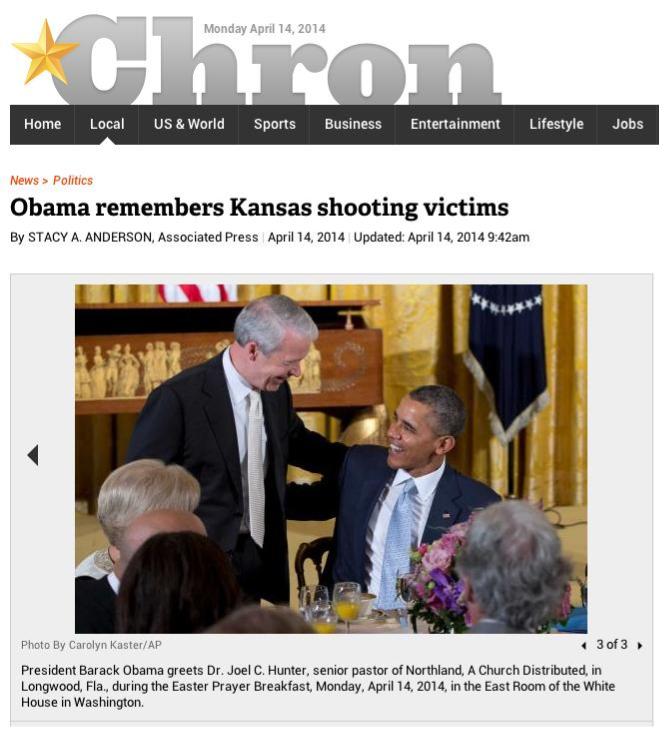
Joel Hunter, a homeless-commission member and senior pastor at Longwood's Northland megachurch, said he hoped the faith community would help persuade parishioners that supportive housing is the way to go.

"We're going to need to present to them how much wiser it is to address this problem than to ignore it," he said. "I don't think there is a huge momentum to fix homelessness at the moment, simply because a lot of people don't see it in front of them every day. But if we can make the business case as well as the moral case for them, I think we can build a desire to help those who need it most."

ksantich@tribune.com or 407-420-5503

SOURCE: http://touch.orlandosentinel.com/?#section/1229/article/p2p-80272962/

View Post

  •   Creation Care   •  

Evangelicals in Florida turn to climate change and call on Gov. Scott to act

Evangelicals in Florida turn to climate change and call on Gov. Scott to act

Evangelicals in Florida turn to climate change and call on Gov. Scott to act

Evangelical leaders in Florida have taken on climate change as a cause and are trying to increase pressure on Gov. Rick Scott to take action, while criticizing Sen. Marco Rubio’s stance on the issue.

“He’s smarter than that,” Joel Hunter, pastor of Northland church in Longwood, said in an interview.

This evening, Hunter will moderate a discussion at his church on why Christians should care about climate change. Among the panelists is the Rev. Mich Hescox, president of the Evangelical Environmental Network, who wrote a letter to Rubio about his widely publicized comments doubting man’s contribution to climate change.

Hescox is also gathering signatures for a petition aimed at Scott.

“As Christians, we believe that God's grace empowers us to honestly confront the challenges we face and change for the better,” it reads. “We are failing to keep our air and water clean for our children, contributing to a changing climate that most hurts the world's poor, and putting Floridians at risk as temperatures and sea levels continue to rise. To meet these challenges, we need leaders who understand our duty to God’s creation and future generations. That's why we are calling on Gov. Rick Scott to create a plan to reduce carbon pollution and confront the impacts of a changing climate.”

Hunter, who is a spiritual advisor to President Obama, says he’s taken to urging congregants to do their part: Turning off lights that aren’t needed, setting air conditioning at a reasonable temperature, keeping car tires properly inflated.

He said he was neither panicked nor preoccupied with the issue. “But this is part of what I think is the moral responsibility of the church to lead in areas that can benefit and protect people.”

Asked about Rubio’s comments, he said: “There are certain aspects of this where qualified scientists could disagree, but not with the overwhelming conclusion. I don’t doubt his sincerity, but I understand his political constituency and so does he.”

Rubio lashed out at liberal critics by saying they won’t accept the settled science that life begins at conception.

“I”m pro life so everything about it, I’m in,” Hunter said. “But even if that’s true, two wrongs don’t make a right. It’s not like you can prove the validity of your stance by saying the other side has a wrong stand. That’s not logical.”

SOURCE: http://www.tampabay.com/blogs/the-buzz-florida-politics/evangelicals-in-florida-turn-to-climate-change-and-call-on-gov-scott-to-act/2180561

View Post

  •   Creation Care   •  

Joel Hunter launches multi-faith effort on climate change

Joel Hunter launches multi-faith effort on climate change

Pastor Joel Hunter announced Wednesday that he is launching an inter-faith initiative to raise awareness and action regarding climate change.

The iniative, called Blessed Tomorrow, brings together Muslim, Jewish, Catholic and Protestant faith leaders who have pledged to work with their congregations and communities in response to climate change.

“Faith leaders and their communities have been at the forefront of moving America forward throughout our nation’s history. From abolition to human rights, we have been there to answer our call to care for all of God’s creation. Blessed Tomorrow builds on that tradition by bringing together a diverse group of leaders from across the country who are committed to making an impact on one of the greatest moral imperatives of our time — climate change,” said Hunter, senior pastor of Northland, a Church Distributed in Longwood.

Blessed Tomorrow expands Hunter's advocacy among evangelicals that care of the planet is founded in the Scriptures, and not the exclusive domain of liberals and environmentalists.

Blessed Tomorrow provides simple, proven resources faith leaders can use to empower their members and communities. Congregations are urged to create a Path to Positive plan, which will guide them to be better stewards of God’s creation for the sake of future generations.

Learn more about how people of faith and congregations can create their own Path to Positive:(http://blessedtomorrow.org/path-to-positive)

SOURCE: http://www.orlandosentinel.com/features/blogs/religion-world/os-joel-hunter-launches-multifaith-effort-on-climate-change-20140507,0,5793860.post

View Post

  •   Interfaith Dialogue, Justice   •  

Evangelicals At The Crossroads

The Jewish Week

Evangelicals At The Crossroads A younger generation is pushing a more nuanced analysis of the Israeli-Palestinian conflict; should Jews be worried? 2/19/14, THE JEWISH WEEK, by Jonathan Mark, Associate Editor

Last December, Palestinian Authority President Mahmoud Abbas sent Christmas greetings recalling the ancient birth of a holy child, a Palestinian child: Jesus, the “Palestinian messenger” of hope. Some in the West surely thought Abbas’ words as meaningless as a popular Arab song referring to Tel Aviv as a Palestinian city, or claims that a Jewish Temple was never on the Temple Mount. But in the little town of Bethlehem, the Bethlehem Bible College, an Evangelical institution, is preparing for “Christ at the Checkpoint,” a four-day conference that begins on March 10.

The conference will address, says its website, “the injustices in the Palestinian territories.” The previous conference, in 2012, issued a “manifesto” that turned Evangelical support for Israel on its head: “Any exclusive claim to land of the Bible in the name of God is not in line with the teaching of Scripture,” it read. The statement continued, “[The] suffering of the Palestinian people can no longer be ignored,” and “Christians must understand the global context for the rise of extremist Islam.”

For those asking, “What would Jesus do?” the answer, according to the conference website, is that Jesus would be alongside the “oppressed” Palestinians at Israeli checkpoints, and that’s where Evangelical support should be, as well.

This is not just the talk in Bethlehem. A December 2011 article in Relevant, a Florida-based magazine aimed at young American Evangelicals, gave a similar twist to the Gospel: There’d be no Three Wise Men if you “place an eight-meter-high wall between the Magi and Baby Jesus. … He’d be without citizenship. …

Considered to be a security threat from birth, he’d receive his green Palestinian ID at the age of 16. ... He would be prohibited from crossing the wall into Jerusalem only 15 minutes away.”

And yet the lineup for the “Checkpoint” in March is attracting some of the most influential Evangelicals in the West: William Wilson, president of Oral Roberts University; Geoff Tunnicliffe, secretary-general of the World Evangelical Alliance; and Joseph Cumming of Yale University’s Center for Faith and Culture. What happened to all that unquestioning Evangelical Zionism we thought we knew so much about? With the Boycott, Divestment and Sanctions (BDS) movement gathering steam, it’s a question that takes on added urgency as Israel becomes increasingly isolated on the world stage.

Evangelical Zionism, the political and spiritual heart of U.S. support for Israel, may have peaked, with an internal schism threatening to erode Israel’s most important foreign alliance, observers are beginning to say. Though Christian Zionists are still the dominant majority among America’s 50 million Evangelicals, a new wave of Evangelicals, the “millennials,” more interested in “social justice” than geopolitics. And they are advocating an “even-handed” approach to the Israel-Palestinian problem, with some more sympathetic to the Palestinians.

David Brog, executive director of Christians United For Israel (CUFI), an Evangelical Zionist group known for being enthusiastically supportive of Israel, told The Jewish Week that he sensed the left’s growing strength. “The last three or four years I’ve started to get that sinking feeling, they were making inroads …. influencing Evangelicals well beyond the extreme left. ... They are finding an interested audience" among the young. The “anti-Israel" message, said Brog, “is resonating. This generation is in play.” (CUFI, chaired by Pastor John Hagee, has ruffled some feathers in parts of the Jewish community for at times staking out positions to the right of Israeli and U.S. policy regarding the Israeli-Palestinian conflict.)

Jews, said Robert W. Nicholson, an Evangelical writer, should know that what drives traditional Christian Zionism is not messianism or conversion but Scripture, “belief in the truth of God’s eternal covenant” with Israel; that God will “bless those who bless” Israel and “curse those who curse.”

However, younger Evangelicals are reportedly less “text-oriented” than their elders, so Israel — whose Evangelical support is driven by biblical text, with past and future promises — is at a disadvantage when juxtaposed with the Palestinian claims for social justice in the here and now.

In Mosaic, the Tikvah Fund’s online journal of Jewish ideas, Nicholson warns that some at the “Checkpoint” conference may express a concern for “peace, justice, and reconciliation.” But what this actually translates to, he says, “is unceasing criticism of perceived Israeli injustice, racism and occupation, peppered with special disdain for Evangelical Zionists who allegedly exacerbate the conflict” by supporting Israel.

The 2010 inaugural “Checkpoint” conference (held every two years) featured Palestinian Rev. Naim Ateek, who once sent out the Easter message, “Jesus is on the cross again with thousands of crucified Palestinians around him. ... The Israeli government crucifixion system is operating daily. Palestine has become the place of the skull.”

Rev. Joel Hunter is among the more centrist leaders in the “Checkpoint” camp. Pastor of an Evangelical megachurch called Northland, with 20,000 congregants at several locations in and around Orlando, Fla., he serves on the board of the World Evangelical Alliance (representing 600 million) and the National Association of Evangelicals (representing 30 million). Indicative of those Evangelicals who don’t want to be considered interchangeable with Republicans, he is the author of “A New Kind of Conservative,” advocating a nonpartisan approach.

A speaker at the 2012 “Checkpoint,” Rev. Hunter told The Jewish Week, “I’m well aware and regret the insecurities that this conference has brought about, some of it justifiable because of some of the participants, and we all get that. But the point of the conference is to identify and hear from Arab Christians. While I was there [at the last conference] I spoke to many people and did not hear one word about Israel as an enemy.” (Ateek didn’t speak at the 2012 conference.)

Everyone agrees, said Rev. Hunter, about the need for “the security and ongoing prosperity of Israel, which is our very good friend and important to our scriptures. But there has been a long theological strand that has been predominant in the loudest voice of the Evangelical movement, identifying the modern-day State of Israel with the [prophecies of the] Hebrew Scriptures. … Anything that would present a more balanced, more compassionate view for all those living in the land, and telling all of their stories was seen as a threat, as a heresy. As we learn more and more about the complications of the peace process, and of the legitimate and significant sufferings of those who have been limited for the sake of security, we want to include them. It doesn’t at all diminish our loyalty to Israel, but it does help us see the other side of the story.”

However, after the 2012 conference defended by Rev. Hunter, the Evangelical magazine Charisma magazine had its doubts, and headlined: “Did Christ at the Checkpoint Conference Undermine Israel?”

The home page for next month’s “Checkpoint” features a graphic depicting Israel’s security wall as a high, dark and foreboding prison wall. Dwarfed by the wall, a Palestinian is planting an olive tree, symbol of peace.

Lee Smith, a senior editor at The Weekly Standard, feared the negativity. He warned in Tablet, “If the ‘Christ at the Checkpoint’ camp wins out, the pro-Israel Jewish community that once looked warily upon evangelical support may come to regard that movement with nostalgia.”

And “bitter regret,” adds Nicholson; regret for the way Jews have been dismissive of Evangelical Zionists. “Christian Zionism cannot be taken for granted.”

Other than Orthodox Jews, American Evangelicals are still the leading supporters of Israel. A 2013 Pew survey found that 82 percent of Evangelicals believe that Israel was given to the Jewish people by God, but 18 percent are no longer certain; 42 percent of Evangelicals now believe that Israel and a Palestinian state can coexist peacefully; a minority opinion but a substantial one.

Among the advocacy groups linked to the new Evangelicals is the Telos Group, founded in 2009 by Todd Deatherage and Gregory Khalil. Deatherage, an Evangelical Republican, worked as chief of staff for Sen. Tim Hutchinson (R-Ark.) and later for the George W. Bush state department; Khalil, a Christian Palestinian, is, according to the Telos website, a “longtime Democrat and a former adviser to Palestinian leaders on peace negotiations.”

Telos, on its website, states that peace would be more likely if Evangelicals were to “pursue the common good for everyone in the Holy Land,” Palestinians as well as Israelis.

Telos’ Deatherage told The Jewish Week, “People try to put us — and the whole situation — in a box, that you can’t be pro-Israel if you’re pro-Palestinian. I do think there can be another way that could encourage a positive difference, as long as it doesn’t devolve into a zero-sum approach. I see that as a dead end — for both peoples.”

Trips to Israel, sponsored by Evangelicals on both sides of the divide, underline the different narratives that have taken hold. The Evangelical Zionists, for example, promote the idea that the Israeli Christian population is the only one in the Middle East that is growing, whereas the Christian population in the Islamic-dominated Gaza and West Bank is shrinking.

On the other end, one of the “new Evangelicals,” who asked not to be named, told The Jewish Week, “I have met with a lot of Palestinian Christians through the years and I have never met a Palestinian Christian who said, ‘My family left here because of Muslim pressure or persecution. Never once. I’ve heard many of them say, ‘We left because it’s too hard to live here. I can’t get from here to there without going through checkpoints. I don’t have educational or economic opportunities. We only have water once a week in our home. That is the reason that Palestinian Christians have stated to me why they’ve left. Christians are not fleeing Bethlehem because of Muslim persecution.”

Yes, polls show that the Evangelicals, as a whole, are still very pro-Israel, but CUFI’s Brog warns, “I’m worried that what we’re seeing could translate, in a generation, to a real shift in the community.”

SOURCE: http://www.thejewishweek.com/news/national/evangelicals-crossroads
View Post

  •   Interfaith Dialogue, Public Square   •  

Orlando Sentinel: Interfaith prayer service honors Joel Hunter

Interfaith prayer service honors Joel Hunter

One by one, members of different faiths and beliefs stepped forward Tuesday night to light candles in remembrance of loved ones they had lost.

In the procession of Christians, Muslims, Jews, Hindus and Buddhists, Northland Church Pastor Joel Hunter and his wife Becky lit a candle for their son, Isaac Hunter.

In the end, some 70 candles flickered in a small sanctuary of the St. James Catholic Cathedral in downtown Orlando during the hour-long Interfaith Prayer Service for Peace.

"Many of us faced losses this past year or unresolved losses," said Rev. Bryan Fulwider, a Congregational minister. "We are strengthened, we are healed, by standing together, walking together, being together."

Leaders of the major religions as well as representatives of the Sikh, Unitarian and Baha'i faiths, also said prayers.

The service was both an act of empathy for all who lost friends and relatives and a public show of support for Hunter, whose son died by suicide in December.

"This is a service designed to bring comfort to all that have had losses, but it's also a collective embrace of him and his family for their loss of Isaac," said Pastor James Coffin, executive director of the Interfaith Council of Central Florida.

Coffin said the idea of focusing on personal peace following a private tragedy came from Orlando Catholic Diocese Bishop John Noonan, who started the annual interfaith prayer service about three years ago.

Hunter is widely respected within the faith community for his commitment to building relationships with leaders of different religions.

One of his longest friendships is with Imam Muhammad Musri, president of the Islamic Society of Central Florida.

"He is an evangelical leader who got a lot of flak for going out and meeting with Muslims and other communities," said Musri, who sat beside Hunter.

"The least we can do is be with him and lift up his spirit."

That willingness to join in with other religions might have cost Hunter friends among evangelicals, but his commitment to interfaith cooperation is the natural extension of his Christian faith, said Fulwider, president of Building US, a nonprofit diversity consulting and training organization.

"He has become a friend to those in other faith communities because this is who Jesus calls him to be," Fulwider said.

"He is not a person who cuts off relations because you have a difference of understanding or belief or thoughts. To me that is the heart of the Christian gospel."

jkunerth@tribune.com or 407-420-5392.

SOURCE: http://articles.orlandosentinel.com/2014-01-14/news/os-joel-hunter-peace-prayer-20140114_1_isaac-hunter-joel-hunter-interfaith-council

View Post

  •   Public Square   •  

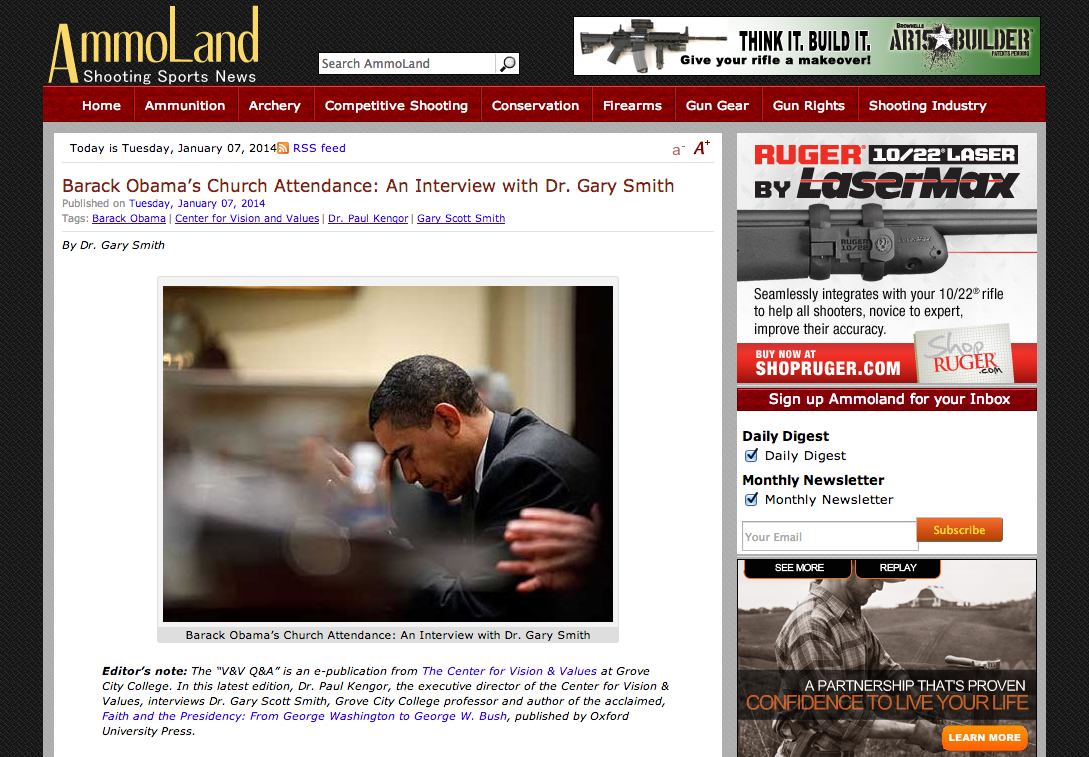
Barack Obama’s Church Attendance: An Interview with Dr. Gary Smith

Screen Shot 2014-01-07 at 1.20.34 PM Editor’s note: The “V&V Q&A” is an e-publication from The Center for Vision & Values at Grove City College. In this latest edition, Dr. Paul Kengor, the executive director of the Center for Vision & Values, interviews Dr. Gary Scott Smith, Grove City College professor and author of the acclaimed, Faith and the Presidency: From George Washington to George W. Bush, published by Oxford University Press.

Kengor: Dr. Smith, you are one of the country’s leading experts on faith and the presidency. Reporters frequently come to you for comment. In that spirit, the New York Times interviewed you last week on the notable fact that President Obama didn’t attend religious services this past Christmas. That’s quite unusual for a president, isn’t it?

Smith: Yes, it is.

Kengor: Do you know of any other president skipping religious services at Christmas?

Smith: Some probably did not attend religious services at Christmas, but I do not know of any specifically. The media was not omnipresent before the 1960s, so it was easier for presidents’ non-attendance to go unnoticed. However, most presidents have attended church faithfully while in office, including George Washington, John Adams, John Quincy Adams, Andrew Jackson, Abraham Lincoln, William McKinley, Theodore Roosevelt, Woodrow Wilson, Dwight Eisenhower, John F. Kennedy, Jimmy Carter, and Bill Clinton. Others who claimed to have a strong Christian faith but attended infrequently while president include Franklin Roosevelt, Harry Truman, and Ronald Reagan. Obama did issue a Christmas message, as he has done every year as president, in which he encouraged Americans to serve others. “For families like ours,” he declared, “that service is a chance to celebrate the birth of Christ and live out what He taught us—to love our neighbors as we would ourselves; to feed the hungry and look after the sick; to be our brother’s keeper.” Obama has used this latter phrase more than 60 times in his presidential addresses and proclamations.

Kengor: Yes, he uses that phrase constantly. Did President Obama give a rationale for not attending church this Christmas? What’s the explanation?

Smith: He apparently has not offered an explanation for not attending Christmas services. He did vacation in Hawaii for five days where he spent time with his family, played golf three times, attended a basketball game, and visited a military base. On Christmas Eve, the president called U.S. armed forces members who are stationed around the globe to wish them a Merry Christmas.

Kengor: Moving away from this Christmas example, what about Obama’s attendance at church generally? The New York Times quotes an “unofficial White House historian” who calculates that Obama has attended church 18 times during his nearly five years in the White House, while his predecessor, George W. Bush, attended 120 times during his eight years in office. Is Obama a member of a church?

Smith: Obama does not currently belong to any congregation. After attending St. John’s Episcopal Church and 19th Street Baptist Church in Washington a few times, he decided instead to worship primarily at the Evergreen Chapel at Camp David. However, he rarely spends weekends at Camp David.

Kengor: Does Obama have a formal religious affiliation? He’s no longer with the denomination that housed Rev. Jeremiah Wright’s church, is he?

Smith: Since ending his relationship with Wright’s Trinity United Church of Christ Church in Chicago during the 2008 campaign, Obama has not joined a church.

Kengor: Has Obama explained his lack of church attendance? You and I both have written on President Ronald Reagan’s faith. Reagan stopped attending church regularly after the assassination attempt, though (to my knowledge) he always attended Christmas and Easter services. Reagan gave a host of reasons for his infrequent attendance as president. (He returned to church regularly again after the presidency.) Has Obama addressed this? Reagan was constantly asked to address it, and did.

Smith: Obama has seldom commented on why he rarely attends church. His basic explanation is that he dislikes being on display when he worships (many people have snapped pictures of him with their cell phones and some pastors have spoken directly to him).

Kengor: In the Times article, you’re quoted as saying, “I would argue that Obama’s faith has been one of the most misunderstood of any president.” What do you mean by that?

Smith: From 2008 until now, many Americans (as high as 20 percent in some polls) have identified Obama as a Muslim despite the controversy over his membership in Wright’s church and his many professions of Christian faith. Because of his connection with Wright, others have labeled him an advocate of black liberation theology. Many political and religious conservatives complain that Obama’s claim to be a Christian is disingenuous and entirely politically motivated. Obama has been labeled “the most explicitly Christian president in American history” by historian John Fea and America’s “Most Biblically Hostile” president by evangelical author and activist David Barton. Many conservative Christian books and websites argue that Obama is trying to destroy the nation’s Christian heritage and cannot possibly be a Christian because of his stances on abortion, gay marriage, and government redistribution of wealth. On the other hand, liberal Protestants and Catholics and some evangelicals praise Obama’s concern for aiding the marginalized, oppressed, and poor. Some younger evangelicals support Obama because of his commitment to social-justice issues like overcoming racism, combating poverty, and tackling global issues like AIDS.

Kengor: As you note, conservatives who don’t like Obama argue that his faith is not genuine, while liberals who do like Obama argue otherwise. Others take a position somewhere in between. What’s your take?

Smith: I believe that Obama’s faith is genuine. He has testified to it many times on both the campaign trail, at National Prayer Breakfasts, and in other settings. Obama has repeatedly declared that Jesus is his savior and Lord and that he bases his life on Christ’s teachings. He has frequently affirmed his belief in Christ’s divinity, bodily resurrection, and atoning death on the cross. Obama insists that he prays and reads the Bible regularly. He meets and prays regularly with ministers of various denominations and theological traditions. Evangelical pastor Joel Hunter, Obama’s closest spiritual mentor, asserts that the president is “born again” and “has trusted in Jesus Christ with his whole heart.”

Obama’s faith is difficult to decipher, however, because various streams—the African-American church, the Social Gospel movement, mainline Protestantism, and evangelicalism—have all shaped it. On the other hand, as Stephen Mansfield contends, Obama’s “big-tent approach” to religion and spirituality “is perfectly in step with the country he now leads.” Like the vast majority of Americans, he believes that many paths lead to God and that all religions contain fundamentals truths. Similarly, New York Times columnist Ross Douthat asserts that Obama embodies America’s “uncentered spiritual landscape” because like 44 percent of Americans, the president switched his religion as an adult, and because he is part of one of America’s fastest-growing religious constituencies—the “unchurched Christian” bloc.

Kengor: Dr. Smith, thanks for your time. I strongly encourage readers to pick up a copy of your outstanding book on faith and the presidency.

Smith: My pleasure.

Dr. Gary Scott Smith chairs the history department at Grove City College and is a fellow for faith and the presidency with The Center for Vision & Values. He is the author of “Faith and the Presidency From George Washington to George W. Bush” (Oxford University Press, 2009) and “Heaven in the American Imagination” (Oxford University Press, 2011).

SOURCE: http://www.ammoland.com/2014/01/barack-obamas-church-attendance-an-interview-with-dr-gary-smith/#axzz2pjmtCxYU

View Post

  •   Immigration   •  

POLITICO: President and Faith Leaders Working to "Raise The Moral Imperative for Immigration Reform"

President Barack Obama gave immigration reform advocates a simple message Wednesday: Don’t let Obamacare get you down.

In an Oval Office meeting with eight Christian faith leaders, the president said he remains engaged on immigration legislation and hopes the reform effort can get a fair hearing despite his other political problems, several faith leaders told POLITICO.

“He said he doesn't want other debates that are going on to hurt this,” said Jim Wallis, the president and CEO of the Christian social justice agency Sojourners. “He doesn't want all the other debates going on to prevent this from passing. It’s caught up in all the other debates and he wants this to be looked at on his own merits.”

Obama’s exhortation came during a meeting just hours before his administration released the first batch of Affordable Care Act enrollment numbers – a figure the White House had for weeks telegraphed as far lower than expected.

Much of Obama’s Oval Office conversation with the faith leaders, Biden and top aides Valerie Jarrett, Cecilia Munoz and Melissa Rogers centered around the idea that contemporary Washington politics is blocking reform efforts, the faith leaders said.

Obama, they said, didn’t make a direct ask for them to press Congress to back the reform effort, as Vice President Joe Biden implored Catholic leaders to do during a call Tuesday night. Instead he asked for their input on how the current immigration system is harming their communities and echoed the urgency to pass reform legislation by the end of the year.

But with House Speaker John Boehner (R-Ohio) announcing earlier in the day that he has “no intention of ever going to conference on the Senate bill,” it was clear to all in the room that immigration reform has lost momentum it had after the Senate immigration bill passed.

“This can be a companion issue that also deserves some attention because we’ve come so far on this issue and we can’t let it get lost in the battle du jour,” said Joel Hunter, the senior pastor at Northland Church in suburban Orlando. “I think all of us are hoping that the headlines of the daily accusations don’t bury what is a very important and urgent issue in our time.”

And still, Obama told the faith leaders he remains optimistic there will be progress by the end of December.

“I did get the sense that he was wanting to reassure us that this is a priority for him,” said Russell Moore, the president of the Southern Baptist Ethics and Religious Liberty Commission. “He actually does want to work with Congress to get a bill, not to just to have an issue.”

White House officials declined to comment on specifics of the meeting. In an official readout, the White House said Obama once again blamed House Republicans for blocking a vote.

“The president and the leaders discussed their shared commitment to raise the moral imperative for immigration reform and said they will continue keeping the pressure on Congress so they can swiftly pass commonsense reform,” the statement said. “The president commended the faith leaders for their tireless efforts in sharing their stories with Congress. He noted there is no reason for House Republicans to continue to delay action on this issue that has garnered bipartisan support.

Moore, a conservative evangelical leader, said he warned Obama not to make immigration a partisan political issue.

“I did say to the president that I think he needs to take seriously that the Republicans in Congress are operating out of what I believe to be good motives and that there needs to be a sense of cooperation and not divisiveness on this issue,” Moore said. “I think that was well received. I think the president seemed to indicate that that’s what he wants to do.”

Wallis said there was a discussion during the meeting that the upcoming holiday season could give a boost to the reform efforts as families and churches gather.

“The holiday season now happens to be coming in the end game. Here are the holidays, religious holidays, maybe there is something there,” Wallis said. “We are hearing a president say, ‘I don’t want politics to prevent this. How can we transcend and reach people to make this not just political. What can you do to help us get this beyond the politics?’”

Biden on Tuesday night told Catholic officials to make their opinions known forcefully to House Republicans. He said they can’t repeat the mistakes of the gun control fight, when opponents of expanding background checks on gun purchases outnumbered White House allies in calls and e-mails to senators debating the legislation.

“Thank the representatives when you call who are already in favor of reform, especially the 32 Republicans who have expressed for a path to citizenship,” Biden said. “Give them a little bit of love and appeal to their better angels, the better angels of those who are still on the fence to take a politically courageous decision.”

Hunter said the push will require some help from the public to spur House Republican leadership to call a vote.

“We think that the votes are there and we think it is tricky for folks to vote the way they want to,” Hunter said. “They just need some momentum from the public in order to have the justification for voting the way they already want to.”

The Wednesday morning meeting ended with Obama asking Moore to offer a prayer for him and the country. He added a blessing for the Congress.

“I prayed for wisdom and discernment,” Moore said. “I prayed also for our congressional leaders and for God’s blessing on the country.”

By Reid J. Epstein. Source: http://www.politico.com/story/2013/11/obama-obamacare-problems-immigration-99834.html

View Post

  •   Public Square   •  

Son of “Orlando’s Favorite Pastor” Named “Orlando's Best Eye Surgeon”

Father and son honored by readers of Orlando Business Journal and Orlando magazine.

ORLANDO, Fla. (OCT. 18, 2013) — Like father like son … readers of Orlando Business Journal have named the son and namesake of nationally known pastor Rev. Joel C. Hunter as “.” Rev. Hunter was recently honored as “Orlando’s Favorite Pastor” by Orlando magazine.

Joel Hunter, M.D. opened the area’s most-advanced LASIK facility back in 2010 at the RDV Sportsplex—offering state-of-the art, bladeless laser vision correction and laser cataract surgery. This year, Hunter Vision expanded its services to include general eye care.

As a distinguished fellow at the most prestigious refractive surgery center in the world, Dr. Hunter had his choice of jobs, but chose instead to create a new and better kind of medical practice in his hometown of Orlando.

Using a new generation of diagnostic and surgical equipment, Dr. Hunter is able to perform some of the finest and most-precise vision correction procedures in the field, including 3D LASIK and laser cataract surgery—a procedure he is helping to pioneer at Hunter Vision.

Dr. Hunter concludes, “My family has been grateful to serve the central Florida community for nearly 30 years. Hunter Vision is committed to continuing that tradition.”

View Post