•   Public Square   •  

In Obama's First Term, an Evolving Christian Faith and a More Evangelical Style
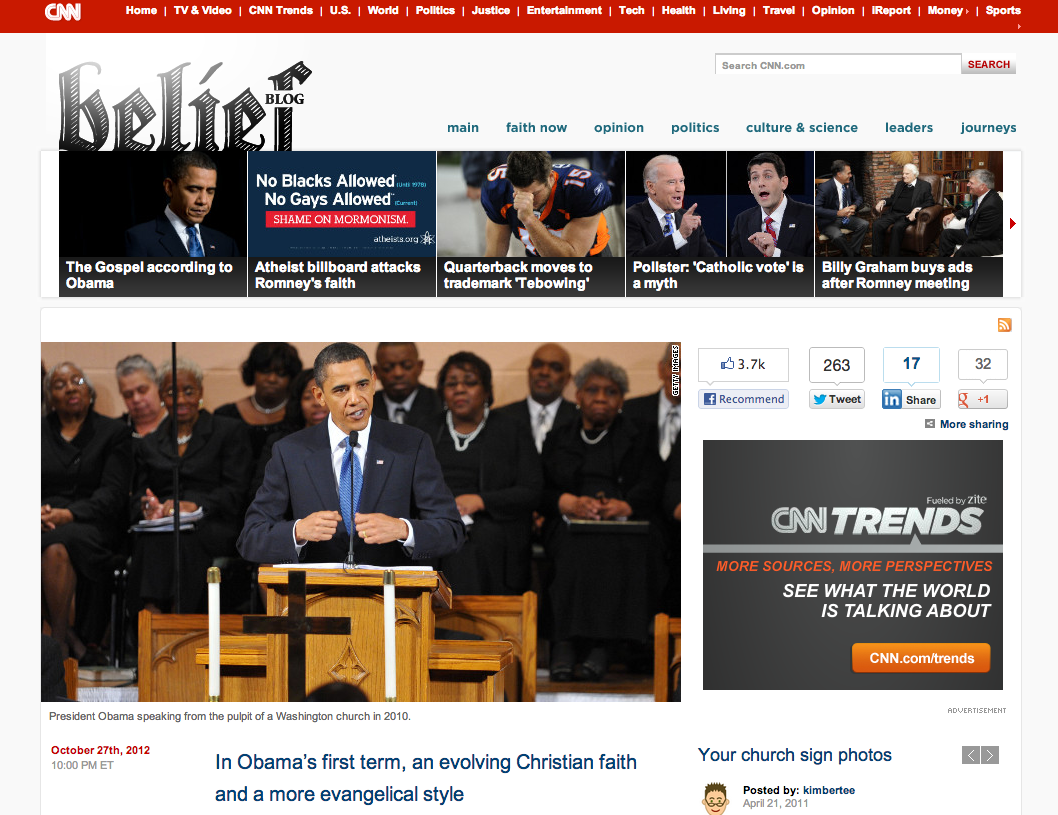
Screen Shot 2012-10-29 at 10.27.32 AM VIEW FULL ARTICLE AND PICTURES AT: http://religion.blogs.cnn.com/2012/10/27/in-obamas-first-term-an-evolving-christian-faith-and-a-more-evangelical-style/

Washington (CNN) - President Obama's prayers for a strong first debate may not have been answered, but that doesn't mean the prayers weren't happening.

Before he stepped onto a Colorado stage earlier this month to face off with Mitt Romney for the first time, Obama joined a conference call with a small circle of Christian ministers.

"The focus of that prayer was, 'Oh, Lord, you know precisely what the president needs to say,'" says Kirbyjon Caldwell, a Methodist megachurch pastor from Texas who helped lead the call. "'You know what this country needs during the next four years.'"

"'And so I would pray that your primary will and words that you want the president to say will fall from his lips,'" Caldwell goes on, recalling his prayer.

Obama, for his part, was mostly silent.

"There's a profound and genuine humility in the presence of Christ himself," Caldwell says, describing the president on such calls. "I think he recognizes it as a holy moment."

It was the second time Caldwell and Obama had prayed by phone in as many months. The two had connected in August on a prayer call Obama has hosted on his birthday every year since coming to the White House.

Welcome to the intense, out-of-the-box and widely misunderstood religious life of President Barack Obama.

Though he famously left his controversial pastor, the Rev. Jeremiah Wright, the year he was elected to the presidency, a handful of spiritual advisers close to Obama say that his time in office has significantly deepened his faith.

Stephen Mansfield, a former Christian pastor who wrote the book "The Faith of Barack Obama," goes so far to say that Obama has experienced a spiritual transformation.

"I think we do have at heart a new man, so to speak," says Mansfield, who worked closely with the White House and with some Obama religious advisers on his book. "He has undergone a pretty significant personal religious change in his first term."

Obama's faith advisers say Mansfield goes a step too far, though they acknowledge that when it comes to his faith, Obama has changed.

"There is a deepening development in his relationship with God," says Joel Hunter, a Florida-based pastor who has been in touch with Obama nearly every week since he took office. "He chooses to stay faithful in daily habits of study and prayer and consistent times of interchange with spiritual leaders."

"I am not sure he did that before he came to the presidency."

Whether or not Obama has been spiritually "reborn" in the evangelical sense, his spiritual counselors say the president's faith has helped shape his first term in ways that haven't been appreciated by voters or the news media.

And they say the presidency is bringing Obama to a new place in his faith - building on a system of belief and practice that helped bring him to the White House in the first place.

Talking like Billy Graham

These days, when the president talks about his faith, he sounds like a born-again Christian.

Addressing the National Prayer Breakfast in Washington this year, Obama recalled meeting the nation's most iconic evangelical Christian, Billy Graham, and described his struggle to find the right words as he prayed aloud with the aging evangelist.

"Like that verse in Romans, the Holy Spirit interceded when I didn't know quite what to say," Obama told the gathering, invoking the New Testament.

It was hardly the only part of the speech where Obama was speaking "Christianese" - employing a lexicon familiar to evangelical Christians, who put a premium on quoting Scripture and communing directly with the Holy Spirit.

At the same breakfast, Obama spoke of spending time every morning in "Scripture and devotion" and dropped the names of "friends like Joel Hunter or T.D. Jakes," both well-known pastors of evangelical megachurches.

"He was talking like Billy Graham" at the breakfast, says Mansfield, who also wrote an admiring spiritual biography of former President George W. Bush.

"While I'm proud of what we've achieved together, I'm far more mindful of my own failings," Obama said in his acceptance speech, "knowing exactly what Lincoln meant when he said, 'I have been driven to my knees many times by the overwhelming conviction that I had no place else to go.'"

Such pious talk marks a departure from how the president discussed his faith life before his White House years.

Back then, Obama cited his religion more as a basis for social action than for spiritual sustenance. He would temper declarations of belief with affirmations of doubt.

Asked in a 2004 interview whether he prayed often, Obama, then a candidate for U.S. Senate in Illinois, responded: "Uh, yeah, I guess I do."

In a 2007 interview with the Chicago Sun-Times, Obama voiced skepticism about Scripture.

"There are aspects of the Christian tradition that I'm comfortable with and aspects that I'm not," he said. "There are passages of the Bible that make perfect sense to me and others that I go 'Ya know, I'm not sure about that.'"

These days, Obama forgoes such equivocations in favor of a full-throated Christianity.

To Mansfield, the evolution of Obama's comments on religion bespeak a born-again experience, prompted largely by the president's break with Wright and his arrival into a circle of spiritual counselors that includes many evangelicals.

The White House declined requests to speak to Obama.

But Hunter, the president's closest spiritual counselor, says Obama has technically been a born-again Christian for more than 25 years, since accepting Jesus at Wright's Chicago church in the 1980s.

But it's in the last four years that the president has become more evangelical in his habits.

He now begins each morning reading Christian devotionals on his Blackberry.

And then there's the circle of pastors Obama has begun praying with before big events like the first presidential debate.

A circle of evangelicals

After landing in Washington following his 2008 election, Obama shopped around for a new church. But he wound up making his spiritual home instead among a circle of far-flung pastors that includes Hunter, Jakes and Caldwell, the minister from Texas.

Conference calls with the group started while Obama was still a presidential candidate, including on the night of his 2008 victory. The president-elect spoke by phone with Hunter and other Christian ministers, rejoicing in victory but also grieving the death of his grandmother, who helped raise him, just a few days earlier.

The migration from Wright - who almost brought down Obama's campaign with videos that showed him sermonizing about "God damn America" and "the U.S. of KKK A" - to this new group, says Mansfield, has been underappreciated.

"[Obama] went into the Oval Office ... questioning the only pastor he'd ever had," Mansfield says. "Wright left him humiliated."

"And there were deeper questions about the theology that [Obama] had received," Mansfield continues. "Some part of Wright's religious orientation had failed."

Where Wright is a liberal mainline Protestant, emphasizing liberation and social action, Obama's new circle of pastors includes theologically conservative evangelicals like Hunter and Jakes, who stress God's grace and personal transformation.

Mansfield notes that the chaplain who has presided for the last few years at Camp David, where Obama spends many Sundays, is also an evangelical.

Some of Obama's spiritual counselors credit Joshua DuBois, executive director of the White House Office of Faith-based and Neighborhood Partnerships, with leading Obama to a more evangelical-flavored Christianity. Caldwell calls him the president's personal pastor.

A former associate pastor at a Pentecostal church in Boston, DuBois is the one responsible for sending Obama Scriptures and scriptural meditations five days a week; Hunter does it on the other two days.

DuBois convenes a daily 8:15 a.m. conference call with pastors to pray for the country and the president, who is not on the call. (Lately, those calls have also included prayers for Mitt Romney.)

And it's DuBois who organized the president's circle of spiritual advisers. After graduate school at Princeton, DuBois talked his way onto Obama's staff at the U.S. Senate, repeatedly driving to Washington to make his case after job applications were rejected.

When Obama launched his presidential campaign a few years later, DuBois was plucked as its faith outreach director.

The 30-year-old White House aide plays down his influence on his boss.

"He has always been on a Christian journey," DuBois says of Obama, "and the challenges of the office, of being leader of the free world, provides a deepening and strengthening of faith, and that's what you see with the president."

"I remember working with him around the Scripture he would use at the memorial service for the miners in West Virginia," DuBois says, referring to the 2010 tragedy that left 29 dead. "These are obviously moments when one's faith is strengthened."

The unparalleled trials of the Oval Office have been known to deepen the religiosity of presidents ranging from Abraham Lincoln to Ronald Reagan.

Hunter says the same thing has happened to this president: "His faith has been growing as the challenges of the presidency have become more naturally the main part of his own everyday life."

One of Hunter's first Oval Office encounters with Obama came shortly after the president took office, at a time when the economy was shedding 750,000 jobs a month.

"He acknowledged at that meeting what many may know but few remember: that by the time issues get to the president, there are no simple or clear answers or they would have been solved by others," Hunter says. "So we prayed."

A few months later, Hunter was in the Oval Office again, noticing that "the unremitting heaviness of the office was setting in."

"I saw something that has been consistent ever since: He cannot just pray for himself and his family," Hunter says by e-mail. "At least I have never seen it. His faith, his heart, always includes those who are being left out through no fault of their own."

Despite the changes they've seen in Obama, both Hunter and DuBois are uncomfortable with the word "transformation" when it comes to Obama's White House faith life.

"The president doesn't deal in labels," says DuBois. "He knows God's grace is sufficient for him and beyond that doesn't get into labels, evangelical or mainline. He's a proud Christian."

Loving God by loving your neighbor

When the Rev. Sharon Watkins and a group of fellow Protestant ministers sat down with Obama at the White House a couple years into the president's term, she knew the pastors would get wonky about religion.

"You get a bunch of ministers in the room and we're all church geeks - it's theological," says Watkins, who along with the other pastors had come to talk about poverty. "But the president got every biblical allusion and reference. ... He's just a person who is biblically and theologically literate."

If Obama's personal theology has grown more conservative, he is inclined to apply it toward liberal political ends.

"I'd be remiss if my values were limited to personal moments of prayer or private conversations with pastors or friends," Obama said at the National Prayer Breakfast in February. "So instead, I must try - imperfectly, but I must try - to make sure those values motivate me as one leader of this great nation."

In signing laws that have increased Wall Street regulations and stopped health insurance companies from rejecting patients with preexisting conditions, Obama said at the breakfast, he wanted to "make the economy stronger for everybody."

"But I also do it because I know that far too many neighbors in our country have been hurt and treated unfairly over the last few years," he continued. "And I believe in God's command to 'love thy neighbor as thyself.'"

Obama went on to frame decisions as disparate as ending tax breaks for the wealthy and defending foreign aid as examples of biblical principles in action, quoting Jesus' teaching that "for unto whom much is given, much shall be required" and invoking the "biblical call to care for the least of these."

That last biblical reference also loomed large in another 2011 White House meeting between Obama and a group of religious leaders. They'd come to urge the president to protect programs for the poor amid his fight with Congress over raising the nation's debt ceiling.

The Rev. Jim Wallis, a progressive activist, recalls the meeting:

In pressing Obama to take cuts to those programs off the table, one Roman Catholic bishop told the president that "the text that we are obliged to obey does not say 'as you have done to the middle class you have done to me.'"

"It says as you've done to the least of these, you have done to me," the bishop said. "I know that text," Obama responded. The passage is from the Matthew 25 in the New Testament.

"So there was this very rigorous conversation," Wallis says, "and we pressed him on applying Matthew 25 to this decision about protecting those who were the least of these."

Ultimately, the programs that the religious leaders were lobbying for were protected in the debt ceiling deal, though it's unclear how big a role the religious leaders played.

For liberal Christians, such victories embody the justice of the social gospel, the idea that believers should do God's work - even aid the Second Coming - by improving society.

"I do notice that sometimes, like on health care, when [Obama] says it's the right thing to do, it's him saying you love God by loving your neighbor," says Watkins, who leads a mainline denomination called Christian Church (Disciples of Christ). "He's doing the best he can to be guided by God so he can be a faithful follower of Christ."

Skeptics might write off Obama's Bible talk as sanctimonious window dressing, aimed at no higher purpose than connecting with churchgoers in the purple and red states. But translating the Good Book into progressive politics has always been a mainstay of Obama's political biography.

'An awesome God in the blue states'

When Obama landed on Chicago's South Side in 1985 as an idealistic 23-year-old, eager to start work as a community organizer, he was already a political liberal.

He was also a man without a religion, the son of a spiritual-but-not-religious mother whom he would later describe as "a lonely witness for secular humanism" and an estranged African father who was born a Muslim but died an atheist.

Obama's work in Chicago, built around causes like tenants' rights and job training for laid-off workers, was steeped in religion.

His salary was paid by a coalition of churches. And the job took him into many black churches, among the most influential institutions in the neighborhood he was organizing, including Wright's Trinity United Church of Christ.

After a lifelong struggle to fit in, set in motion by his mixed-race parents, Trinity felt like home.

"I came to realize that without a vessel for beliefs, without an unequivocal commitment to a particular community of faith," he wrote later, "I would be consigned at some level to always remain apart."

The changes that Wright's church wrought weren't just personal. Baptism and active membership there equipped Obama with an ability to connect with churchgoers he was trying to organize - and, years later, with religious voters he was trying to win over - in a deeper way.

Wright, who did not respond to interview requests for this story, gave Obama a moral framework for his liberal politics. The pastor espoused a black liberation theology that equates Jesus' life and death with the plight of those who Wright saw as disenfranchised, from African-Americans to Palestinians.

"Wright is the religious version of almost everything Obama already believed without religion," says Mansfield, who spent time at Trinity for his book. "It's a support of oppressed people anywhere in the world."

When Obama emerged on the national stage, his comfortable religiosity and sensitivity to the concerns of churchgoing Americans helped distinguish him as a Democrat.

"We worship an awesome God in the blue states," he declared to huge applause in his keynote address at the 2004 Democratic National Convention, catching the attention of young Christians like Joshua DuBois.

But at that same convention, Obama's party nominated John Kerry, a candidate who eschewed God talk and who lost his own Catholic demographic on Election Day.

Four years later, Obama hired religious outreach staffers like DuBois for his presidential campaign and made a point of meeting with Christian Right leaders who'd never before heard from a Democratic presidential nominee.

Obama went on to win in places like Indiana and North Carolina, evangelical-heavy states that a Democratic presidential nominee hadn't taken in decades.

If the Rev. Wright had almost brought down his presidential campaign, the controversial minister had also long ago laid the groundwork for Obama to connect with the churchgoing voters who had turned their backs on Kerry.

The politics of confusion

As president, the line between Obama's personal convictions and his political prowess on religious matters can sometimes be hard to discern.

Obama invited the conservative evangelical megapastor Rick Warren to give the invocation at his 2009 inauguration, ruffling liberal feathers. He introduced an annual Easter prayer breakfast as a new White House tradition. He gives shout-outs to young evangelical leaders in major speeches.

All can be seen as genuine reflections of Obama's faith and his appreciation for the role of religious leaders in public life. And in a nation where more people believe in angels than in evolution - a fact that the president himself has publicly noted - all promise political benefits.

The same could be said for Obama's predecessor, George W. Bush, and for presidents as diverse as Jimmy Carter and Reagan: All had deep spiritual streaks that enabled the political art of courting religious Americans, especially evangelicals.

The irony, in Obama's case, is that despite his orthodox utterances - there's "something about the resurrection of our savior, Jesus Christ, that puts everything else in perspective," he said at this year's Easter breakfast - polls continue to show widespread confusion about his faith.

Only half the country can correctly identify Obama as Christian, according to one recent Pew poll, while 17% falsely believe he is a Muslim.

"He's a Christian and he professes his Christian faith - I don't know what else this man has to do to get that into folks' ears," says Caldwell, who was also close to George W. Bush.

But Obama's public piety has helped him bond with young evangelical leaders, who are less tied to the GOP than their parents' generation.

"I was struck by the specificity of what he described in terms of theology and what it means to him," says Gabe Lyons, one such leader, describing a White House Easter breakfast he attended. "His message is very specific and very orthodox."

Where exactly that new orthodoxy comes from - the pressures of the White House, a new circle of religious advisers or, to a certain degree, from political calculation - may become clearer after Obama's presidency, if he opens up about such matters.

Until then, the president is likely to keep speaking "Christianese" - and resisting Christian labels. Dan Gilgoff - CNN Belief Blog Co-Editor
View Post

  •   Peace   •  

Huffington Post: Who Speaks for Christianity and Islam?

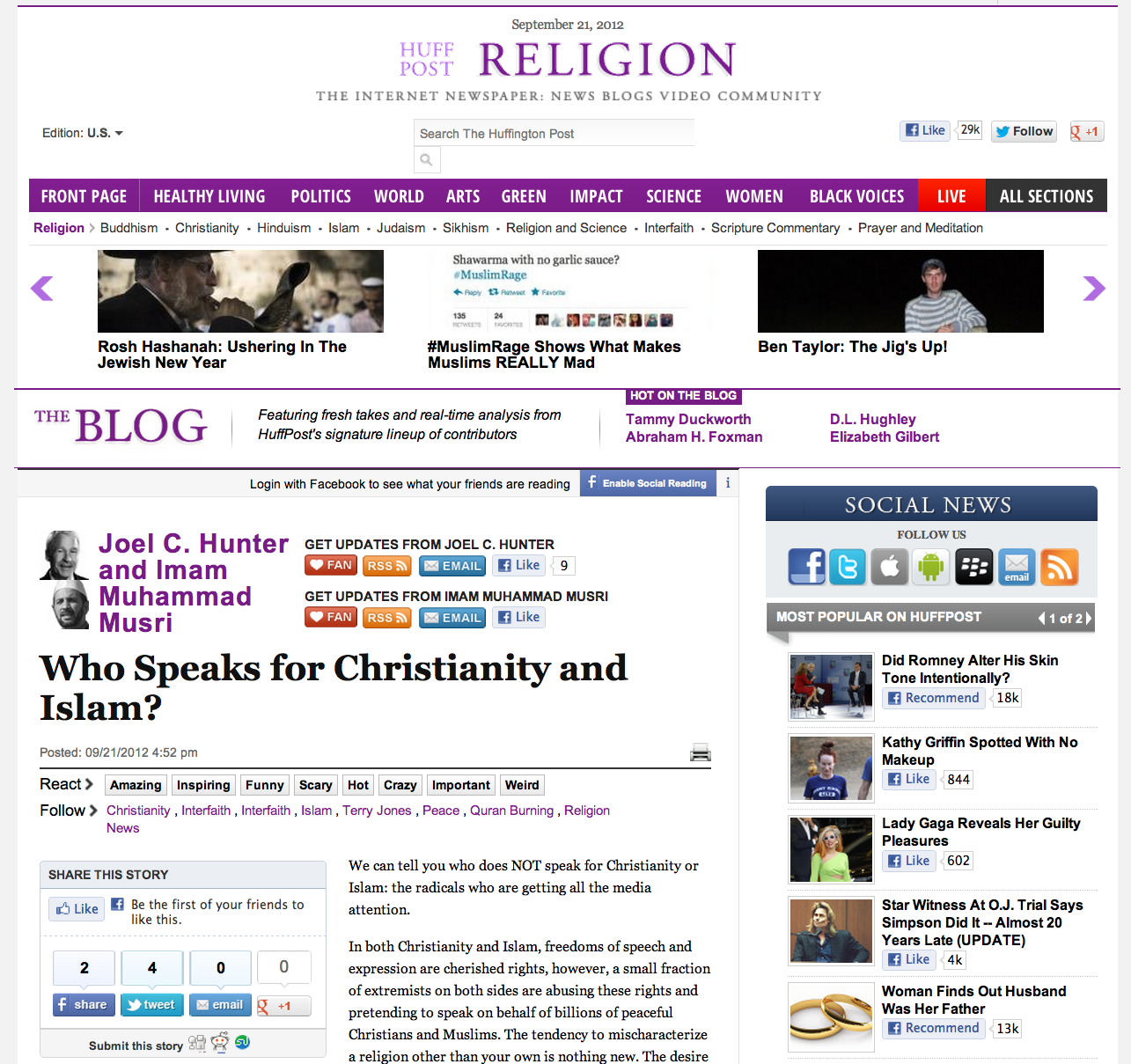
Who Speaks for Christianity and Islam?
Posted: 09/21/2012 4:52 pm
We can tell you who does NOT speak for Christianity or Islam: the radicals who are getting all the media attention.
In both Christianity and Islam, freedoms of speech and expression are cherished rights, however, a small fraction of extremists on both sides are abusing these rights and pretending to speak on behalf of billions of peaceful Christians and Muslims. The tendency to mischaracterize a religion other than your own is nothing new. The desire to defend one's faith and respond to insults is certainly understandable. But let us all take a moment to put this in perspective: Who is launching the attacks?
Recently, a demeaning and degrading hate film, produced by a radical Christian in California and promoted by a fundamentalist Christian leader in Florida, resulted in radical Muslims rioting in several countries. The Christian extremists intended to outrage Muslims worldwide, and to get the Muslim extremists to respond violently. They blame each other, but they are two faces of the same coin.
We have both been in the office of Rev. Terry Jones, on different occasions, to try to dissuade him from actions that would place Americans, especially those serving in our Armed Forces, in danger. We have failed for a simple reason: He loves the attention and he believes he is fighting evil. His tiny congregation loves the idea that believers like them are the only ones true to Christ and courageous enough to defend the faith against enemies. Like other fundamentalists of any faith, he speaks with disdain when talking about other churches let alone Islam. When we visited him, instead of carrying a Bible around the office, Rev. Jones and his assistant pastor carried guns.
We do not know any respected Christian leader or denomination who would promote or even tolerate a despicable video denigrating the leader of another religion. Out of the billions of Christians on this earth, only a very few would approve of such slander. The question is, how many will speak out against it?
We both have talked to Muslims, encouraging them to peace and dialogue. Compared to the of the millions that demonstrated for more democratic reforms in the "Arab Spring" movement across the Middle East, how many have been involved in these violent reactions to the film? Only thousands, in some cases hundreds, demonstrated angrily and only a fraction of those were violent.
Everyone likes to blame the media for focusing on the loud voices of the radicals, but some of the responsibility must rest on the majority of religious leaders who are silent during these times, the ones who would speak up for peace and respect of others but they do not take the initiative. Maybe if more of us spoke up, we could drown out the radical provocations and the radical responses with voices of reason, civility and thoughtfulness.
As a Christian leader, I, Pastor Joel Hunter, rebuke the Coptic Christian who made such a disgusting video. I know many Coptic Christians in Egypt and other countries who would be sick about this kind of attack on the Prophet of Islam. I will be part of the voices that will drown out future attempts to incite the clash of religions and civilizations.
As a Muslim leader, I, Imam Muhammad Musri, strongly condemn the cowardly criminal attacks against the U.S. Consulate in Benghazi, Libya, and other U.S. Embassies around the world. My prayers and condolences go out to the families and loved ones of Ambassador Christopher Stevens and his colleagues, who were killed in these senseless criminal acts. I strongly condemn the radical mob that carried out the attacks, and I stand up with the vast majority of Muslims who are peaceful against the extremists who keep trying to hijack our faith. Islam is peace, and under no circumstances is any kind of violence ever justified in response to such provocations.
While many religious leaders find it difficult to reach out across the religious divide, we are proud to say we have been best friends for nearly 20 years. We have advocated for many issues of compassion and justice and health together. We have worked together to reduce nuclear arms, pollution, eliminate torture, minimize poverty and other important issues. How
many will stand with us to speak out and outlast the voices of degradation when it comes to other religions? We are each strong advocates for our own scriptures and understandings of God, but we do not build our communities by tearing others down.

Screen Shot 2012-09-21 at 8.51.10 PM

By Dr. Joel C. Hunter and Imam Muhammad Musri

We can tell you who does NOT speak for Christianity or Islam: the radicals who are getting all the media attention.

In both Christianity and Islam, freedoms of speech and expression are cherished rights, however, a small fraction of extremists on both sides are abusing these rights and pretending to speak on behalf of billions of peaceful Christians and Muslims. The tendency to mischaracterize a religion other than your own is nothing new. The desire to defend one's faith and respond to insults is certainly understandable. But let us all take a moment to put this in perspective: Who is launching the attacks?

Recently, a demeaning and degrading hate film, produced by a radical Christian in California and promoted by a fundamentalist Christian leader in Florida, resulted in radical Muslims rioting in several countries. The Christian extremists intended to outrage Muslims worldwide, and to get the Muslim extremists to respond violently. They blame each other, but they are two faces of the same coin.

We have both been in the office of Rev. Terry Jones, on different occasions, to try to dissuade him from actions that would place Americans, especially those serving in our Armed Forces, in danger. We have failed for a simple reason: He loves the attention and he believes he is fighting evil. His tiny congregation loves the idea that believers like them are the only ones true to Christ and courageous enough to defend the faith against enemies. Like other fundamentalists of any faith, he speaks with disdain when talking about other churches let alone Islam. When we visited him, instead of carrying a Bible around the office, Rev. Jones and his assistant pastor carried guns.

We do not know any respected Christian leader or denomination who would promote or even tolerate a despicable video denigrating the leader of another religion. Out of the billions of Christians on this earth, only a very few would approve of such slander. The question is, how many will speak out against it?

We both have talked to Muslims, encouraging them to peace and dialogue. Compared to the of the millions that demonstrated for more democratic reforms in the "Arab Spring" movement across the Middle East, how many have been involved in these violent reactions to the film? Only thousands, in some cases hundreds, demonstrated angrily and only a fraction of those were violent.

Everyone likes to blame the media for focusing on the loud voices of the radicals, but some of the responsibility must rest on the majority of religious leaders who are silent during these times, the ones who would speak up for peace and respect of others but they do not take the initiative. Maybe if more of us spoke up, we could drown out the radical provocations and the radical responses with voices of reason, civility and thoughtfulness.

As a Christian leader, I, Pastor Joel Hunter, rebuke the Coptic Christian who made such a disgusting video. I know many Coptic Christians in Egypt and other countries who would be sick about this kind of attack on the Prophet of Islam. I will be part of the voices that will drown out future attempts to incite the clash of religions and civilizations.

As a Muslim leader, I, Imam Muhammad Musri, strongly condemn the cowardly criminal attacks against the U.S. Consulate in Benghazi, Libya, and other U.S. Embassies around the world. My prayers and condolences go out to the families and loved ones of Ambassador Christopher Stevens and his colleagues, who were killed in these senseless criminal acts. I strongly condemn the radical mob that carried out the attacks, and I stand up with the vast majority of Muslims who are peaceful against the extremists who keep trying to hijack our faith. Islam is peace, and under no circumstances is any kind of violence ever justified in response to such provocations.

While many religious leaders find it difficult to reach out across the religious divide, we are proud to say we have been best friends for nearly 20 years. We have advocated for many issues of compassion and justice and health together. We have worked together to reduce nuclear arms, pollution, eliminate torture, minimize poverty and other important issues. How many will stand with us to speak out and outlast the voices of degradation when it comes to other religions? We are each strong advocates for our own scriptures and understandings of God, but we do not build our communities by tearing others down.

View Post

  •   Culture Wars   •  

Young Evangelicals Calling for "Truce" in Gay Marriage Debate

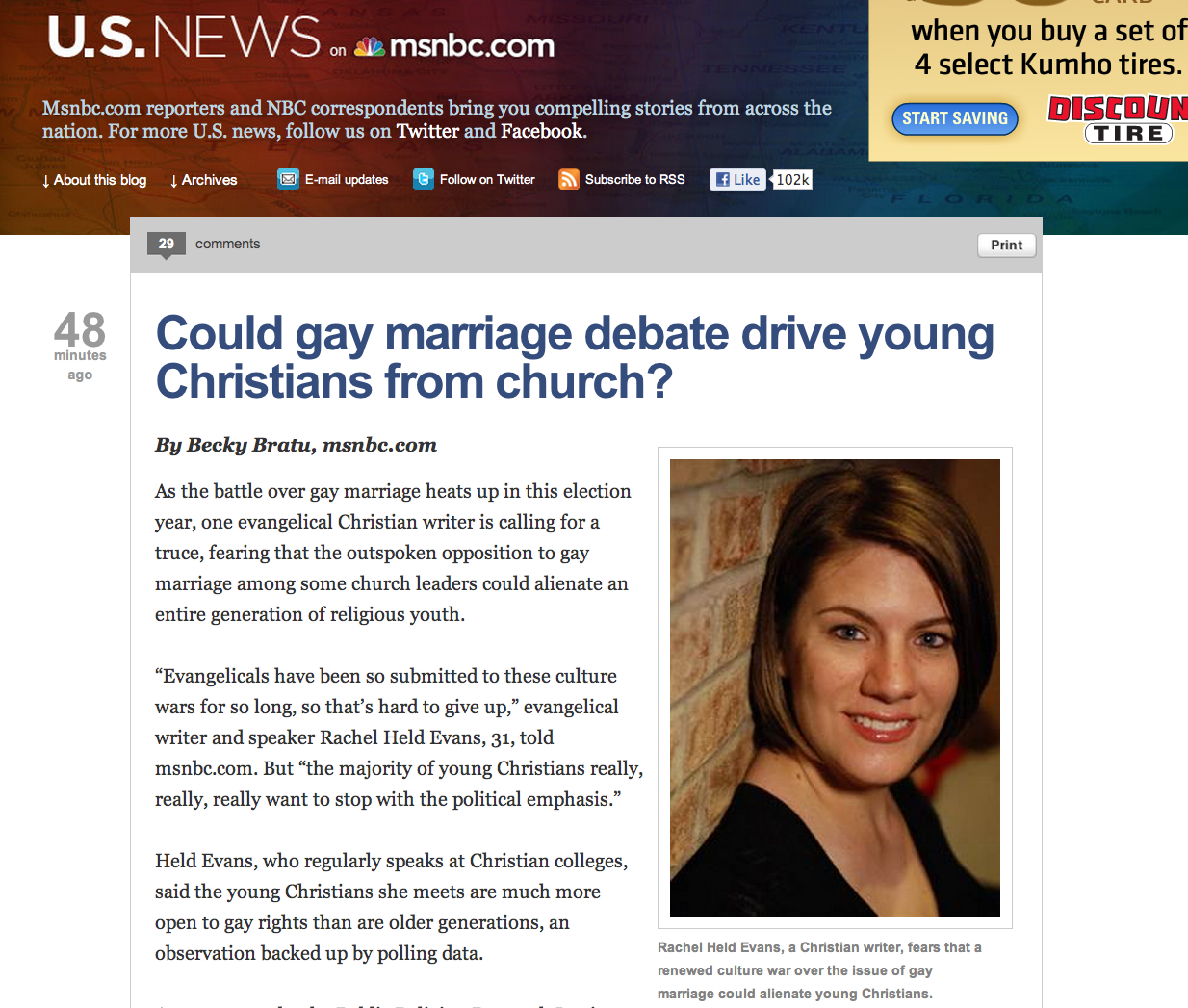
Screen Shot 2012-07-02 at 12.16.30 PM As the battle over gay marriage heats up in this election year, one evangelical Christian writer is calling for a truce, fearing that the outspoken opposition to gay marriage among some church leaders could alienate an entire generation of religious youth.

“Evangelicals have been so submitted to these culture wars for so long, so that’s hard to give up,” evangelical writer and speaker Rachel Held Evans, 31, told msnbc.com. But “the majority of young Christians really, really, really want to stop with the political emphasis.”

Held Evans, who regularly speaks at Christian colleges, said the young Christians she meets are much more open to gay rights than are older generations, an observation backed up by polling data.

A 2011 survey by the Public Religion Research Institute shows the generation gap between young Christians and their elders is large, with 44 percent of white evangelicals aged 18-29 in support of marriage equality compared to only 12 percent of those 65 and older.

According to the same survey, nearly 70 percent of young Christians also agree that religious groups are alienating young people by being too judgmental about gay and lesbian issues.

“For young Christians, having gay and lesbian friends is just a part of our life,” Held Evans said. “It’s just really hard for us to see them as mere issues to debate, because we’re talking about our friends here.”

The shift is manifesting itself increasingly on Christian college campuses, including at Biola University in California, where, about two months ago, an anonymous group of students announced the presence of the "Biola Queer Underground," asking that the LGBT community on campus “be treated with equality and respected as another facet of Biola's diversity."

At Wheaton College in Illinois, a group of alumni known as OneWheaton coalesced in 2011 to express its support of the LGBT community on campus.

“OneWheaton understands that LGBTQ issues are difficult to process at Wheaton College,” reads a statement from the group. “We desire this to change for current students and wish to create such an environment, a safe place for them to process these issues and develop into the people they are meant to be.” In response, school officials have said they are open to having a conversation about homosexuality on campus.

To Held Evans, American churches’ attitude toward gay rights will play an important role in the retention of young Christians. In an article she wrote following North Carolina’s recent vote to ban gay marriage, Held Evans points to data mentioned in David Kinnaman’s book You Lost Me, which shows that 59 percent of teens who were raised Christian abandon the church when they become adults. One of the main reasons, the article says, is the church’s attitude toward gay rights.

Fellow Christian writer Matthew Anderson, 30, agrees that there is a generational shift taking place in Christians’ support for gay rights, but he is less convinced it’ll lead to any profound changes in the near-term.

“Those of the conservative side aren’t going away. They’re just going to be a lot more careful in terms of how they frame their positions,” Anderson told msnbc.com.

He also doesn’t think younger Christians are going to embrace more liberal views on matters of sexuality, including homosexuality.

“There’s going to be a large, less vocal, at least a substantive minority – it’s not an outright majority – of younger evangelicals who are going to take a broadly conservative position on sexual ethics,” he said.

That position stems from the conviction that God defined marriage in the scripture as between a man and a woman, Anderson said, and Christians don’t believe they have the right to redefine it.

For thousands of years the definition of marriage has been the same, said Pastor Joel Hunter, a spiritual advisor to President Obama. “And so, there’s some reason for the apprehension that says this thing is moving so fast that I wonder what the next 10 years will hold,” he told msnbc.com.

In Hunter’s view, the word “marriage” cannot be used to characterize a same-sex union, but he believes having this debate on a national stage offers a unique opportunity.

“We really have an opportunity to raise the level of respect, to raise the dialogue to where no rights of one group trumps another group’s rights,” he said, adding: “The scripture has certain listed sins, and we want to dissuade people from those behaviors, because we think in the long run if it’s in scripture then that’s not something that God approves of.”

Hunter, who leads a Florida megachurch, said he believes the government could establish a kind of civil marriage, which would not fit within the definition of Biblical marriage.

”We don’t 100% equate this as a part of the civil rights movement because for us at least a part of this is a matter of choice, it’s a behavior, and so it’s a different category than skin pigmentation,” he said. “Having said that, we want to be sure that all Americans do have citizens’ rights to enter any legal relationship that they want to.”

But finding compromise appears unlikely, Anderson believes, as most players on the national stage treat the debate as a zero-sum game.

“It’s winner-take-all, and there’s sort of no middle ground between the two positions,” he said.

While young Christians may be divided on whether gay relationships should be celebrated in the church, Held Evans said, they’re increasingly unified on their stance against legislative action, such as North Carolina’s gay marriage ban and others that will be up for votes this fall.

“The majority of young Christians really, really, really want to stop with the political emphasis,” she said. “Even young Christians who think that gay relationships are not God’s design, a lot of them will still say ‘but I think it should be legal for gay people to get married, because this is America.’”

By Becky Bratu, msnbc.com

FIND THIS ARTICLE AT: http://usnews.msnbc.msn.com/_news/2012/07/02/12524736-could-gay-marriage-debate-drive-young-christians-from-church?lite

View Post

  •   Public Square   •  

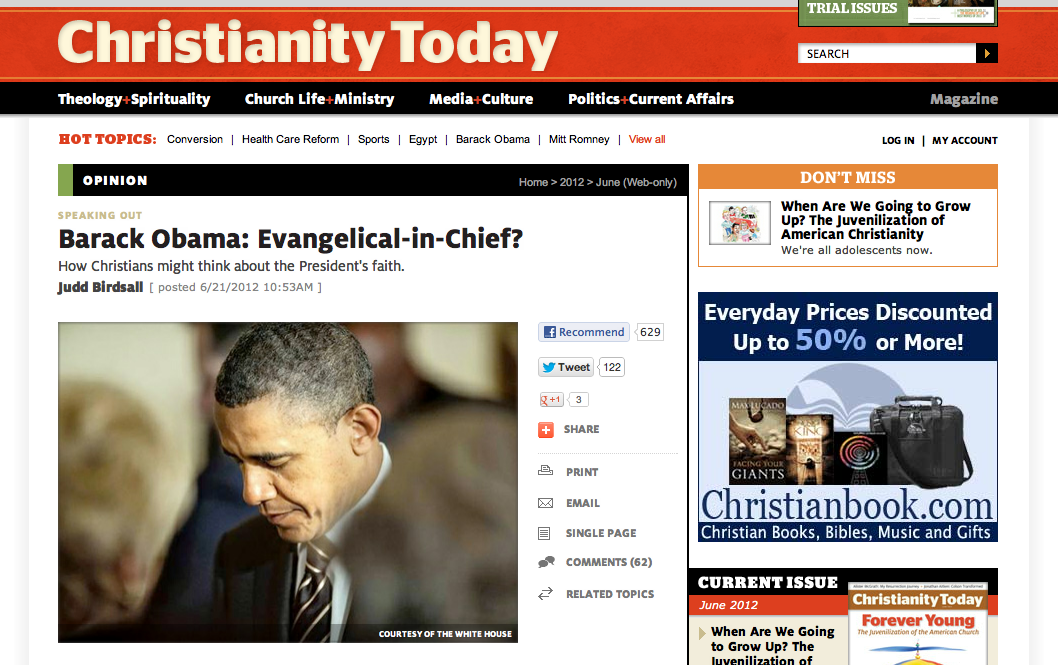
How Christians Might Think About the President's Faith

The 2012 campaign has placed evangelicals in a paradox. A recent PRRI/RNS poll reveals that white evangelicals support a Mormon presidential candidate over Obama by an overwhelming 49% margin, but are simultaneously the religious group most likely to say it is important for a presidential candidate to share their religious beliefs (67%).
While there are plenty of legitimate policy reasons that evangelicals might support Governor Romney, their willingness to overlook their desire for a coreligionist candidate may also have at least something to do with the fact that 24% of them—higher than any other religious group—believe Obama is a Muslim, and even more are unaware (or unconvinced?) he's a Protestant. What if more evangelicals knew Obama largely shares their religious beliefs?
That the true religious identity of the world's most famous, most powerful man could remain a mystery to so many is itself a mystery. Before and especially during his presidency, Obama has been extraordinarily open on matters of faith, providing ample evidence for his repeated claim to be a devout Christian. The evidence may even suggest Obama is our evangelical-in-chief.
In his excellent religious biography of the President, The Faith of Barack Obama, author Stephen Mansfield spends several pages exploring whether Obama has been "born again." Mansfield's interviews with the President's spiritual advisors suggest so.
"I know he's born again," said Joshua DuBois, head of the White House Office of Faith-based and Neighborhood Partnerships, in an interview with Mansfield. A pastor's kid who served briefly in a Pentecostal pastorate himself, DuBois has queried the President about his faith and found that he "believes what the majority of Christians believe."
Joel Hunter, pastor of Florida's 15,000-member Northland Church and Obama's closest spiritual mentor, is even more emphatic. "There is simply no question about it: Barack Obama is a born again man who has trusted in Jesus Christ with his whole heart."
These assertions of Obama's "born again" status are instructive but only tell us so much. The Christian experience of spiritual rebirth is internal, subjective, and thus difficult to disprove. Moreover, it constitutes only one dimension of what it means to be an evangelical.
Admittedly, the meaning of evangelicalism is contested, and in the United States the term has become loaded with political baggage. Evangelicalism is an exceedingly diverse and diffuse global movement, lacking a unifying political agenda, institutional structure, or doctrinal basis (that's why the e in "evangelical" is usually not capitalized). Yet we can identify core features shared by evangelicals across all continents.
The most widely accepted definition of evangelicalism comes from British historian David Bebbington. According to Bebbington, an evangelical is a Christian marked by four distinct emphases: "conversionism, the belief that lives need to be changed; activism, the expression of the gospel in effort; biblicism, a particular regard for the Bible; and what may be termed crucicentrism, a stress on the sacrifice of Christ on the cross."
If Obama is an evangelical, we should expect to find him in alignment with at least this minimalist "Bebbington Quadrilateral." Let's look at how he squares with each of the four elements.
Conversionism: Barack Obama has a conversion story, if not an entirely traditional one. In his bestseller, The Audacity of Hope, Obama recounts how he warmed to Christianity, and the black church tradition in particular, while attending Trinity United Church of Christ in Chicago. One Sunday, Obama writes, "I felt God's spirit beckoning me. I submitted myself to His will, and dedicated myself to discovering His truth." Obama's eventual decision to be baptized "came about as a choice and not an epiphany; the questions I had did not magically disappear."
Only years later would Obama attach salvific significance to his embrace of the gospel. "I believe that faith gives me a path to be cleansed of sin and have eternal life," he told Christianity Today in 2008. His more recent statements sound even more evangelical. At the 2011 National Prayer Breakfast Obama spoke of Jesus, in typical evangelical idiom, as "my Lord and Savior." Still, the President acknowledges that his "faith journey has had its twists and turns"—a testimony that comports with a younger generation of evangelicals who are more likely to conceive of conversion as a process rather than a specific point in time.
Activism: For evangelicals, the experience of conversion naturally spills over into action, both evangelism and social witness. The President has addressed Christian activism on many occasions, and his latest National Prayer Breakfast speech was an extended meditation on how Christian faith compels charity and the pursuit of justice. "The Bible," Obama said, "teaches us to 'be doers of the word and not merely hearers.'We're required to have a living, breathing, active faith in our own lives.And each of us is called on to give something of ourselves for the betterment of others—and to live the truth of our faith not just with words, but with deeds."
Biblicism: Obama begins each day with a brief Scripture reading, and quotes frequently from the Bible. He clearly has a "special regard" for the Bible, though it's unclear if he holds to biblical inerrancy or infallibility. In 2007 Obama told the Chicago Sun-Times, "There are passages of the Bible that make perfect sense to me and others that I go, 'Ya know, I'm not sure about that.'" That was five years ago. More recently, he sounds surer about the Bible. Whereas his first Prayer Breakfast speech in 2009 had just one biblical reference—the Golden Rule, the politically safest biblical citation possible—his 2012 address offered several biblical quotations and allusions, indicating a growing respect for and reliance on the sacred text.
Crucicentrism: Obama has shared his reflections on the cross of Christ at his annual Easter Prayer Breakfast—a new White House tradition he started in 2010. At the 2012 event in April, the President described Holy Week as an opportunity to remember "all that Christ endured," to "give thanks for the all-important gift of grace," and to "celebrate that glorious overcoming, the sacrifice of a risen savior who died so that we might live." That's a summary of Easter all evangelicals can embrace.
We are accustomed to hearing politicians offering guarded generalities about the goodness of faith. It's quite another thing for the President of the United States to personally affirm the atoning death and resurrection of Jesus Christ. If Obama is a secret Muslim, he's really good at making his closet Islamic beliefs sound a lot like crucicentric Christianity.
So, is Obama our evangelical-in-chief? When a reporter asked Obama point blank in 2007 if he was an evangelical, the Illinois senator gave a nuanced, noncommittal answer:
Gosh, I'm not sure if labels are helpful here because the definition of an evangelical is so loose and subject to so many different interpretations. I came to Christianity through the black church tradition where the line between evangelical and non-evangelical is completely blurred. Nobody knows exactly what it means. Does it mean that you feel you've got a personal relationship with Christ the savior? Then that's directly part of the black church experience.
Five years later, his answer would likely be more definitive. As President, Obama has surrounded himself with evangelical spiritual advisors and has regularly interacted with the evangelical community. His public statements and private devotions point to a deepening faith—a path commonly tread by American heads of state. Obama's "experience of the presidency," says DuBois, "is strengthening his Christian muscles, making him a calm, confident, certain believer in Jesus Christ."
Hunter explained to Mansfield that Obama's theologically equivocal statements about sin, heaven, and other topics before entering the White House were those of a man with little biblical training. "He would not hold most of those views now," says Hunter. "He is very much in transition."
Hunter's point is crucial. Critics can piece together dated quotes from the President to paint a picture of a hesitant, heterodox Christian. That is unfair as it fails to account for Obama's progression from the highly unconventional, liberationist Christianity of Jeremiah Wright to the more mainstream evangelicalism of Hunter and DuBois.
But what about the President's policies? Hasn't his "evolution" on gay marriage, for example, gone in the opposite direction of his "transition" on faith matters? Obama may have become more conservative theologically, but he is still liberal politically—placing him somewhere on the Christian Left.
Obama's liberal positions don't sit well with most American evangelicals, and for some his views prove the insincerity of his religious claims. But relating Christian faith to public life is enormously complicated, and every believer must continually examine how he applies changeless truths in a changing world. We are all in "transition" to some degree. Obama deserves grace as he continues to work out what his maturing faith means for his policies.
Evangelicals may evaluate Obama's policy record and find ample grounds to give their vote to Mitt Romney. But in evaluating Obama's personal faith no credence should be given to groundless insinuations and graceless mischaracterizations.
Obama is clearly not a secret Muslim or anything other than what he claims to be: a committed Christian. For evangelicals, the commander-in-chief is a brother in Christ.
Judd Birdsall is a graduate of Wheaton College and a Ph.D. candidate at Cambridge University. From 2007 to 2011 he served at the U.S. State Department's Office of International Religious Freedom and was founding chairman of the Forum on Religion & Global Affairs.

Screen Shot 2012-06-26 at 11.16.01 AM

The 2012 campaign has placed evangelicals in a paradox. A recent PRRI/RNS poll reveals that white evangelicals support a Mormon presidential candidate over Obama by an overwhelming 49% margin, but are simultaneously the religious group most likely to say it is important for a presidential candidate to share their religious beliefs (67%).

While there are plenty of legitimate policy reasons that evangelicals might support Governor Romney, their willingness to overlook their desire for a coreligionist candidate may also have at least something to do with the fact that 24% of them—higher than any other religious group—believe Obama is a Muslim, and even more are unaware (or unconvinced?) he's a Protestant. What if more evangelicals knew Obama largely shares their religious beliefs?

That the true religious identity of the world's most famous, most powerful man could remain a mystery to so many is itself a mystery. Before and especially during his presidency, Obama has been extraordinarily open on matters of faith, providing ample evidence for his repeated claim to be a devout Christian. The evidence may even suggest Obama is our evangelical-in-chief.

In his excellent religious biography of the President, The Faith of Barack Obama, author Stephen Mansfield spends several pages exploring whether Obama has been "born again." Mansfield's interviews with the President's spiritual advisors suggest so.

"I know he's born again," said Joshua DuBois, head of the White House Office of Faith-based and Neighborhood Partnerships, in an interview with Mansfield. A pastor's kid who served briefly in a Pentecostal pastorate himself, DuBois has queried the President about his faith and found that he "believes what the majority of Christians believe."

Joel Hunter, pastor of Florida's 15,000-member Northland Church and Obama's closest spiritual mentor, is even more emphatic. "There is simply no question about it: Barack Obama is a born again man who has trusted in Jesus Christ with his whole heart."

These assertions of Obama's "born again" status are instructive but only tell us so much. The Christian experience of spiritual rebirth is internal, subjective, and thus difficult to disprove. Moreover, it constitutes only one dimension of what it means to be an evangelical.

Admittedly, the meaning of evangelicalism is contested, and in the United States the term has become loaded with political baggage. Evangelicalism is an exceedingly diverse and diffuse global movement, lacking a unifying political agenda, institutional structure, or doctrinal basis (that's why the e in "evangelical" is usually not capitalized). Yet we can identify core features shared by evangelicals across all continents.

The most widely accepted definition of evangelicalism comes from British historian David Bebbington. According to Bebbington, an evangelical is a Christian marked by four distinct emphases: "conversionism, the belief that lives need to be changed; activism, the expression of the gospel in effort; biblicism, a particular regard for the Bible; and what may be termed crucicentrism, a stress on the sacrifice of Christ on the cross."

If Obama is an evangelical, we should expect to find him in alignment with at least this minimalist "Bebbington Quadrilateral." Let's look at how he squares with each of the four elements.

Conversionism: Barack Obama has a conversion story, if not an entirely traditional one. In his bestseller, The Audacity of Hope, Obama recounts how he warmed to Christianity, and the black church tradition in particular, while attending Trinity United Church of Christ in Chicago. One Sunday, Obama writes, "I felt God's spirit beckoning me. I submitted myself to His will, and dedicated myself to discovering His truth." Obama's eventual decision to be baptized "came about as a choice and not an epiphany; the questions I had did not magically disappear."

Only years later would Obama attach salvific significance to his embrace of the gospel. "I believe that faith gives me a path to be cleansed of sin and have eternal life," he told Christianity Today in 2008. His more recent statements sound even more evangelical. At the 2011 National Prayer Breakfast Obama spoke of Jesus, in typical evangelical idiom, as "my Lord and Savior." Still, the President acknowledges that his "faith journey has had its twists and turns"—a testimony that comports with a younger generation of evangelicals who are more likely to conceive of conversion as a process rather than a specific point in time.

Activism: For evangelicals, the experience of conversion naturally spills over into action, both evangelism and social witness. The President has addressed Christian activism on many occasions, and his latest National Prayer Breakfast speech was an extended meditation on how Christian faith compels charity and the pursuit of justice. "The Bible," Obama said, "teaches us to 'be doers of the word and not merely hearers.'We're required to have a living, breathing, active faith in our own lives.And each of us is called on to give something of ourselves for the betterment of others—and to live the truth of our faith not just with words, but with deeds."

Biblicism: Obama begins each day with a brief Scripture reading, and quotes frequently from the Bible. He clearly has a "special regard" for the Bible, though it's unclear if he holds to biblical inerrancy or infallibility. In 2007 Obama told the Chicago Sun-Times, "There are passages of the Bible that make perfect sense to me and others that I go, 'Ya know, I'm not sure about that.'" That was five years ago. More recently, he sounds surer about the Bible. Whereas his first Prayer Breakfast speech in 2009 had just one biblical reference—the Golden Rule, the politically safest biblical citation possible—his 2012 address offered several biblical quotations and allusions, indicating a growing respect for and reliance on the sacred text.

Crucicentrism: Obama has shared his reflections on the cross of Christ at his annual Easter Prayer Breakfast—a new White House tradition he started in 2010. At the 2012 event in April, the President described Holy Week as an opportunity to remember "all that Christ endured," to "give thanks for the all-important gift of grace," and to "celebrate that glorious overcoming, the sacrifice of a risen savior who died so that we might live." That's a summary of Easter all evangelicals can embrace.

We are accustomed to hearing politicians offering guarded generalities about the goodness of faith. It's quite another thing for the President of the United States to personally affirm the atoning death and resurrection of Jesus Christ. If Obama is a secret Muslim, he's really good at making his closet Islamic beliefs sound a lot like crucicentric Christianity.

So, is Obama our evangelical-in-chief? When a reporter asked Obama point blank in 2007 if he was an evangelical, the Illinois senator gave a nuanced, noncommittal answer:

Gosh, I'm not sure if labels are helpful here because the definition of an evangelical is so loose and subject to so many different interpretations. I came to Christianity through the black church tradition where the line between evangelical and non-evangelical is completely blurred. Nobody knows exactly what it means. Does it mean that you feel you've got a personal relationship with Christ the savior? Then that's directly part of the black church experience.

Five years later, his answer would likely be more definitive. As President, Obama has surrounded himself with evangelical spiritual advisors and has regularly interacted with the evangelical community. His public statements and private devotions point to a deepening faith—a path commonly tread by American heads of state. Obama's "experience of the presidency," says DuBois, "is strengthening his Christian muscles, making him a calm, confident, certain believer in Jesus Christ."

Hunter explained to Mansfield that Obama's theologically equivocal statements about sin, heaven, and other topics before entering the White House were those of a man with little biblical training. "He would not hold most of those views now," says Hunter. "He is very much in transition."

Hunter's point is crucial. Critics can piece together dated quotes from the President to paint a picture of a hesitant, heterodox Christian. That is unfair as it fails to account for Obama's progression from the highly unconventional, liberationist Christianity of Jeremiah Wright to the more mainstream evangelicalism of Hunter and DuBois.

But what about the President's policies? Hasn't his "evolution" on gay marriage, for example, gone in the opposite direction of his "transition" on faith matters? Obama may have become more conservative theologically, but he is still liberal politically—placing him somewhere on the Christian Left.

Obama's liberal positions don't sit well with most American evangelicals, and for some his views prove the insincerity of his religious claims. But relating Christian faith to public life is enormously complicated, and every believer must continually examine how he applies changeless truths in a changing world. We are all in "transition" to some degree. Obama deserves grace as he continues to work out what his maturing faith means for his policies.

Evangelicals may evaluate Obama's policy record and find ample grounds to give their vote to Mitt Romney. But in evaluating Obama's personal faith no credence should be given to groundless insinuations and graceless mischaracterizations.

Obama is clearly not a secret Muslim or anything other than what he claims to be: a committed Christian. For evangelicals, the commander-in-chief is a brother in Christ.

Judd Birdsall is a graduate of Wheaton College and a Ph.D. candidate at Cambridge University. From 2007 to 2011 he served at the U.S. State Department's Office of International Religious Freedom and was founding chairman of the Forum on Religion & Global Affairs.

FIND THIS ARTICLE AT: http://www.christianitytoday.com/ct/2012/juneweb-only/barack-obama-evangelical-in-chief.html

View Post

  •   Public Square   •  

Code of Ethics for Pastors

Screen Shot 2012-06-15 at 9.48.32 AM

The National Association of Evangelicals has developed and released a "Code of Ethics for Pastors" document and is asking church leaders across denominational lines to sign and uphold its outlined principles in their lives as ministers.

"This is to remind people who they are in ministry and how important their personal integrity, their personal conduct and lifestyle really are for what they are trying to accomplish," Dr. Joel C. Hunter, senior pastor of Northland, A Church Distributed in Longwood, Fla., told The Christian Post.

Hunter, who is a board member of the NAE and one of several pastors who have already signed the code of ethics, said that the document is an important way to reemphasize that those in ministerial leadership need to live above reproach.

"Personal conduct is as important as any theological knowledge – the medium is the message," he said. "With a lot of people coming into the ministry these days without a lot of training or a lot of growing up in the church, many ministers may not be aware or may have forgotten what the expectations are of someone in ministry. It's a great teaching device as well as a reminder."

The document does not describe specific rules or infractions, but does include five primary admonitions. It suggests pastors should pursue integrity, be trustworthy, seek purity, embrace accountability and facilitate fairness. Bible verses are used to support the principles.

Specifically, pastors who sign on to the document vow to, among other things:

Exalt Christ, not self Interpret the Bible accurately and apply it discerningly Be honest and prudent in regard to personal and ministry resources Avoid sinful sexual behavior and inappropriate involvement Build God's Kingdom in cooperation, not competition, with other local ministries "We don't want to be legalistic. We are not into a bunch of rules," Hunter explained. "What we wanted to do is give people a way to commit their life to holiness and excellence looking to Scripture as their standard."

According to a survey of NAE leaders earlier this year, 71 percent of evangelical leaders are not required to sign a formal code of ethics. NAE states that some evangelical leaders noted in the survey that ethical expectations are implicit in doctrinal statements and other organizational commitments that they sign, but the documents include issues outside ethics and don't expound thoroughly on issues of ethics.

The Code of Ethics for Pastors was developed over 18 months through the work of a taskforce that included ethicists, pastors, editors and denominational leaders. The NAE Board of Directors reviewed the document several times throughout the drafting process and unanimously adopted the NAE Code of Ethics for Pastors on March 8.

It was officially released this week after being endorsed and signed by several leading pastors in the Christian community. Pastors that have already signed the document, include Charles Blake, West Angeles Church of God in Christ; Bill Hybels, Willow Creek Community Church; Tim Keller, Redeemer Presbyterian Church; Max Lucado, Oak Hills Church; John Ortberg, Menlo Park Presbyterian Church; Samuel Rodriguez, New Season Christian Worship Center; and Bryant Wright, Johnson Ferry Baptist Church.

Church strategy consultant Ron Edmondson, who is a co-founding pastor at Grace Community Church in Clarksville, Tenn., told CP that he sees nothing wrong with the document, but is not sure of its impact on pastors and churches.

"It's only going to be as good as the character and the heart of the ones who sign it. But it's a step in the right direction and a good positive move for evangelicals to get behind it. We can all agree with everything that is on the list," Edmondson said. "I don't believe just writing it and signing it is going to necessarily improve some of the struggles that we have right now with defining morals."

However, Hunter believes the Code of Ethics for Pastors will certainly have a positive effect and is encouraging other pastors to sign the document.

"When you understand that a public commitment many times is not only a good thing as far as making your congregation feel like you are being your very best for them, but it is also a way of outwardly reminding yourself that you aspire to the best ministry possible in order to represent the Kingdom in the best possible way. I think it has a personal motivational power that is beneficial," Hunter said. "It tends to hold us to a higher standard instead of if we just have this kind of vague idea that 'Hey, I just want to be a good minister.'"

NAE President Leith Anderson stated that most pastors are highly ethical, but few have signed a written code of ethics.

"This is every pastor's opportunity to know, commit and tell others about a personal and professional standard of biblical pastoral ethics. I invite every pastor and every church board to put this code of ethics on the agenda for an upcoming meeting. Discuss. Adopt. Live these standards," Anderson said.

The NAE plans to commission a similar document on ethics for churches. The Code of Ethics for Pastors is available for download and to sign at www.naecodeofethics.com.

Alex Murashko

FIND THIS ARTICLE AT: http://www.christianpost.com/news/pastors-urged-to-sign-newly-released-code-of-ethics-76624/

View Post

  •   Creation Care   •  

Evangelicals and Climate Change: What Does the Future Hold? (Pt. 1)

Screen Shot 2012-06-15 at 9.42.38 AM When it comes to the issue of global warming, the label conservative and liberal won't necessarily help you determine if an evangelical Christian is a proponent or skeptic. Why? Because even within the inner core of conservative evangelical circles people are divided over the issue, with both sides asserting that science is clearly on their side. Take The Christian Post, for example: Dr. Richard Land, CP's executive editor, is among those who are skeptical that humans tip the scales toward global warming, while Dr. Joel C. Hunter, CP's senior editorial adviser, believes controlling human behavior may be in order.

Moreover, the prospects for a global decision to control carbon because of warming have dropped precipitously over the last three years because of a worldwide economic downturn, much to the consternation of evangelical and secular activists alike. Skeptics are delighted. But activists also point to a recent article in The New Yorker, which reports that President Barack Obama will make climate change a priority if he gets elected to a second term.

So which side is correct? And how should Christians view the future of the global warming debate, both inside the Christian community and out?

The Christian Post will publish a multi-part series on evangelicals and climate change to look at both sides of the argument, and, more importantly, to look at the science underlying the debate.

Causes of Global Warming

Before one can properly understand the dynamics of the debate, a proper understanding of what science can and cannot determine is essential. When fossil fuels – coal, oil and natural gas – are burned, they release carbon (mostly in the form of carbon dioxide, but also as carbon monoxide) into the air. Carbon dioxide is an essential component of the atmosphere. Plants need it to grow. Humans and animals release carbon dioxide every time they exhale or pass gas. Plants use the carbon dioxide for photosynthesis and return oxygen to the atmosphere for animals to breathe.

With the burning of fossil fuels, however, humans are increasing the amount of carbon in the atmosphere. Changing the atmosphere in this way is causing the Earth to get warmer. The debate is over whether this additional carbon is actually affecting climate negatively enough to warrant regulating carbon emissions.

Molecules in the atmosphere, including carbon dioxide, trap some of the heat from the sun while the rest escapes back into space. If the amount of heat-trapping molecules is increased, then the Earth's natural "greenhouse effect" will increase, thus trapping more heat than usual. There are also some "multiplier effects" that further contribute to the greenhouse effect, such as additional water vapor in the air caused by warmer temperatures and less heat reflected into the atmosphere because there is less white (snow and ice) on the Earth's surface.

Cyclical Change to the Earth's Temperature

But there is debate over whether humans are taking the earth out of balance. The Earth's temperature has not been steady, even before industrialization. The 10th-14th centuries, for instance, are known as the "Medieval Warm Period." Temperatures in Europe were about one degree Celsius warmer than they are today. This led to greater harvests, which contributed to a flourishing of art, literature and science.

The Medieval Warm Period was followed by the "Little Ice Age" from about 1300 to 1870. Average temperatures during the coldest part of the Little Ice Age were about one degree Celsius colder than they are today. (For more information, see the website of Dr. Jan Oosthoek, an environmental historian at the University of Newcastle in England.)

Part of the debate over global warming has to do with whether the current warming period is mostly due to another warming period in Earth's natural warming/cooling cycles, or if the changes that humans have made to the Earth's atmosphere are pushing the planet beyond its ability to regulate itself. Those who believe the latter argue that the amount of warming taking place warrants considerable action to reduce the amount of carbon humans are putting into the atmosphere. For this series, this will be called the "global warming activist" position. Those who disagree will be called "global warming skeptics." Not because they are skeptical of global warming caused by atmospheric carbon, but because they are skeptical of the need for significant action to reduce atmospheric carbon. This will be discussed in more detail in part 3.

Global Warming Activists

A 2009 survey conducted by The Pew Forum on Religion & Public Life showed that white evangelical protestants were less likely than any other major religious group to say that the Earth is warming because of human activity (34 percent), followed closely by black protestants (39 percent). By comparison, 58 percent of the unaffiliated, 48 percent of white mainline protestants and 44 percent of white non-Hispanic Catholics said that the Earth is warming because of human activity.

Among evangelicals, there have been two main groups representing either side of this debate. The Evangelical Climate Initiative (ECI) represents global warming activists while Cornwall Alliance represents global warming skeptics.

The ECI issued a statement, "Climate Change: An Evangelical Call to Action," in 2006 expressing the view that global warming will have significant consequences warranting immediate action to greatly reduce the amount of carbon entering the atmosphere. It called for legislation that would limit carbon dioxide emissions.

"In the United States, the most important immediate step that can be taken at the federal level is to pass and implement national legislation requiring sufficient economy-wide reductions in carbon dioxide emissions through cost-effective, market based mechanisms such as a cap-and-trade program," the ECI statement reads.

Many evangelical leaders have signed the statement, including Leith Anderson, president of the National Association of Evangelicals (he was not with NAE at the time he signed) and senior pastor of Wooddale Church, Eden Prairie, Minn.; Rob Bell, former senior pastor of Mars Hill, Grandville, Mich.; Andy Crouch, editorial director of The Christian Vision Project for Christianity Today; David Gushee, professor of ethics, Mercer University, Atlanta, Ga.; Joel Hunter, senior pastor of Northland, A Church Distributed, Longwood, Fla. and a senior editorial adviser for The Christian Post; Brian McLaren, Emergent leader; Ron Sider, president of Evangelicals for Social Action; Jim Wallis, founder of Sojourners; and Rick Warren, senior pastor of Saddleback Church, Lake Forest, Calif.

Evangelical Environmental Network (EEN) also represents the global warming activist position. Founded in 1993, EEN publishes Creation Care magazine and speaks broadly on environmental issues. Its executive vice president, Jim Ball, has written a book on climate change called Global Warming and the Risen Lord: Christian Discipleship and Climate Change.

Some politically liberal evangelical organizations, such as Sojourners and Evangelicals for Social Action, can also be counted among the global warming activists.

Global Warming Skeptics

On the global-warming-skeptic side of the debate, The Cornwall Alliance began in 2005 as The Interfaith Stewardship Alliance. The name was changed in 2007 to reflect its founding document, The Cornwall Declaration on Environmental Stewardship. The Cornwall Declaration was first drafted by Dr. E. Calvin Beisner, the current spokesperson for the organization, in the fall of 1999 and was initially signed by 35 scholars who met in Cornwall, Conn.

Cornwall Alliance agrees that atmospheric carbon is warming the planet, but does not believe that the warming will be significant enough to warrant efforts to reduce carbon emissions. Further, it argues that those efforts would be harmful to the poor and vulnerable.

In 2010, Cornwall Alliance published its own statement, "An Evangelical Declaration on Global Warming," which was initially signed by over 450 evangelical scholars, pastors, theologians and ministry leaders. The signers include David Barton, president of Wallbuilders; Joel Belz, founder of World Magazine; Richard Land, president of the Ethics and Religious Liberty Commission and executive editor of The Christian Post; Tom Minnery, executive vice president of Focus on the Family; Tony Perkins, president of Family Research Council; and R. C. Sproul, Jr., president of Highlands Ministries.

Among evangelical denominations, the Southern Baptist Convention has passed resolutions on climate change that reflect a view similar to the Cornwall Alliance. The Southern Baptist Convention is the nation's largest evangelical denomination but is not a member of the National Association of Evangelicals.

Part two of this series will take a closer look at the activist position and discuss a debate among some of the activists on the best way to present their views. Part three will explain the skeptic's position.

FIND THIS ARTICLE AT: http://www.christianpost.com/news/evangelicals-and-climate-change-what-does-the-future-hold-pt-1-75935/

View Post

  •   Culture Wars, Religious Freedom   •  

How the Church Should Respond to Same Sex Marriage

Screen Shot 2012-06-11 at 2.49.38 PM Last month President Obama publicly acknowledged his support for same sex marriage in an interview with ABC News. Shortly before the interview, the president called Dr. Joel Hunter, pastor of Northland Church near Orlando and a spiritual adviser to the president, to tell him about his decision. Hunter told the president that he disagreed with his view on marriage, but the decision would not fracture their friendship.

I had the privilege of meeting Dr. Hunter and his wife in April at the White House Easter Prayer Breakfast. As we walked along the grounds of the White House and West Wing, I asked Dr. Hunter about his friendship with President Obama. He told me what he said to NBC News last week: “I love him and he’s a friend.” We also discussed how his church members have responded to their evangelical pastor being so close with a Democratic president. His response was both wise and full of grace.

So when news broke about President Obama’s “fully evolved” position on same sex marriage, I decided to contact Dr. Hunter about it. Specifically, I wanted to know what he was saying to his congregation about the matter, and how he thinks other Christians should react to the rapidly shifting cultural views on marriage. Once again, his thoughtful remarks struck me as both wise and gracious.

What are you telling people in your church about the President’s announcement last week that he supports same sex marriage?

First, it gives us a wonderful platform to reemphasize the definition of marriage as God has laid it out in Scripture. We are not free to redefine it once God has defined it. Secondly, I am saying we have to be careful not to enter into a culture war. We have gay people in our congregation. They are people made in the image of God, and we want them to come close to him in Christ and follow God. So we have to remember that this is a hurtful issue for many, many people and we have to be very respectful as we talk about it.

Third, we have to remember that this is a leadership issue. The church should not try to manage society. 1 Corinthians 5:12 says “what have we to do with judging outsiders?” Our business is the Church. We have to be careful not to expect people to follow the same values that Christians follow. Even though marriage is a sacred thing to us, that doesn’t mean it is to everybody. So as this conversation continues, we need to differentiate what is expected from a biblical, obedient Christian and what’s expected from someone who is acting from another worldview. They may have every right to make whatever legal arrangements they want for their relationships, but we have to make sure that the church is protected to do what it believes it is right and not violate its conscience.

Rather than fighting against same sex marriage, do you feel we should be working harder to protect religious liberty?

I think the conversation needs to be extended to include protecting religious liberty. Right now the conversation is only about the civil rights of gay people, but let’s also lift up the rights of those who want to practice their religion without being afraid of lawsuits. If gay marriage becomes civil law, then we need protections for the churches that choose not to marry gay couples. We need to know we will not be open to lawsuits. We do not want to be forced into something that would violate our conscience and our faith.

Was that part of your conversation with President Obama?

When the President called me, I told him that his support of gay marriage is going to be perceived by some Christians as a war on religion. I don’t agree with that, but we’re talking about perception here. I also told him there is an opportunity to lift up both sides--respect for gay people and respect for religious practices that limit the covenant of marriage.

How did the President respond?

He is there. The President is a Christian, and he gets it. He knows what we believe about traditional marriage, and he doesn’t want to violate religious conscience. But there is still a lot of conversation that needs to happen to see how this will actually work out. Until we hear statements and see policy that protects churches and religious liberty, then I’m not sure everyone will be reassured.

Are you concerned that this announcement will spark a new round of culture wars?

Yes, I am. It’s starting right now as people are beginning to organize a response, and given the history of some of these leaders it could become another culture war. But we need to be a third voice saying we don’t need to go there.

What advice do you give pastors who are scared to address marriage or gay rights issues because they’ve become so politicized?

I absolutely understand why pastors are reluctant. Some pastors live in fear of upsetting people because they don’t want to lose their jobs, but many of us are also concerned about dividing the congregation. But we still have to talk about God’s “Plan A” for marriage and raise up examples of exemplary marriages. We don’t have to approach this as a culture war and say the nation is going to hell in a hand basket. We can talk about the positive principles of Scripture without attacking those who disagree with us. I think more pastors feel equipped to do that.

What about critics who say the divorce rate within the church is doing more to harm marriage than anything else? Have we lost moral authority on this issue in the culture?

They certainly have a point, and they can point out our failings. But our platform will always be Scripture. We must stand on Scripture with an understanding that what it says is very difficult for people.

FIND THIS ARTICLE AT: http://us2.campaign-archive1.com/?u=87188c8737bc50c1a2fb8e2c9&id=5696f25902&e=d3ef06aa8b

View Post

  •   Culture Wars   •  

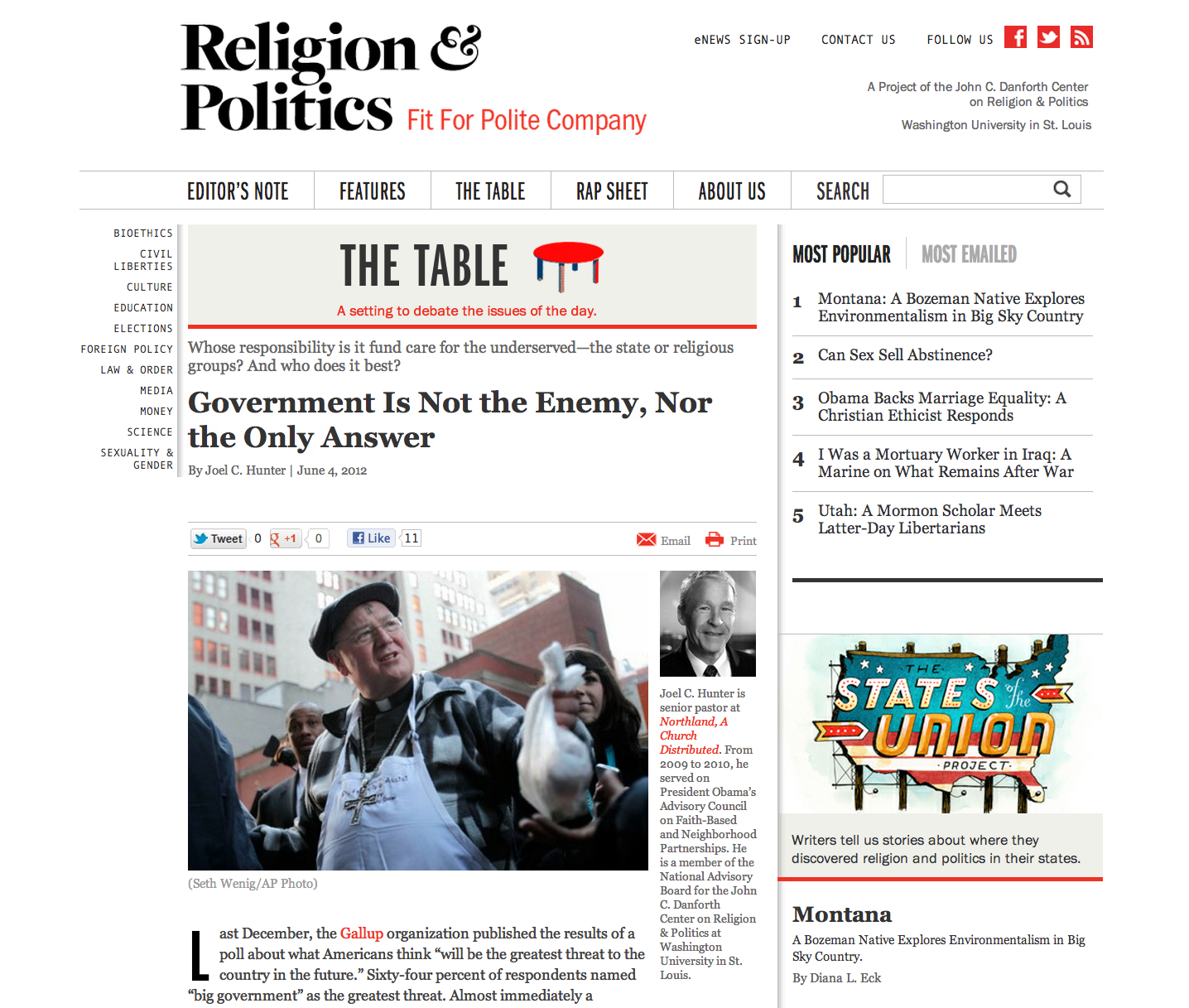
Government Is Not the Enemy, Nor the Only Answer

Screen Shot 2012-06-04 at 11.05.51 AM Last December, the Gallup organization published the results of a poll about what Americans think “will be the greatest threat to the country in the future.” Sixty-four percent of respondents named “big government” as the greatest threat. Almost immediately a conservative blogger declared, “It is official. Government is the enemy.” Commentary’s Peter Wehner read the numbers as “good news for conservatives.” “They re-confirm,” Wehner wrote, “that this remains a center-right nation, one instinctively committed to limited government and the free market.”

Vigilance about government overreach is always wise; it also has its dangers. The problem with jumping from a normal concern about government intrusion to a far-flung conclusion that all governmental growth is bad is that it falls short of logic, practical solutions, and, for Christians, the foundational place of government in God’s design.

A biblical overview stands in contrast to the simplistic but popular objectification of “the government.” Objectifying the government as beneath us is as intellectually lazy and dismissive as objectifying women or races. The government is people. And most of the people I have met who serve in governmental capacities are working hard to fulfill their responsibilities of office. We can argue whether their office is truly needed, but we cannot simply lump them all together as “the enemy.”

The beginning verses of Romans 13 summarize God’s design to use and shape governments. He always had believers involved with government as agitators or advisors. Some of the prophets in both the New Testament (John the Baptist and Paul) and the Old Testament (Jeremiah, Hosea, Amos) offered corrective rebukes to those in power. Others (Joseph, Nehemiah, Esther, Daniel) offered guidance inside the halls of power to both non-Hebrew-God believing leaders and to Hebrew-God believing leaders.

God has instituted government for our well-being. If government policy or leaders are bad, we are to oppose what we deem to be hurtful rather than helpful. But Romans 13:1-7 reveals that government is of God, government is a minister of God, and rulers are servants of God. Spiritually, government is not the enemy.

Logic also declares, “Government is not the enemy.” Jesus taught us that loving our neighbor involves practical help for those in need (Luke 10:30-37). The problems are too big for one faith community or even all faith communities combined to solve—extreme poverty, the ravages of climate change, the horrors of human trafficking, the financial bankruptcy of long-term medical conditions, et al. Logic would tell us that we must enlist various kinds of partners to help with a more comprehensive effort to effectively love our neighbor. Government funding is a necessary and welcome support for those who have no other effective safety net.

It is naive to believe that if the church was doing its job, the government would not have to be in the business of taking care of the needy. Would the church, or all religious institutions together, ever replace government aid? Practically speaking, and even faithfully believing, I say the answer is no.

A small church pastor, Chuck Warnock, summed it up quite nicely. He pointed out that according to figures from the Cato Institute and the Center on Policy and Budget Priorities, the average church would have to double its budget and funnel all its extra giving just to replace the government’s Supplemental Nutritional Assistance Program—aka SNAP (formerly called food stamps). What makes this idea surreal is that almost every church is struggling to meet its week-to-week expenses. And these figures do not even address the additional provisions of government assistance: transportation, job training/education health care, et al.

Our church in Longwood, Florida has experienced firsthand the value of partnering with government agencies. For example, last March, when 60 Minutes did a segment on the challenge of homeless school children in our own county, the show highlighted how the school board and local faith communities banded together to set up a food bank at every school in the county. School-church partnerships mean needy kids don’t go hungry on weekends or during breaks when they are away from reliable food sources at their schools. Additionally, in order to break the cycle of homelessness, churches can do what the school and government cannot. In our church we provide a caseworker, often trained with government funds, for each family that wants personal support to work towards financial independence.

In the traditional Christian understanding of government, government is not the enemy; neither is government the answer. Government is a possible partner in completing faith communities’ mission of loving and serving our neighbors in practical ways. In God’s economy, government agencies and faith communities cooperate to maximize what each can provide for the community. God uses governments to provide material support for the well-being of those in need. He uses faith communities to promote the well-doing of those struggling due to circumstances or choices. He intends the right mix of faith communities and government to create a healthier, more loving society.

View Post

  •   Public Square   •  

Pastor Hunter to Hometown Church: "You’re the Reason I’m In Ministry"

Screen Shot 2012-05-29 at 3.15.23 PM SHELBY -- He is one of the top pastors in the world, and in 2011 was named one of the "50 Most Powerful People in Orlando."

Since graduating from Shelby High School in 1966, the Rev. Joel Hunter also has become one of President Barack Obama's spiritual advisers, but he said little of it would have been possible without the foundation he received from his hometown.

Hunter is senior pastor at Northland Church, in Longwood, Fla., a church where he grew membership from 200 to more than 15,000.

Hunter, who was invited to preach Sunday morning at his home church, The Shelby First United Methodist Church, took the podium around 10 a.m. He started by asking the congregation to excuse him if he happened to cry during the sermon.

Few held back their own tears as he reminisced about his days growing up in Shelby, and shared what the 18 S. Gamble St. church means to him.

"It is so, so good to be back in this church," he said. "Thank you for welcoming me back. This is a big deal to me. A very big deal. I hope you'll all indulge me in a few moments of nostalgia."

"This church is a very big part of who I am. I often talk about the Shelby church in my sermons. I say I went to the First Church in Shelby, Ohio, where all the men wore pin stripes on their suits and all the women wore fruit in their hats."

The whole sanctuary erupted in laughter when Hunter singled out Dwight Somerville, a choir member who has been a church member since 1950.

"I knew Jesus would be here, but I wasn't sure about Mr. Somerville," Hunter said. "This is amazing!"

Hunter said his original goal was never to go into ministry, but that the civil rights movement changed his path in life.

"There was a little custodial couple (who used to attend the church) and they didn't have two nickels to rub together," he said. "There were times in seminary when I just wanted to quit because I didn't think I was good enough to do this -- but that was before I learned it wasn't about our goodness but about God's goodness.

"And from time to time I would get a letter in the mail from that couple with a check for $5. Now I know what you're thinking, back in those days $5 was a lot of money, but it really wasn't -- but it was more than they had. And there would be a little note inside saying, 'Joey, we think you'll be a good minister someday.'"

Hunter paused as his eyes welled up.

"And it was just enough to keep me going," he said, his voice cracking. "That's what this place means to me. You're the reason I'm in ministry. I feel the same way about the whole town."

Hunter's sermon dealt with relationships and the importance of human differences.

"Everyone has a different reason for coming to church," he said. "Some come because of relationships or they're looking for relationships, but they all see that God has something for them.

"If you have someone who thinks just like you, one of you is not necessary. Differences are so important. God knew that in order to be a healthy church, we had to be a combination of differences. So as God grew the church he grew us to work together, and he grew us to be a team."

Jeanette Allard, of Shelby, raved about Hunter's speech as the congregation filed out.

"It was absolutely wonderful," she said. "He's such a good speaker. It was very inspiring. It brought tears to my eyes."

Hunter told the congregation no matter where he's preaching and living, the Shelby church will always be with him.

"Every time I walk into the Oval Office and I speak with the president, you're there. Every time I meet with church leaders from other countries, in meetings so secret no one can ever find out, you're with me. I loved listening to the choir this morning. I haven't heard a church choir in I don't know how long, but I miss it. And I loved listening to all the family concerns you shared. With a church of 15,000, if we did that, we'd be here till next week -- but yet we're in the same church. You have strengths and weaknesses my church doesn't have, but we are all the church together."

FIND THIS ARTICLE AT: http://www.mansfieldnewsjournal.com/article/20120528/NEWS01/205280306/Fond-memories-Shelby?odyssey=mod%7Cnewswell%7Ctext%7C%7Cs

View Post

  •   Public Square   •  

Obama's Spiritual Adviser Speaks in Shelby, Ohio

SHELBY -- Last week he was sitting comfortably in the Oval Office, but the Rev. Joel Hunter said returning to Shelby this weekend will be an exciting honor, too. Shelby, his hometown, will keep him busy.

Friday night, the spiritual adviser to President Barack Obama spoke at Shelby High School's graduation. Hunter is a 1966 Shelby graduate. At 9:15 a.m. Sunday, he will preach at the First United Methodist Church, where he grew up.

"I went there every Sunday with my grandmother," Hunter said. "I've been in ministry over 40 years, but always think of myself as a kid from Shelby who has a really good foundation."

When he attended Ohio University in the 1960s, Hunter said he never imagined he'd end up in ministry.

"But I was part of the civil rights movement and when Martin Luther King Jr. was assassinated, I felt crisis," Hunter said.

He recalled the words of a former pastor of his Shelby church: "Nothing will be right in the world until you take care of the sin in your own heart."

Hunter began attending the chapel at OU and said he felt a calling from God. He eventually changed his college path, went into ministry and became one of the most prestigious pastors in the country. Hunter is senior pastor at Northland Church, in Longwood, Fla., a church where he grew membership from 200 to more than 15,000.

"I don't really know what to attribute it to," he said. "Every day you go in and try to do the right thing, and God arranges the rest."

Hunter has gained national attention through his relationship with the president.

"About four years ago, I was featured in an article in the New York Times," he said. "Following that article, then-Senator Obama called me and said, 'I want to catch up with you.' He wanted to know what I thought was the right relationship between faith communities and government."

The pair met again at a spiritual event. Afterward, Hunter said, an Obama staff member asked if he would pray for the future president.

"I walked out to a hallway and figured there would be 50 pastors there, but it was just he and I," Hunter said. "Since then, he's asked me to pray for him at major events in his life. The night he was elected president, I was on the phone praying for him."

Since his election, Hunter said, Obama has asked him to write devotions for him every week.

"Our relationship isn't political, it's pastoral. I've simply become a pastoral voice in his life," Hunter said. "I'm very aware of his position and where God has put him in life, but a pastor's life is very simple. Our job is to help anyone who needs to get closer to the Lord. That's my job, no matter who you are.

"Here's the most powerful person in America, but the pastor part of me says, 'Here's just another person who wants to get help.'"

Hunter's Sunday speech is open to the public.

The Rev. Tom Snyder said many local people have fond memories of Hunter.

"This is a great way for the older folks to reconnect and for others to hear from a wonderful man of God," he said.

Hunter will attend the service at 22 S. Gamble St. with his wife, Becky.

"I'm going to talk about lifelong lessons learned from Shelby, Ohio," he said. "I'd like to give people a broader perspective of how God uses us in broader ways than we can think."

FIND THIS ARTICLE AT: http://www.mansfieldnewsjournal.com/article/20120526/NEWS01/205260313/Obama-s-spiritual-adviser-speak-Shelby?odyssey=mod%7Cnewswell%7Ctext%7C%7Cs

View Post