•   Public Square   •  

President Obama’s Other Pastor
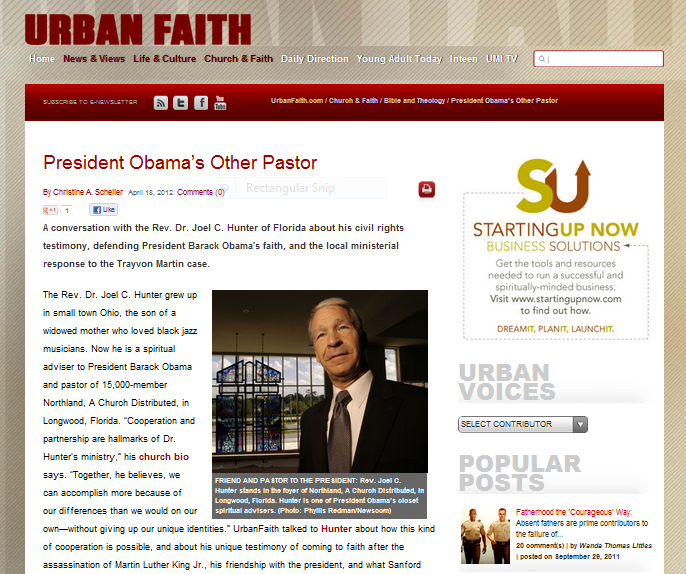
Joel Urban Faith A conversation with the Rev. Dr. Joel C. Hunter of Florida about his civil rights testimony, defending President Barack Obama's faith, and the local ministerial response to the Trayvon Martin case.

FIND THIS ARTICLE AT: http://www.urbanfaith.com/2012/04/the-pastor-the-president-and-civil-rights.html/

The Rev. Dr. Joel C. Hunter grew up in small town Ohio, the son of a widowed mother who loved black jazz musicians. Now he is a spiritual adviser to President Barack Obama and pastor of 15,000-member Northland, A Church Distributed, in Longwood, Florida. “Cooperation and partnership are hallmarks of Dr. Hunter’s ministry,” his church bio says. “Together, he believes, we can accomplish more because of our differences than we would on our own—without giving up our unique identities.” UrbanFaith talked to Hunter about how this kind of cooperation is possible, and about his unique testimony of coming to faith after the assassination of Martin Luther King Jr., his friendship with the president, and what Sanford area ministers are doing in response to the shooting death of Trayvon Martin. The interview has been edited for length and clarity.

UrbanFaith: You have a unique testimony in that you were involved in the Civil Rights Movement and came to the Lord after the assassination of Martin Luther King, Jr. You also recently wrote an op-ed for Charisma about the Trayvon Martin case. Has racial reconciliation always been a thread in your ministry?

Joel C. Hunter: Yes, it has been. The little town I came from in Ohio didn’t have one ethnicity other than white. I think it was one of those Midwestern towns that had a law about the exclusivity of races. But my mother, who reminds me in some ways of President Obama’s mother, was one of those free spirits who loved everybody and thrived on Jazz: Nat King Cole and all of those great—back in that day they were called “Negro geniuses” with music. And so, when I went to Ohio University, it was a natural thing for me to go to the other end of the spectrum and get involved almost immediately with the Civil Rights Movement. It wasn’t from a faith perspective that that first happened, but when Martin Luther King, Jr. was assassinated, I went to Galbraith Chapel, a little generic chapel at Ohio University, and came to Christ. Caring for those who are left out was at the core of my calling to ministry and that’s always been.

Now that there has been an arrest in the Trayvon Martin case, have things settled down in the Sanford area?

We are in the same county and I’m actively meeting with ministers from Sanford, being led by the African American ministers. We have another meeting scheduled for tomorrow night about how we can take our community toward, not just reconciliation and healing, but toward improvement because of what has happened here. We’ve had ongoing meetings together: prayer meetings and brainstorming meetings. We may have a community memorial service with the Martin family. I’m not sure. The publicity has somewhat died down now, but the ministers and spiritual leaders are much more conversant, active, and cooperative than we’ve ever been. So, I’m thinking God is really going to do something wonderful from this.

As a pastor who comes from a relatively humble upbringing, how do you keep being a spiritual adviser to the president of the United States in perspective?

I don’t know how this happens, but it’s really true: people are people to me. The president is a person. He’s great about this; he has a great sense of humor and he’s very personable, so it’s not like this is a lot of work. I realize that to the world, it’s a long way for a kid from Shelby, Ohio (where the largest buildings literally are the grain elevators for the farmers), but to me he’s a person and the job of a pastor is to help the person in front of him or her to get closer to God. And so, that’s exactly what I do.

I remember a time when I had had a conversation and a prayer with the president and within 24 hours I was back at my church talking to a AIDS-infected prostitute who wanted to get closer to the Lord. It struck me that my conversation with her resembled very closely the conversation I had had with the president less than 24 hours previous. To me, that was the ultimate. That’s what a pastor does. Each person has the same value in God’s eyes. I didn’t count one of those conversations more valuable than the other.

When your five-year-old granddaughter Ava passed away from glioblastoma in 2010, the president called you and prayed with you. How do you respond to criticism of his faith when you’ve been so personally engaged with him on a spiritual level?

The president called me when Ava was first diagnosed and then, of course, he called me when she passed away, so it was very tender and kind thing for him to do. I understand that people are ignorant, that is they lack knowledge about his faith walk. I realize there is some political agenda when people accuse him of not being a Christian. I’m not naïve about that, but the president and the candidate Barack Obama chose—even more after he was president—not to make his faith walk very public because he knew it would be politicized and that’s an area of his life he didn’t want politicized.

I always say that nature hates a vacuum and when you don’t have a lot of information, you will fill it in with your latest email. That’s exactly what happens. I know from personal experience and from many personal conversations that they’re wrong. I know his daily practice of reading Scripture. I write many of those devotions. Our prayer times in the Oval Office, over the phone, and on special occasions have been just as sweet and participatory as you can imagine. Of course, there’s always the defensiveness for a friend. I consider the president a friend and any time a friend is wrongly accused, you want to defend them. But, by the same token, I can’t really go much further, because this is the president and I don’t want to give a lot of information that is not directly related to his role and official duties. So, I have to be very careful about not saying too much.

You were on a press call defending President Obama’s faith around the time the Rev. Franklin Graham publicly questioned it. How do you address other Christian leaders who cast doubt on the president’s faith?

I can and do openly tell them about my personal relationship with the president and my personal knowledge of his spiritual life. Sometimes I say I wish most of the people in my congregation were as attentive to reading the Bible every day, praying every day, and trying to put their faith into practice as the president is. Some of them are really taken aback, because they just don’t have the knowledge. It’s not covered in the media by design. That’s fine. I’m very open about my personal knowledge of his walk.

I heard the president debate Sen. John McCain at Saddleback Church in 2008. He seemed more articulate and comfortable talking about faith than McCain then and continues to sound more comfortable and articulate talking about faith than some other candidates now. Do you attribute doubts about his faith to politics or to his policy positions on issues like abortion?

It’s kind of all of the above. I think a lot of it is politically driven. I also think there’s some racism attached in this. I don’t play the race card, but I do think that because his father was from a different country (not faith, because his father wasn’t a man of faith) and with the hyper-sensitivity about Islam, there’s been an effort to paint this man as being very different because he does come from a unique background.

In that particular debate with McCain, he said something that didn’t quite come out right; he was a little too flip about it. When questioned about when life begins, he said, “That’s above my pay grade,” or something like that. Because he is such a respectful thinker in terms of religious questions, he won’t give the reflexive responses. When he didn’t say the axiom that “Life begins at conception,” he was hearkening back to something that is not particularly addressed in Scripture. If we don’t come from a particular faith tradition that says this is the dogma of my church and you simply look to Scripture, “Does life begin at conception?” is an open question. And so, part of this is because he is very careful not to give just the patently religious responses, or the religious platitudes. When people don’t get those, then they begin to say, “Maybe he’s not a Christian like others that have given us boiler-plate Christianity.” I would say to that: he doesn’t pretend to be a theologian, but he really does want to search the Scriptures authentically and personally, and it’s because he takes it so seriously and so personally that he won’t automatically give the response that everybody is looking for.

Is there a level of theological illiteracy on the part of the general public that contributes to this kind of misunderstanding?

Absolutely. In cultural Christianity in general there is, but specifically, the more fundamentalist versions of Christianity have shibboleths: “You have to say the right thing with the right accent or you’re not really one of us.” Part of the problem is not his level of sophistication, but ours, not his level of thinking, but our lack of more broad-based responsiveness to the depths of the theology of Scripture. When you don’t come with automatic or dogmatic sound-bite answers, that’s a good thing. That’s a sign of personal engagement. But because we would rather just have a category of correct belief and many people are satisfied with that, then we are the ones making ourselves upset. It’s not because he’s not answered adequately; it’s partially our discomfort at not having simple answers. That’s part of the unease with his particular faith walk.

The president comes down on the side of keeping abortion legal and you are pro-life. How do you, or anyone else, preserve relationships with other believers when there are such deep disagreements over these kinds of issue?

Abortion is probably the premiere issue where we see this. I am pro-life; therefore I think that’s a baby. I don’t happen to subscribe to “It’s a baby at conception,” because I don’t see that in Scripture, but I do believe that soon after that baby is implanted in a womb, it becomes a person. So I think abortion is homicide. Having said that, the way that I want to work with other Christians who don’t have the same theological presumption that I do about the personhood of a developing fetus is to keep my eyes on the goal. My goal is to have no abortions some day, ultimately because no woman decides to do that.

Other people say, “How can we reduce, by practical common sense, the number of abortions?” I’m on board. Every baby that can be saved, I think, is invaluable. And so, if I talk to somebody who is pro-choice and they say, “A lot of abortions come from feeling financial pressure or because people are afraid they won’t be able to complete their education, and if we could relieve that kind of pressure, they would carry their baby to term,” I’m all over that. I don’t have to have an all or nothing. That’s why the president and I, even though we would disagree probably on who should be able to get an abortion, we still can agree on the reduction of abortion as a very important goal together. That’s kind of how I walk that through.
View Post

  •   Poverty   •  

A Tax Day Bible Lesson

Screen Shot 2012-04-16 at 10.51.16 AM

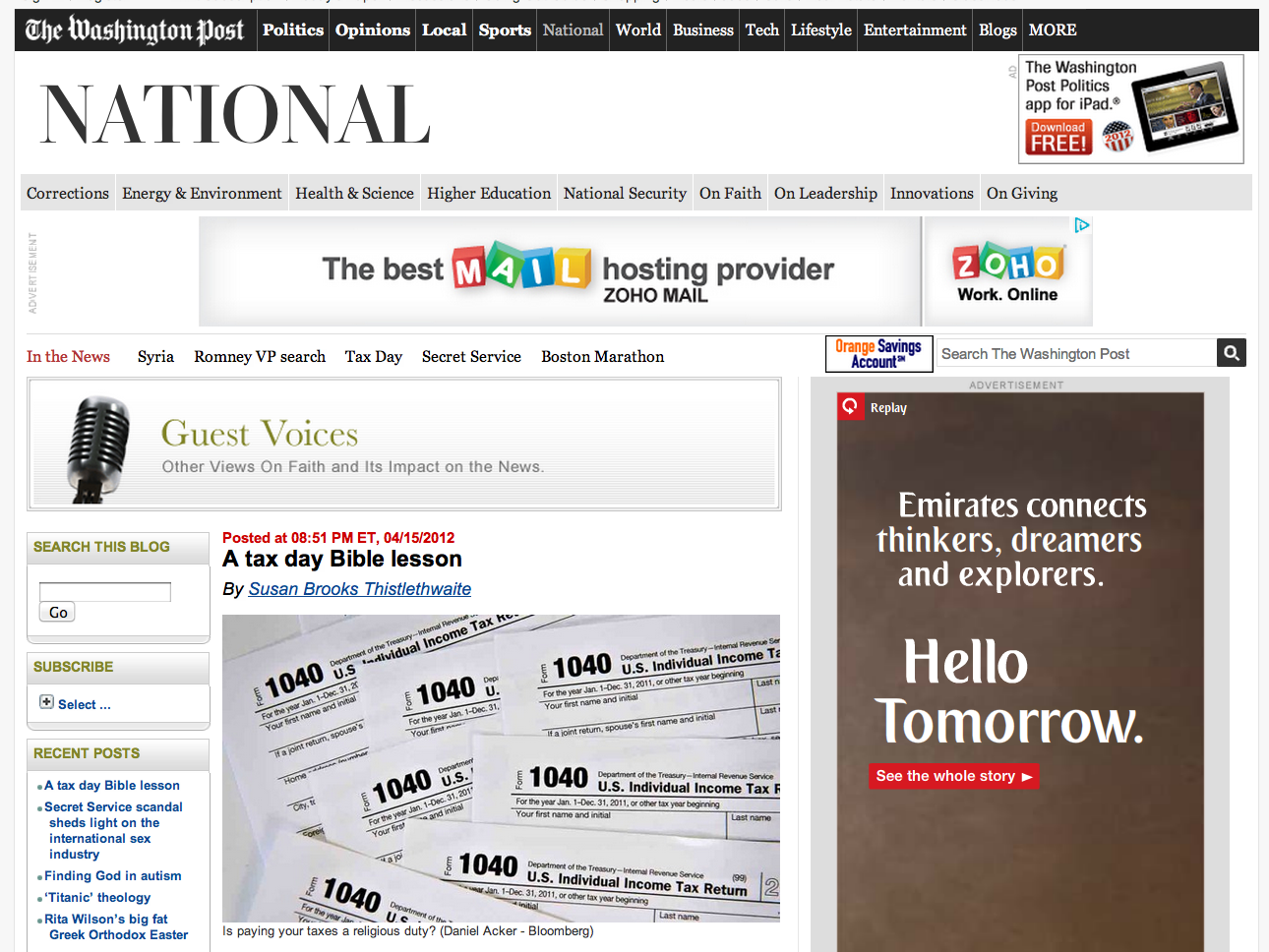
Jesus’ famous line on paying taxes is “Render to Caesar the things that are Caesar’s, and to God the things that are God’s.” (Mark 12:17)What is less well remembered is the reason Jesus called out both the political and the religious leaders who asked him about whether you should pay your taxes: Jesus “knew their hypocrisy.” (Mark 12:15)

FIND THIS ARTICLE AT: http://www.washingtonpost.com/blogs/guest-voices/post/a-tax-day-bible-lesson/2012/04/15/gIQAv3YCKT_blog.html

There’s nothing more hypocritical today than the kind of political gamesmanship we have about paying taxes. The most vivid example of this is, as Erza Klein so rightly says, the “dumb tax pledges that dominate Washington.” These dumb tax pledges, especially “Grover Norquist’s now-infamous pledge” that Republicans have taken never to raise taxes on anyone for any reason, effectively ended our capacity to have government function properly. Of course, now, as Klein points out, Democrats are being forced into tax pledges of their own, exempting those who earn less than $250,000 per year from having their taxes raised. Dumb and hypocritical.

Taxes happen, friends. Nobody likes them, and yet it is certain they have to be paid. Daniel Defoe, in “The Political History of the Devil,” (1726) coined the famous phrase, “Things as certain as death and taxes, can be more firmly believed.” Death and taxes. They’re inevitable.

Taxes happen because taxes are how you fund government and you can’t have a government unless you have revenue.

Of course, the attack on taxes from the political right is an attack on government and its right to even exist. Norquist has said, “I don’t want to abolish government. I simply want to reduce it to the size where I can drag it into the bathroom and drown it in the bathtub,” thus, of course, abolishing it.

Government needs to exist and in fact be celebrated. It’s U.S., all of us, and the way we take care of each other. We have a moral responsibility to our fellow citizens, both from a civil and a moral perspective. We are one people. The problem is that some of us, in fact, many of us in this difficult economy are struggling, and we need to help those folks out. Government does that.

The “small government” or even “no government” folks want to say that the churches should pick up the slack on taking care of the poor instead of us paying taxes for a social safety net. Rev. Joel Hunter, a prominent evangelical pastor, has recently noted how unrealistic that view really is in a recent talk with the title, “Government is Not the Enemy.”

Hunter’s church does a huge amount of humanitarian work, but, he says, they can’t do it all without the government:

“Look at the math. It is ridiculous to even, just look at the SNAP – Supplemental Nutrition Assistance Program, the old Food Stamps program – it has been estimated by I think the Center on Budget and Policy Priorities that the average church in America would literally have to double its budget and just take that extra budget and give to hungry people. And that is just one government program. So let’s not fool ourselves.”

What is hypocrisy but ‘fooling yourself’? That’s what Jesus is talking about. Don’t be a hypocrite. We need taxes to run the government, and we need government because it does things no individual or even organization can do on its own.

Don’t be a hypocrite. Pay your taxes.

Even the Romans used the taxes they collected to build infrastructure, per Monty Python, the British comedians. Besides, everybody deserves a good laugh on tax day.

An On Faith panelist and former president of Chicago Theological Seminary (1998-2008), Thistlethwaite is a senior fellow at the Center for American Progress.

By

View Post

  •   Poverty   •  

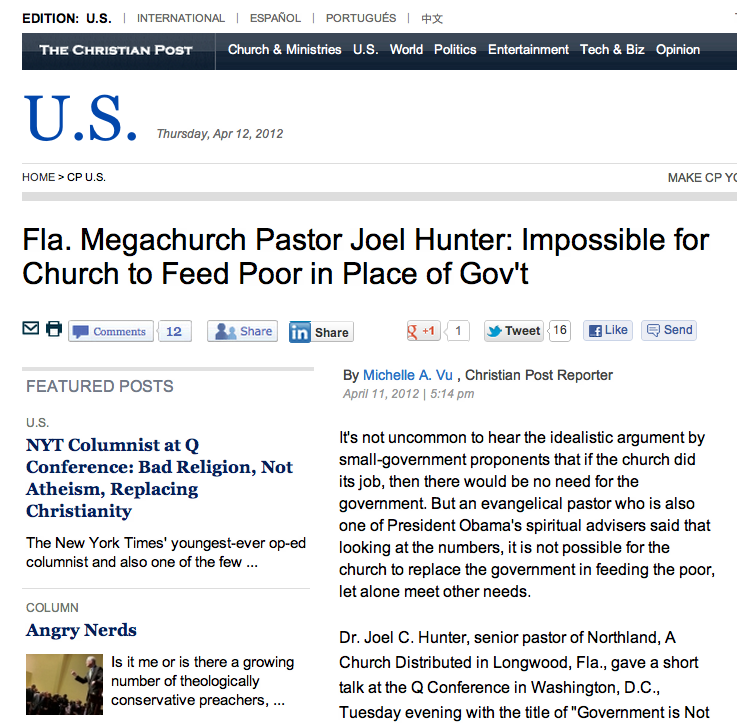
Pastor Joel Hunter: "Government Can't Change Lives, But They Have Resources We Need"

Screen Shot 2012-04-12 at 9.34.19 AM

It's not uncommon to hear the idealistic argument by small-government proponents that if the church did its job, then there would be no need for the government. But an evangelical pastor who is also one of President Obama's spiritual advisers said that looking at the numbers, it is not possible for the church to replace the government in feeding the poor, let alone meet other needs.

Dr. Joel C. Hunter, senior pastor of Northland, A Church Distributed in Longwood, Fla., gave a short talk at the Q Conference in Washington, D.C., Tuesday evening with the title of "Government is Not the Enemy." Hunter, who was named one of the 50 most powerful people in Orlando by Orlando Magazine in 2011, leads the 15,000-member Northland church, which is well-known for its humanitarian work in the community.

Northland has sent relief teams to neighboring states when they were devastated by natural disasters, been involved in the Homeless Services Network in Central Florida, worked with local schools to feed children from low-income families, and has organized community green cleaning events, among other activities.

Despite all of his church's humanitarian efforts, Hunter believes that the government is needed when it comes to helping the poor.

"Look at the math. It is ridiculous to even, just look at the SNAP – Supplemental Nutrition Assistance Program, the old Food Stamps program – it has been estimated by I think the Center on Budget and Policy Priorities that the average church in America would literally have to double its budget and just take that extra budget and give to hungry people. And that is just one government program. So let's not fool ourselves."

Hunter recalled a conversation with then-presidential candidate Barack Obama during which he said that the faith community is tremendously underutilized. Obama had agreed, but also added that the church cannot do for the common good what the government can. The Florida pastor had also agreed.

"Government can't change lives, but they have resources we don't have. We can change lives with those resources," said Hunter, who served on the first Obama administration Advisory Council on Faith-Based and Neighborhood Partnerships.

"The point is government isn't the enemy, and government isn't the answer. But government is the potential partner that we look for, that we might need."

Earlier in his talk, Hunter discussed what the biblical view of government is. He said the biblical view of government is it is an instrument of God. Pointing to the Bible, the Florida pastor said there are two types of relationships that God's people had with the government: the outsider – a prophet that would rebuke those in authority, such as Jeremiah, Amos, or John the Baptist; and the inside adviser – a person who would speak and guide the unbelieving government, such as Joseph, Nehemiah, Esther, Daniel, and even Paul who used the judicial system of his time to give a witness of what Christ had done for him.

"God has always seen to it that believers had some role in the institution of government," Hunter said.

The Q Conference in Washington, D.C., opened Tuesday and will conclude on Thursday. Some 700 Christian participants are gathering in downtown D.C. at the Andrew W. Mellon Auditorium to hear 30 presentations by church and cultural leaders on a wide range of issues that are aimed at inspiring them to come up with innovative ways to shape the church's future role in culture.

Speakers at the Q DC event include: New York Times columnists David Brooks and Ross Douthat; author and cultural historian Os Guinness; Elevation Burger Franchise Ventures founder Hans Hess; and D.C. pastor and author Mark Batterson.

Michelle A. Vu

View Post

  •   Culture Wars   •  

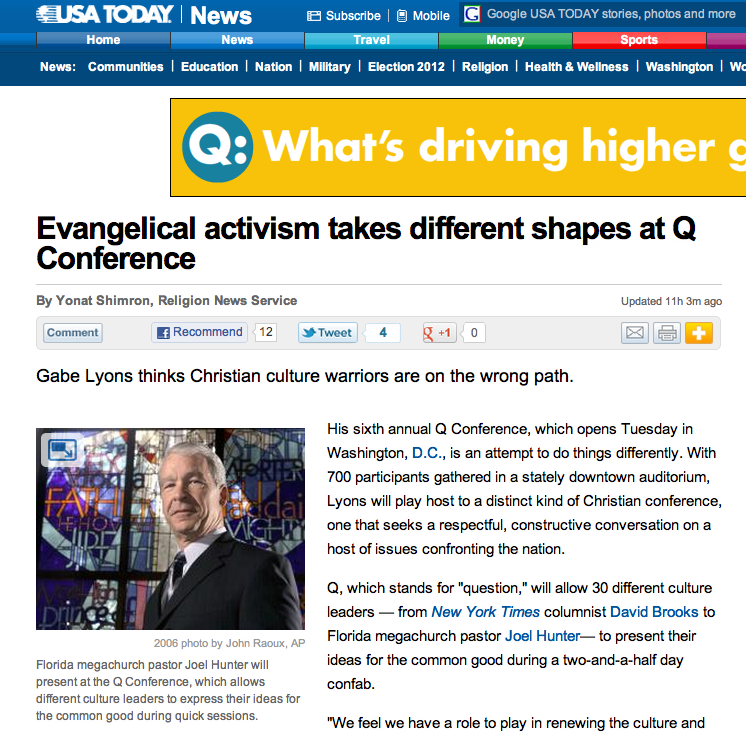
Evangelical activism takes different shapes at Q Conference

Screen Shot 2012-04-10 at 5.38.02 AM Gabe Lyons thinks Christian culture warriors are on the wrong path.

His sixth annual Q Conference, which opens Tuesday in Washington, D.C., is an attempt to do things differently. With 700 participants gathered in a stately downtown auditorium, Lyons will play host to a distinct kind of Christian conference, one that seeks a respectful, constructive conversation on a host of issues confronting the nation.

Q, which stands for "question," will allow 30 different culture leaders — from New York Times columnist David Brooks to Florida megachurch pastor Joel Hunter— to present their ideas for the common good during a two-and-a-half day confab.

"We feel we have a role to play in renewing the culture and holding back the effects of sin," said Lyons, founder of Q, a nonprofit organization based in New York City. "We're not to do it in an antagonistic way. We hope to do it in a hopeful way that gives witness to the rest of the world in how things ought to be."

Part Clinton Global Initiative, part TED Talk, the conference is designed to highlight the best ideas rather than condemning the nation's ills. Presenters are allocated three, nine, or 18 minutes to talk. Participants sit at round tables instead of rows, and time is built in for participants to reflect and talk about what they've heard.

That kind of format allows Q to include both Richard Land from the religious right and Jim Wallis from the religious left; both will share the stage Tuesday to discuss areas of potential agreement.

Lyons, a Liberty University graduate, said he realized nine years ago how little most Americans respected Christianity. That realization prompted him to acknowledge that the nation's religious pluralism was here to stay, and that if Christians wanted their views to be given a thoughtful hearing, they had better quit resisting and start creating a culture that allows God's love to break though.

His 2010 book, The Next Christians: The Good News About the End of Christian America, was a kind of manifesto calling Christians to quit cursing the darkness and start lighting a candle.

Land, who heads the Southern Baptist Convention's Ethics and Religious Liberty Commission, said he appreciates Lyons' point, but thought it was overly simplistic. "Jesus called us to do both; He called us to be salt and light," Land said. "We can walk and chew gum at the same time."

Land said his own denomination, which is often cast as a judgmental culture agitator, is also among the nation's largest providers of emergency disaster relief. In addition, its members give a higher proportion of their incomes to charity.

But Q participants are not about to compromise their evangelical convictions. On Thursday, participants will fan out across Washington to press Congress, the White House and the State Department on issues they deem important.

The difference, Lyons said, is the tone.

"It's more civil, less fear-based," he said. "There's more appreciation for the intellect and a commitment to let the best ideas win out."

The Q Conference will provide a free video stream of its opening day sessions from 9 a.m. to 10:30 a.m. and from 7 p.m. to 8:45 p.m. at www.qideas.org/live/

FIND THIS ARTICLE AT: http://www.usatoday.com/news/religion/story/2012-04-09/q-conference-christian-evangelical/54135672/1

View Post

  •   Peace   •  

Christ at the Checkpoint

Pastor Hunter speaks to a gathering of more than 600 local and international Christians in Bethlehem. Organized by Bethlehem Bible College, the conference addressed the issue of how to find hope in the midst of conflict. Conference organizers challenged the evangelical community to join in following Jesus in the prophetic pursuance of justice, peace and reconciliation.

View Post

  •   Poverty   •  

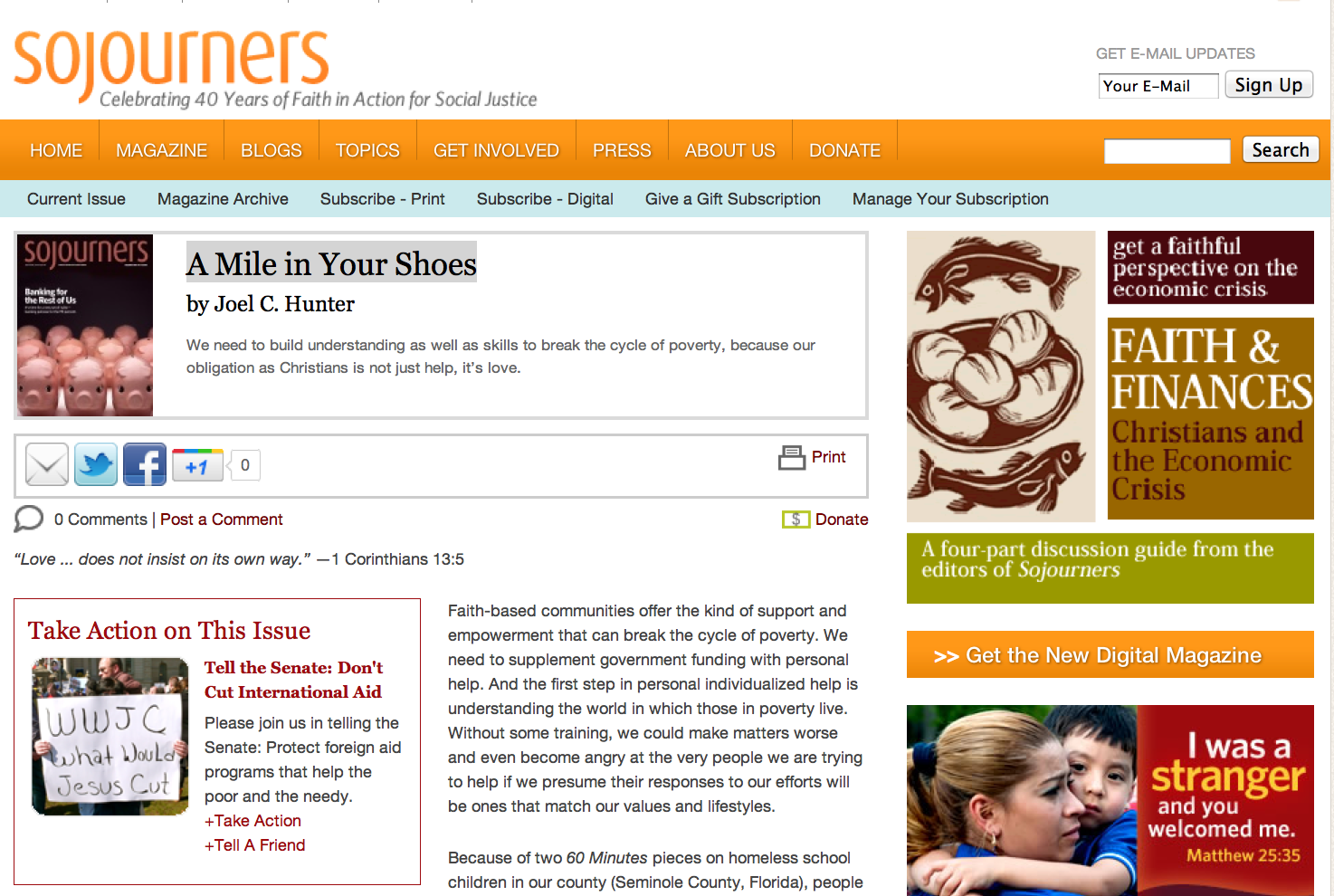
"Supplement Government Funding With Personal Help," by Dr. Joel C. Hunter

Screen Shot 2012-03-13 at 1.25.18 PM “Love ... does not insist on its own way.” —1 Corinthians 13:5

Faith-based communities offer the kind of support and empowerment that can break the cycle of poverty. We need to supplement government funding with personal help. And the first step in personal individualized help is understanding the world in which those in poverty live. Without some training, we could make matters worse and even become angry at the very people we are trying to help if we presume their responses to our efforts will be ones that match our values and lifestyles.

Because of two 60 Minutes pieces on homeless school children in our county (Seminole County, Florida), people in our congregation and other county groups got fired up to help those families transition out of poverty. It seemed wise to our church leaders that we train our congregation members in understanding poverty and some of the thinking of those who are poor. We adopted a course from the Billy Graham Institute for Prison Ministries on transitioning out of generational poverty.

Part of the course alerts those of us who have never been poor to our lack of knowledge on what it takes to survive without adequate income. Would you know where to get help if you had little or no money? What places offer food and how do you get there without a car? Which agencies offer which kind of services—housing, medical attention, job training, child care—in addition to any financial help you can get? Additionally—and this is key in being able to love well—how do those in poverty think differently than those in the middle or upper class?

This training is enlightening for many of its middle-class participants, who often are able to come to the point where we can see ourselves as likely to have the same response in various situations as do people living in poverty. Let me give a few examples. When you are in poverty, you ask a different question about meals than when you are in the middle class. In the middle class, people might ask, “Did you like it?” In poverty, the question might be, “Did you get enough?”

Those in poverty see resources differently. In the middle class we are more likely to turn to possessions in times of need. “Do you have savings? An emergency fund? An IRA?” For those in poverty, relationships are often the most valuable source of aid—“Who do you know that can help?”

When you are in the middle class, bills come first and vacations are optional. When you are in poverty, living with the constant pressure of survival, fun is so much more important—there may be nothing more coveted. The story is told of an elementary school girl who let it slip to her teacher that her family did not have a refrigerator. The good-hearted teachers pitched in from their already-meager salaries and surprised the family with a refrigerator. The next few days the girl was missing from school. When she returned, she again thanked the teacher and told her that they had sold the refrigerator and gone camping. They needed the break more than they needed the appliance! The way they chose to use this gift illustrates a difference in thinking that would make many who have plenty to share angry enough to stop engaging, if we are limited to our own perspective.

Both those in poverty and those who are not need training. We need to build understanding as well as skills to break the cycle of poverty, because our obligation as Christians is not just help, it’s love.

Dr. Joel C. Hunter is senior pastor of Northland Church in Orlando, Florida.

FIND THIS ARTICLE AT: http://sojo.net/magazine/2012/04/mile-your-shoes

View Post