•   Peace   •  

Evangelicals Support U.S., Russia Nuclear Arms Treaty

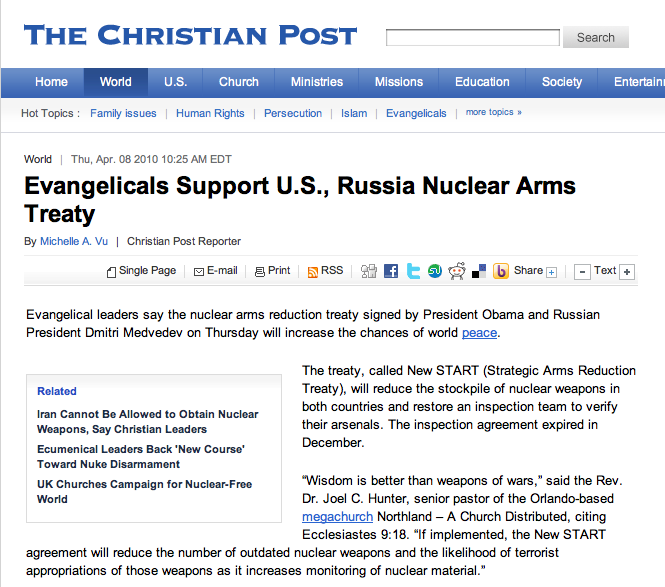
Screen shot 2010-04-13 at 9.10.01 AM Evangelical leaders say the nuclear arms reduction treaty signed by President Obama and Russian President Dmitri Medvedev on Thursday will increase the chances of world peace.

Evangelical leaders say the nuclear arms reduction treaty signed by President Obama and Russian President Dmitri Medvedev on Thursday will increase the chances of world peace.

The treaty, called New START (Strategic Arms Reduction Treaty), will reduce the stockpile of nuclear weapons in both countries and restore an inspection team to verify their arsenals. The inspection agreement expired in December.

"Wisdom is better than weapons of wars," said the Rev. Dr. Joel C. Hunter, senior pastor of the Orlando-based megachurch Northland - A Church Distributed, citing Ecclesiastes 9:18. "If implemented, the New START agreement will reduce the number of outdated nuclear weapons and the likelihood of terrorist appropriations of those weapons as it increases monitoring of nuclear material."

"It therefore will increase the chances of world peace from both state and non-state actors."

The new treaty, if ratified by lawmakers in both countries, would require each country to have a maximum of 1,550 strategic warheads, down from 2,200. It would also limit both countries to 800 total launchers, down from 1,600.

New START is seen as a sign of President Obama's commitment to make good on his promise of a nuclear weapon-free world.

Almost exactly a year ago, Obama had given a speech in Prague where he articulated his commitment to seek a world without nuclear weapons. On Thursday, Obama and Medvedev signed the historic arms reduction pact also in Prague.

"I can hardly imagine a more important foreign policy goal for Christian citizens of the United States than pursuing a realistic, comprehensive strategy to reduce the number of strategic nuclear weapons - weapons which cannot be used in any conceivable scenario in accordance with the principles of just war," said Andy Crouch, senior editor at Christianity Today International.

Crouch called the New START treaty a significant step towards "greater security, stability, transparency, and predictability, and toward the ultimate goal of shaping of a world where the use of nuclear weapons, by anyone, is truly impossible."

The United States and Russia has 95 percent of the global stockpile of nuclear weapons. The huge buildup of nuclear weapons in both countries is a result of the Cold War. Other countries with nuclear weapons include the United Kingdom, France, China, India, and Pakistan.

Israel is thought to have nuclear weapons but has never publicly declared it does, and Iran and North Korea are also suspected of possessing or building nuclear weapons.

The New START treaty, the first was in 1991, was signed just two days after the Obama administration released its Nuclear Posture Review, which more clearly defines in what situation and against whom the U.S. can use nuclear weapons.

Under the 2010 Nuclear Posture Review, the U.S. cannot use nuclear weapons to attack a non-nuclear country that complies to the Nuclear Non-Proliferation Treaty. The new document also changes nuclear command structure to help prevent accidental launch, rejects new nuclear weapons programs, and reduces the role of nuclear weapons in the U.S. national security strategy.

Christian anti-nuclear weapons group Two Futures Projects calls the Nuclear Posture Review a step towards a "morally sound" nuclear policy.

The Rev. Tyler Wigg-Stevenson, director of the Two Futures Project, told The Christian Post Wednesday that in a post-Cold War era the U.S. can no longer depend on the deterrence strategy to maintain world peace. These days,he said, nuclear weapons can fall into the hands of terrorists who do not care if we retaliate with nuclear weapons because some of them have a suicide bomber mentality.

Wigg-Stevenson called for a "wholesale reassessment" of the U.S. nuclear security paradigm in the 21st century.

"The status quo is not protecting our people," he asserted.

"We can't wait until a crisis happens. We have to do all the work up ahead," he said, commenting on the possibility of terrorists obtaining nuclear weapons.

He added that in a just war framework the only somewhat moral explanation for possessing nuclear weapons is to deter an attack. But one cannot make a moral case of deterrence to permanently possess nuclear weapons.

The Baptist preacher said Christians should view their responsibility to advocate for the abolishment of nuclear weapons like their faith commitment to fight human trafficking or eliminate extreme poverty. Though anyone with a conscience would care about these issues, Wigg-Stevenson said Christians should bring the "zeal" to the issue because they believe in protecting innocent life.

President Obama will continue addressing the nuclear weapons issue next week during the nuclear security summit in Washington that will draw the world's top leaders.

Michelle A. Vu Christian Post Reporter

FIND THIS ARTICLE AT: http://www.christianpost.com/article/20100408/evangelicals-support-u-s-russia-nuclear-arms-treaty/index.html

View Post

  •   Culture Wars   •  

Christian Leaders Sign 'Civility Covenant'

NOTE: Concerned over the alarming level of disrespect, personal attacks and even hateful rhetoric that is occurring among religious leaders, Dr. Hunter recently joined with 126 other Christian representatives from across the church to sign the Civility Covenant. You can participate by reading the covenant and then clicking the link below to sign on.

A COVENANT FOR CIVILITY:

Come Let Us Reason Together

How good and pleasant it is when the people of God live together in unity.—Psalm 133:1

As Christian pastors and leaders with diverse theological and political beliefs, we have come together to make this covenant with each other, and to commend it to the church, faith-based organizations, and individuals, so that together we can contribute to a more civil national discourse. The church in the United States can offer a message of hope and reconciliation to a nation that is deeply divided by political and cultural differences. Too often, however, we have reflected the political divisions of our culture rather than the unity we have in the body of Christ. We come together to urge those who claim the name of Christ to “put away from you all bitterness and wrath and anger and wrangling and slander, together with all malice, and be kind to one another, tenderhearted, forgiving one another, as God in Christ has forgiven you” (Ephesians 4:31-32).

1) We commit that our dialogue with each other will reflect the spirit of the Scriptures, where our posture toward each other is to be “quick to listen, slow to speak and slow to become angry” (James 1:19).

2) We believe that each of us, and our fellow human beings, are created in the image of God. The respect we owe to God should be reflected in the honor and respect we show to each other in our common humanity, particularly in how we speak to each other. With the tongue we bless the Lord and Father, and with it we curse those who are made in the likeness of God …. this ought not to be so” (James 3:9, 10).

3) We pledge that when we disagree, we will do so respectfully, without falsely impugning the other’s motives, attacking the other’s character, or questioning the other’s faith, and recognizing in humility that in our limited, human opinions, “we see but a poor reflection as in a mirror” (1 Corinthians 13:12). We will therefore “be completely humble and gentle; be patient, bearing with one another in love” (Ephesians 4:2).

4) We will ever be mindful of the language we use in expressing our disagreements, being neither arrogant nor boastful in our beliefs: “Before destruction one’s heart is haughty, but humility goes before honor” (Proverbs 18:12).

5) We recognize that we cannot function together as citizens of the same community, whether local or national, unless we are mindful of how we treat each other in pursuit of the common good in the common life we share together. Each of us must therefore “put off falsehood and speak truthfully to his neighbor, for we are all members of one body” (Ephesians 4:25).

6) We commit to pray for our political leaders—those with whom we may agree, as well as those with whom we may disagree. “I urge that supplications, prayers, intercessions, and thanksgivings be made … for kings and all who are in high positions” (1 Timothy 2:1-2).

7) We believe that it is more difficult to hate others, even our adversaries and our enemies, when we are praying for them. We commit to pray for each other, those with whom we agree and those with whom we may disagree, so that together we may strive to be faithful witnesses to our Lord, who prayed “ that they may be one” (John 17:22).

We pledge to God and to each other that we will lead by example in a country where civil discourse seems to have broken down. We will work to model a better way in how we treat each other in our many faith communities, even across religious and political lines. We will strive to create in our congregations safe and sacred spaces for common prayer and community discussion as we come together to seek God’s will for our nation and our world.

+Click here to sign on to the Civility Covenant

View Post

  •   Culture Wars, Interfaith Dialogue, Public Square   •  

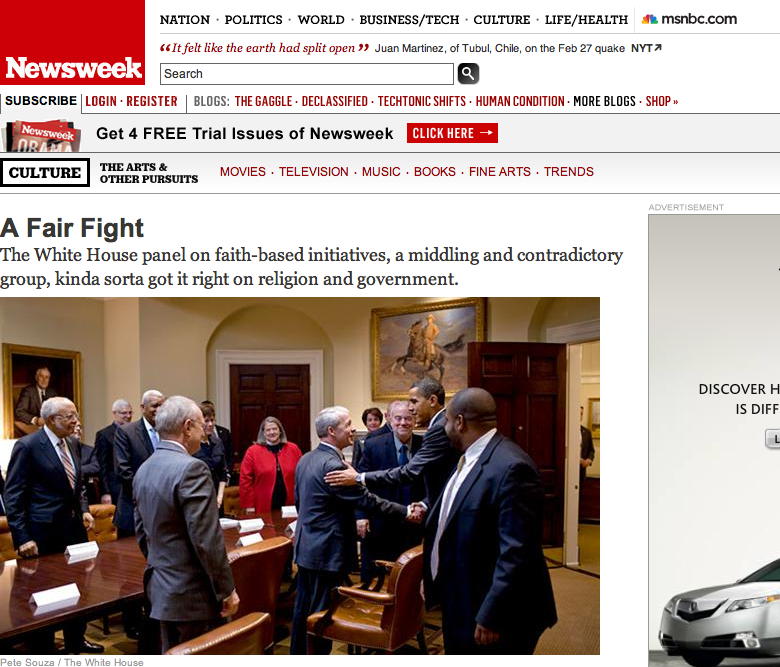
NEWSWEEK: White House Religion Panel "Gets It Right"

Screen shot 2010-03-15 at 4.00.05 PM By Lisa Miller | Newsweek.com | Mar 10, 2010

There has been some bellyaching in recent months—including by me, and also especially in The Washington Post—over the relevance and influence of the task force of the White House Office of Faith-Based and Neighborhood Partnerships (a god-awful mouthful of an administrative tag if ever there was one). This was a committee of about two dozen people, appointed by President Obama just over a year ago, asked to address some of the country's most important values issues and make recommendations to the president. Rumors persisted that relations within the council were acrimonious and, given that council members had such differing views on questions of faith—they were progressive and conservative and were at odds over the best government role inside churches and other faith-based institutions—there was no way to hammer out any but the lowest-common-denominator type of resolution. The most persistent complaint, and the one that I continue to hear, is the worry that their recommendations, which they offered to the president this week, would not get a fair hearing at the highest levels of the administration.

That would be a shame. The report addresses interrreligous dialogue, climate change, fatherhood, and poverty among other things. There are, certainly, some namby-pamby recommendations in the report—upholding fatherhood as a good thing, for example—but elements of the report have heft. Especially serious and provocative are the task force's recommendations on the subject of reforming the Office of Faith-Based and Neighborhood Partnerships itself. Though bureaucratic and unsexy, these recommendations essentially demand that the administration clarify the muddy and inconsistent ground rules for religious groups seeking federal funds for charitable work. This has long been a legislative and administrative quagmire, characterized by misunderstandings, favoritism, and legal challenges. At this moment in time, when Boston's Catholic Charities has closed its historic adoption agency rather than take government money and so be required to adopt children to homosexual married couples, such clarification would seem necessary indeed.

Council members were able to agree that the constitutional separation of church and state is foundational and that recipients of government money be more clearly informed about what that means in terms of their activities—at the federal and at the local level. Most interesting, the task force asked the president to revise language that bars religious groups receiving federal aid from "inherently religious activities, such as worship, religious instruction and proselytizing" saying the word "inherently" allowed too much room for misunderstanding. "Explicitly," they said, would be a better word choice.

The task force was also able to agree that protecting the religious identities of religious institutions is crucial. They disagreed over things like whether a religious organization receiving government aid could perform social services in a room containing religious symbols, and whether churches receiving government money should be required to set up a separate corporation for those funds. In a political environment of gridlock and frustration, the clarity of these agreements—and even of the disagreements—is welcome.

The most difficult question, however, was left aside, for the Department of Justice to decide at another time. This is the question of whether faith-based organizations receiving government money should be able to hire and fire based on religion. This fight is a mini culture war in itself, for it goes to the question of religious and civic identity. The left sees it as a question of civil liberties, the right one of unwelcome government intervention in the lives of private institutions. Conservatives and liberals promise that this is a hill upon which they are willing to die.

Now the White House task force has disbanded, and a new one—along with new issues—has not yet been named. Which of the task force recommendations will be adopted, and when, remains the driving question; if the president delays, he will have squandered considerable goodwill. In the meantime, I will make my own recommendation. Please change the name of the faith-based office. Please.

Lisa Miller is NEWSWEEK's religion editor. Her book Heaven: Our Enduring Fascination With the Afterlife is due out from Harper in March.

Find this article at

http://www.newsweek.com/id/234706

© 2010

View Post

  •   Public Square   •  

Evangelical Pastor Sending President Obama Bible Verses from Book of Mark

Hunter is considered one of the more conservative Evangelical members of President Obama’s Faith Council. He gave the Benediction at the 2008 Democratic Convention and has taken some heat from fellow conservative Evangelicals for partnering with the administration. But sharing the Gospel with the President? (or anyone for that matter) Who can take issue with that?

"I send probably two or three devotionals a week. He gets a devotional everyday on his blackberry and so I'm going through the Gospel of Mark with him and then there are other conversations I can’t tell you how many that have to do with how do you in his position continue your spiritual growth in Christianity.”

"Months and months ago he invited me to do daily devotionals and I just decided it would be more consistent to go through a Gospel with him so that I could talk about Jesus because Jesus is the author and finisher of our faith.

We fix our eyes on Jesus and so I just decided that Mark was the Gospel that I would go to because it was short and to the point and it had all of the essentials.”

FIND THIS ARTICLE AND VIDEO AT: http://blogs.cbn.com/thebrodyfile/

View Post

  •   Public Square   •  

Meet the President's 'Spiritual Cabinet'

Screen shot 2010-03-12 at 5.47.33 AM By Daniel Burke | Religion News Service

Near the end of a bumpy first year in office, President Obama readied for a Christmas vacation in Hawaii, but before he left, he called on a group of five ministers for a spiritual recharge.

Like previous prayer calls, this one was more personal than political.

"He certainly does not ask us how we would run the country and what issue to pursue or not pursue," said Bishop Charles Blake of the Los Angeles-based Church of God in Christ, who was on the call.

For 10 minutes, the president and the pastors prayed for peace, an economic recovery, protection for U.S. soldiers, and for Obama to be guided by a wisdom and power beyond himself.

Glimpses into Obama's spiritual life have been rare since he became president. He split with his longtime Chicago pastor, the Rev. Jeremiah Wright, after the fiery minister nearly derailed Obama's campaign, and has not joined a church in Washington.

"Having been burned, for lack of a better word, during the campaign and early days of his administration, I would not be surprised that he would be rather discreet about any revelations of his religious life," Blake said.

Still, he Obama continues to champion the role of faith in public life, frequently summoning the spirits of the Rev. Martin Luther King Jr., Protestant theologian Reinhold Niebuhr and even St. Thomas Aquinas to frame his policies in moral terms.

Like previous presidents, Obama regularly seeks the counsel of longtime Washington insiders, including Sojourners founder Jim Wallis, Reform Rabbi David Saperstein and retired Cardinal Theodore McCarrick, to shape decisions about the Iraq war, health care reform and the economy.

But Obama has also turned to a group of fresh--and relatively unfamiliar--faces to manage religious issues in his administration. They are recalibrating America's engagement with Muslims, revamping the White House faith-based office and tending to the president's own soul. A year into Obama's presidency, each of the following seven people has become an essential member of what might be called his "spiritual cabinet."

Joshua DuBois

His official title is director of the White House Office of Faith-based and Neighborhood Partnerships. Unofficially, Joshua DuBois is the administration's go-to guy for almost all things religious. He travels as Obama's roving ambassador to religious gatherings, connects the president with faith leaders for spiritual counsel, helps scout Washington churches for the first family, and handles the frequent media queries about Obama's faith.

Before stepping into politics, DuBois, 27, was a pastor at small Pentecostal church in Massachusetts, and his approach to the president bears traces of his former calling. DuBois sends daily devotionals to Obama's Blackberry--often a Bible verse or an excerpt from the Episcopal Book of Common Prayer, or a snippet from the works of theologians Richard and Reinhold Niebuhr, particular favorites of the president.

More publicly, DuBois is tasked with overhauling the White House faith-based office and managing its branches in 12 federal agencies. Under Obama, DuBois is steering the office away from the Bush administration's policy of direct funding to religious charities, and attempting to rescue it from charges that it improperly blends church and state.

Denis McDonough

When Denis McDonough was in eighth grade, he heard his older brother, a Catholic priest, deliver a homily entirely in Spanish. McDonough soon learned Spanish himself, and became an expert on bridging cultural gaps.

Now, as Obama's deputy national security adviser and chief of staff of the National Security Council, McDonough is working to strengthen international bonds strained by the Bush administration's go-it-alone approach to foreign policy.

Traveling by the president's side on overseas missions, the 40-year-old Minnesotan is a crucial player in Obama's quest to engage Muslims, find common cause with the Vatican, and restore the country's moral authority.

McDonough helped craft Obama's landmark address to Muslims last June in Cairo, and the robust defense of American foreign policy--including the waging of "just wars"--during the president's Nobel Peace Prize acceptance speech in Norway.

A key component of Obama's foreign policy is the Catholic concept of the common good, McDonough said. "It's a general posture of seeking engagement to find mutual interests, but also realizes that there is real evil in the world that we must confront," he said in an interview at his West Wing office. "The president also recognizes that we are strongest when we work together with our allies."

In addition, McDonough has schooled Obama on the internal politics of the Catholic Church, an institution he knows intimately. His brother Kevin was vicar general of the Archdiocese of St. Paul and Minneapolis, another brother is a priest-turned-theologian, and his best friend in Washington is a priest. A graduate of St. John's University in Collegeville, Minn., he helped vet a young theologian on the faculty, Miguel Diaz, to become ambassador to the Vatican last May.

Rashad Hussain

As Obama pursues a "new beginning" between the U.S. and Muslims around the world, he frequently seeks the counsel of Rashad Hussain, a 31-year-old White House lawyer.

Hussain briefed Obama before his first interview as president--with Al Arabiya, a television station based in the United Arab Emirates. He has also contributed to Obama's two major speeches to Muslims--in Ankara, Turkey and Cairo--offering insights about the history of Islam in America and suggesting suitable verses from the Quran.

Hussain has also traveled to the Middle East with Secretary of State Hillary Rodham Clinton, and, closer to home, helped organize a Ramadan dinner at the White House that replaced the usual crowd of ambassadors with young American Muslims.

In naming Hussain as his envoy to the Organization of the Islamic Conference, Obama noted that the young Muslim is a hafiz (someone who has memorized the Quran). But Hussain and others said Muslims abroad are more likely to take note of his White House credentials, and access to the Oval Office, as he seeks partnerships in education, health, science and technology.

"For many years, Muslim communities have been viewed almost exclusively through the lens of violent extremism," Hussain said in an interview. "We do not feel that we should engage one-quarter of the world's population based on the erroneous beliefs of a fringe few."

Melissa Rogers

When the Obama administration decided that Bush's faith-based office was on shaky legal ground, it sent Melissa Rogers to firm up the foundation.

For the last year, the 43-year-old church-state expert has chaired Obama's Advisory Council on Faith-based and Neighborhood Partnerships.

DuBois called Rogers, the director of the Center for Religious and Public Affairs at the Wake Forest University School of Divinity, "one of the country's foremost experts on faith and public policy," who is "respected across the board," by liberals and conservatives alike.

Her legal and political acumen helped Rogers guide the council's 25 members, who run the theological gamut from Baptist to Hindu, to reach a consensus on more than 60 recommendations for revamping the White House faith-based office, which were presented on Tuesday (March 9).

Twelve of the proposals aim to put the faith-based office on more solid constitutional footing by clarifying its "fuzzy" rules, as Rogers says, on charities that accept direct government aid; insulating charity clients from proselytism; and making government partnerships with local groups more transparent. Rogers said she expects the faith-office to enact many of the reforms--and be better off for it.

"The more we can come to agreement on the church-state issues, the more durable the policies are," Rogers said, "and the more time and energy we have to focus on people who are in need."

Joel Hunter and Sharon Watkins

When Obama wants to pray privately, he has repeatedly called Joel Hunter, a Florida megachurch pastor, and the Rev. Sharon Watkins, president and general minister of the Christian Church (Disciples of Christ).

Politically, Hunter, a registered Republican, and Watkins, who heads a liberal-leaning denomination, may not always agree, but, like Obama, both are committed to transcending traditional barriers.

Hunter, 61, pastors the 12,000-member Northland Church outside Orlando, and leads a new crop of centrist pastors calling for a cease-fire in the culture wars. He's also pushing to broaden the evangelical agenda to include issues like poverty, immigration and the environment.

Watkins, 55, who Obama tapped as the first woman to preach at the post-inauguration National Prayer Service last year, leads a denomination where Christian unity and overcoming divisiveness are central to its DNA.

Watkins caught Obama's eye during the 2008 presidential campaign when she closed a tense meeting between Obama and Christian leaders with a prayer that seemed to bond the room's mix of liberals and conservatives.

"It's just in her bones to try to bring people together," said Verity Jones, former publisher and editor of DisciplesWorld, a journal that covered the denomination.

Hunter and Watkins both declined to comment on their roles in Obama's spiritual life, invoking the rare pastor-president privilege. "He takes his role very seriously," said Hunter's spokesman, Robert Andrescik. "He just doesn't talk about it--all the more because it's the president."

Lt. Carey Cash

The pastor who's preached to Obama most often since he became president is a 6-foot-4-inch Southern Baptist Navy chaplain whose great uncle was country music legend Johnny Cash.

Like President George W. Bush, Obama has often preferred to worship outside the fishbowl of Washington, in the seclusion of Camp David's Evergreen Chapel, where Cash "delivers as powerful a sermon as I've heard in a while," Obama says.

White House officials say Obama has worshipped at the Maryland retreat a half-dozen times, and his daughters, Sasha and Malia, have attended Sunday school there.

Before his stint at Camp David, Cash, 39, was an All-American football player for the Citadel, and a chaplain for the Marine's 1st Battalion in 2003 in the Iraq war, during which he baptized 59 soldiers, including one in Saddam Hussein's former presidential palace in Baghdad.

The Memphis native was raised in a deeply religious household--his mother is a Christian author--and has harsh words for Muslims, writing in his 2004 book that Islam "from its very birth has used the edge of the sword as the means to convert or conquer those with different religious convictions."

Cash's three-year rotation at Camp David began in 2009, so Obama has nearly two more years to hear him preach, but they may not form the usual pastor-parishioner bond. Former Camp David chaplains say there is often little interaction between president and pastor outside of the services.

"We used to tell people our job is to run it like a five-star resort," said Patrick McLaughlin, who was chaplain at Camp David from 2002-2005. "One of the things you value when you go on vacation is peace and quiet."

Religion News Service

FIND THIS ARTICLE AT: http://www.washingtonpost.com/wp-dyn/content/article/2010/03/10/AR2010031003208_pf.html
View Post

  •   Culture Wars, Interfaith Dialogue, Public Square   •  

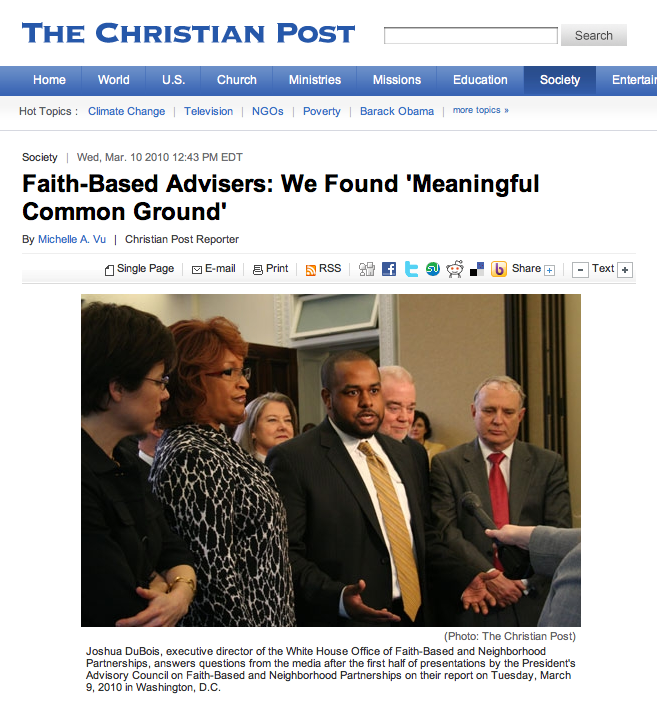
Faith-Based Advisers: We Found 'Meaningful Common Ground'

Screen shot 2010-03-12 at 5.42.30 AM

WASHINGTON – We have different opinions, admitted the White House's faith-based advisers on Tuesday when they presented their recommendations. But we were able to find “meaningful common ground,” they added.

After a year of work, the 25 members of the first Advisory Council on Faith-Based and Neighborhood Partnerships presented a report that included more than 60 recommendations for six issues - economic recovery and domestic poverty, fatherhood and healthy families, environment and climate change, inter-religious cooperation, global poverty and development, and reform of the Office of Faith-Based and Neighborhood Partnerships.

The proposals provide suggestions on how the government can better work with faith-based and community groups to tackle major social issues.

“We are a diverse group,” stated Melissa Rogers, chair of the council, at the onset of the event for the report's release. “We differ on matters of faith. We differ in our political perspectives and our philosophical approach. We differ in matter of theology even within our particular faith traditions.”

Yet despite their diverse and strong opinions, she said, the advisers “really listened” to one another and found “meaningful common ground” that went beyond the “lowest common denominator.”

Rogers’ sentiments were echoed by Pastor Joel C. Hunter, an adviser on the taskforce for inter-religious cooperation.

Hunter, who sits on the board of directors for the World Evangelical Alliance and the National Association of Evangelicals, told The Christian Post frankly that he is not usually attracted to such interfaith dialogues.

“I’m a conservative evangelical,” Hunter stated matter-of-factly. “I kind of always shied away from general ecumenical, let’s-all-just-be-nice-to-one-another, kumbaya stuff. Well, that’s not this. This is [about] 'How do we maintain our distinctions, make them even more clear, but at the same time cooperate in a way that makes the world safer?'”

The Florida megachurch pastor said these types of conversations are essential to national security because they marginalize the violent extremists among the people of America and give people who want to be fully engaged in their faith an alternative.

Throughout the event, high-level members of the Obama administration joined the panel for the presentation related to their department. The officials listened to the report and then gave feedback on recommendations and how they plan to use the report.

Health and Human Services Secretary Kathleen Sebelius joined for the report on the economic recovery and domestic poverty recommendations. In her response, she shared about how schools serve as feeding sites for needy children during the school year. But a current problem the country is facing is how to provide meals for the children during the summer. Sebelius said she would like to work with churches and other community organizations to make sure children have somewhere they can receive meals during the summer.

“It (the report of recommendations) won’t just be a document on a shelf,” said Sebelius. “I promise you this document will become an active action plan in the Department of Health and Human Services.”

Though the report, in general, has escaped any big controversy, there have been questions on why the council did not address the hot-button issue of abortion reduction, which President Obama last year said he would like the advisers to work on.

Joshua DuBois, the director of the office, said the council members have been involved in conversations about abortion reduction but did not create a task force for the issue because the president would like to extend the discussion to include the Domestic Policy Council.

Still, pro-life groups such as Focus on the Family say they are disappointed that the council did not present a plan to reduce abortions.

“The president said he wanted to reduce the need for abortions,” said Ashley Horne, federal issues analyst with Focus on the Family Action. “So, that topic would have been a natural fit for this group.”

“It’s one more strike against a president who, so far, has catered only to the pro-abortion agenda.”

Besides the abortion issue, the report has also been criticized for not including religious language. Council member Dr. Frank Page, former president of the Southern Baptist Convention, said he appreciated the work of the advisers but he wished the report expressed the motivation behind why faith leaders care about the issues.

Nevertheless, DuBois said that he is proud of the work the office and its first advisory council has done in the first year. The office under President Obama went directly to faith leaders and community leaders, through the council, and sought their advice on how best to partner, he said.

“The previous initiative largely had a dollar-and-cents vision of their office which caused a lot of controversy,” DuBois said to The Christian Post. “We’re seeking to communicate that when we partner with faith-based groups, it doesn’t have to be about finance. It could be about sharing information with them, about building their capacity, serving as a convener, and we think that will slowly but surely help turn this initiative around.”

The new faith-based advisory council will be installed sometime this spring or summer. Advisers serve one-year terms.

Some of the recommendations made by the council include:

  • Utilization of the knowledge, expertise, and on-the-ground experience of local faith- and community-based organizations to redefine the federal poverty guideline so that it more accurately measures and responds to the needs of low-income people
  • Support of faith-and community-based partnerships as a means to fill the gaps in providing essential services like transportation, housing, food assistance, job training, education, and healthcare for low-income families and individuals
  • Hosting of an annual Father’s Day Celebration at the White House to honor exemplary fathers and to highlight advances in father involvement resulting from the government’s interdepartmental working groups and the strategic partnerships formed at the quarterly roundtables
  • Formation of an Office of Faith-Based and Neighborhood Partnerships at the Environmental Protection Agency and assignment of faith- and community-based liaisons to EPA regional offices
  • More partnerships with interreligious councils and women of faith networks to advance peace building and development
  • Placement of Faith-Based and Civil Society Engagement Officers in USAID missions
  • Reduction of barriers to obtaining 501(c)(3) recognition

Michelle A. Vu
Christian Post Reporter

FIND THIS ARTICLE AT: http://www.christianpost.com/article/20100310/faith-based-advisers-we-found-meaningful-common-ground/

View Post

  •   Culture Wars, Poverty   •  

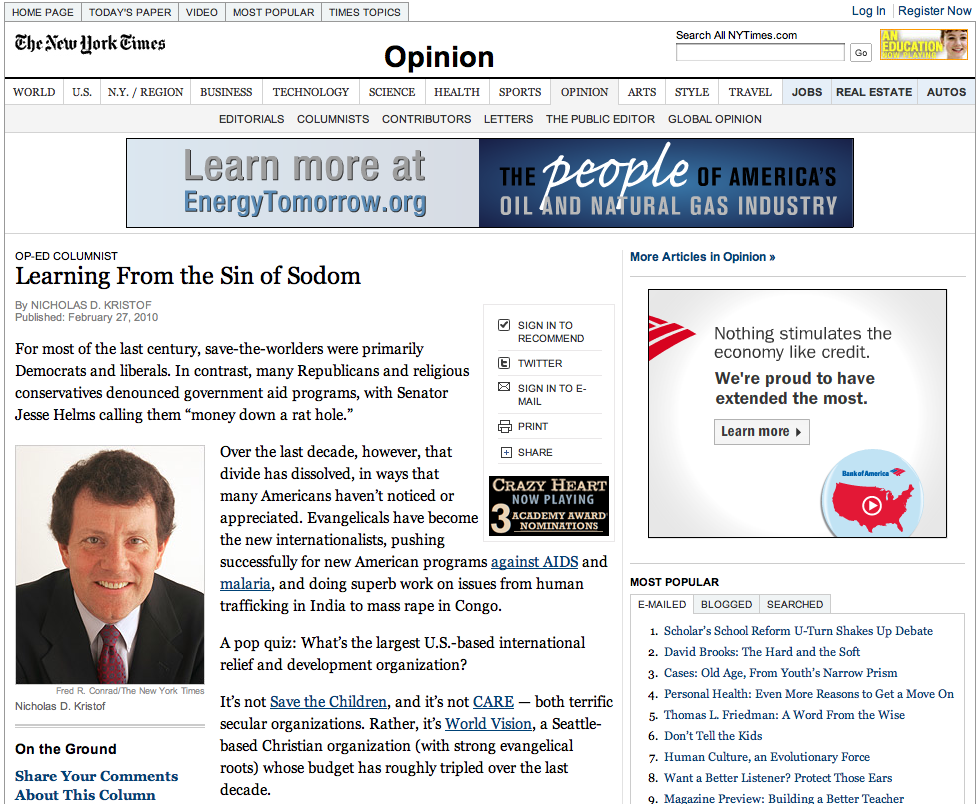
Learning From the Sin of Sodom

Screen shot 2010-03-03 at 3.34.42 PM Dear Friends,

There is a great article in today's New York Times by Nicholas Kristof, who has written about what a huge mistake it would be not to channel government money through faith-based organizations for international aid. Read below or at http://www.nytimes.com/2010/02/28/opinion/28kristof.html.

Blessings, Pastor Joel

OP-ED COLUMNIST

Learning From the Sin of Sodom

By NICHOLAS D. KRISTOF

For most of the last century, save-the-worlders were primarily Democrats and liberals. In contrast, many Republicans and religious conservatives denounced government aid programs, with Senator Jesse Helms calling them “money down a rat hole.”

Over the last decade, however, that divide has dissolved, in ways that many Americans haven’t noticed or appreciated. Evangelicals have become the new internationalists, pushing successfully for new American programs against AIDS and malaria, and doing superb work on issues from human trafficking in India to mass rape in Congo.

A pop quiz: What’s the largest U.S.-based international relief and development organization?

It’s not Save the Children, and it’s not CARE — both terrific secular organizations. Rather, it’s World Vision, a Seattle-based Christian organization (with strong evangelical roots) whose budget has roughly tripled over the last decade.

World Vision now has 40,000 staff members in nearly 100 countries. That’s more staff members than CARE, Save the Children and the worldwide operations of the United States Agency for International Development — combined.

A growing number of conservative Christians are explicitly and self-critically acknowledging that to be “pro-life” must mean more than opposing abortion. The head of World Vision in the United States, Richard Stearns, begins his fascinating book, “The Hole in Our Gospel,” with an account of a visit a decade ago to Uganda, where he met a 13-year-old AIDS orphan who was raising his younger brothers by himself.

“What sickened me most was this question: where was the Church?” he writes. “Where were the followers of Jesus Christ in the midst of perhaps the greatest humanitarian crisis of our time? Surely the Church should have been caring for these ‘orphans and widows in their distress.’ (James 1:27). Shouldn’t the pulpits across America have flamed with exhortations to rush to the front lines of compassion?

“How have we missed it so tragically, when even rock stars and Hollywood actors seem to understand?”

Mr. Stearns argues that evangelicals were often so focused on sexual morality and a personal relationship with God that they ignored the needy. He writes laceratingly about “a Church that had the wealth to build great sanctuaries but lacked the will to build schools, hospitals, and clinics.”

In one striking passage, Mr. Stearns quotes the prophet Ezekiel as saying that the great sin of the people of Sodom wasn’t so much that they were promiscuous or gay as that they were “arrogant, overfed and unconcerned; they did not help the poor and needy.” (Ezekiel 16:49.)

Hmm. Imagine if sodomy laws could be used to punish the stingy, unconcerned rich!

The American view of evangelicals is still shaped by preening television blowhards and hypocrites who seem obsessed with gays and fetuses. One study cited in the book found that even among churchgoers ages 16 to 29, the descriptions most associated with Christianity were “antihomosexual,” “judgmental,” “too involved in politics,” and “hypocritical.”

Some conservative Christians reinforced the worst view of themselves by inspiring Ugandan homophobes who backed a bill that would punish gays with life imprisonment or execution. Ditto for the Vatican, whose hostility to condoms contributes to the AIDS epidemic. But there’s more to the picture: I’ve also seen many Catholic nuns and priests heroically caring for AIDS patients — even quietly handing out condoms.

One of the most inspiring figures I’ve met while covering Congo’s brutal civil war is a determined Polish nun in the terrifying hinterland, feeding orphans, standing up to drunken soldiers and comforting survivors — all in a war zone. I came back and decided: I want to grow up and become a Polish nun.

Some Americans assume that religious groups offer aid to entice converts. That’s incorrect. Today, groups like World Vision ban the use of aid to lure anyone into a religious conversation.

Some liberals are pushing to end the longtime practice (it’s a myth that this started with President George W. Bush) of channeling American aid through faith-based organizations. That change would be a catastrophe. In Haiti, more than half of food distributions go through religious groups like World Vision that have indispensable networks on the ground. We mustn’t make Haitians the casualties in our cultural wars.

A root problem is a liberal snobbishness toward faith-based organizations. Those doing the sneering typically give away far less money than evangelicals. They’re also less likely to spend vacations volunteering at, say, a school or a clinic in Rwanda.

If secular liberals can give up some of their snootiness, and if evangelicals can retire some of their sanctimony, then we all might succeed together in making greater progress against common enemies of humanity, like illiteracy, human trafficking and maternal mortality.

View Post

  •   Interfaith Dialogue   •  

WASHINGTON POST: Obama task force: Consult religious groups more on foreign policy

Screen shot 2010-03-08 at 12.50.26 PM Among the major recommendations of the task force on inter-religious cooperation is to involve religious communities more in the making of American foreign policy. According to Dalia Mogahed, an advisory board member who is on that task force and also runs Gallup's Center for Muslim Studies, that means both religious leaders abroad and domestic ones. This theme was also sounded earlier in the week by a group of mostly faith leaders called the Chicago Council on Global Affairs, the idea being that U.S. foreign policy is governed without enough understanding of religion.

I asked Joel Hunter, an evangelical mega-church pastor from Florida who also sat on the group, what's new about this philosophy (of pushing for more interfaith work)? How will the average American notice anything different from the pro-interfaith vibe that's been lauded and talked about by religious and political leaders for years and years?

Hunter said the difference is that, for decades, "interfaith" was viewed as a liberal idea, largely consisting of (in the minds of skeptics) sitting around talking about your faith and papering over the profound differences between competing truth claims.

Today's interfaith, Hunter said, doesn't seek those interactions, but rather finding shared goals dissimilar faith communities can collaborate on, such as decreasing poverty or boosting health care. More socially conservative types - Hunter was nominated in 2006 to be head of the Christian Coalition, though he wound up stepping down - can and do embrace this vision, he said.

"I don't want to get into a lot of homogeneity," he said Friday.

Among the most significant recommendations of the task force focused on economic recovery, according to National Council of Churches President Peg Chemberlin, who sat on that group, is its urging of the White House to redefine the guidelines used to measure poverty. The current measure, she said, is too reliant on the cost of food, which Chemberlin said has become less accurate.

BY MICHELLE BOORSTEIN. READ ORIGINAL ARTICLE.

View Post

  •   Public Square   •  

BOSTON GLOBE: Pastor Joel C. Hunter Comments on President Obama's Spiritual Life

Screen shot 2010-02-22 at 9.52.13 AM WASHINGTON - He named a best-selling book after a pastor’s sermon and was outspoken as a candidate about the value of faith in public life. He infused stump speeches with phrases like “I am my brother’s keeper,’’ and made his journey to Christianity a central theme of the life story he shared with voters.

But since President Obama took office a year ago, his faith has largely receded from public view. He has attended church in the capital only four times, and worshiped half a dozen times at a secluded Camp David chapel. He prays privately, reads a “daily devotional’’ that aides send to his BlackBerry, and talks to pastors by phone, but seldom frames policies in spiritual terms.

The greater privacy reflects not a slackening of devotion, but a desire to shield his spirituality from the maw of politics and strike an inclusive tone at a time of competing national priorities and continuing partisan division, according to people close to the White House on faith issues.

“There are several ways that he is continuing to grow in his faith, all of them - or practically of all them - he’s trying to keep as private and personal as possible so they will not be politicized,’’ said Pastor Joel C. Hunter, who is part of an inner circle of pastors the president consults by phone for spiritual guidance.

But the shift has drawn notice from some religious leaders and political analysts, who say it opens Obama to questions of sincerity and threatens his support among the religious voters his campaign helped peel away from the Republican Party.

“You can’t be using the church just to get elected and then push the church to the side,’’ said the Rev. Wilfredo De Jesus, a prominent Chicago pastor who had campaigned for Obama among Hispanic evangelicals, many of whom had voted in earlier elections for George W. Bush. “If the president says he’s Christian, then in his narrative, and in his speeches and in his life, that should be displayed.’’

The first family’s intensive, early search for a church in Washington appears to have lost steam amid concerns about the disruption security arrangements would cause local worshipers. And since breaking with his Chicago church and longtime pastor, the Rev. Jeremiah Wright, nearly two years ago, Obama has not openly aligned with any one denomination or spiritual adviser.

A poll last August by the Pew Forum on Religion and Public Life indicated that the proportion of Americans who saw the Democratic Party as friendly to religion had dropped to Bush-era levels, at 29 percent, after peaking at 38 percent at the height of the Obama campaign a year earlier.

Joshua DuBois, director of the White House’s Office of Faith-Based and Neighborhood Partnerships, said he believes Obama “wants to make sure that there is something about his daily religious practice that is separate from the news cycle.’’

“He’ll talk about his Christian faith when it feels right and appropriate, and other times he’s just going to practice his Christian faith through the way he lives his life,’’ said DuBois, a Pentecostal pastor who was Obama’s campaign liaison to faith groups. “It’s not about a political strategy or a communication strategy. It’s about him walking the walk, which is always more valuable than just talking the talk.’’

Said Hunter, the senior pastor of an Evangelical megachurch in Longwood, Fla.: “When you’re on the campaign trail . . . that faith component is very important to people in trying to get a sense of your identity. When you become president, pretty suddenly you’re the president of all the people.’’

Hunter also said that during phone calls with the president, Obama’s spiritual questions are more often personal than political, though Hunter declined to share specifics.

Analysts say that another reason for Obama’s reticence may be the sheer number of crises in his first year in office and that a sharper public focus on faith risks becoming a divisive distraction.

Obama’s choice of evangelical Pastor Rick Warren to give the inaugural invocation, for instance, inflamed gay-rights supporters, while Obama’s commencement address in May at the University of Notre Dame, a Catholic institution, where he called for “open minds’’ on the abortion debate, angered some Catholics and religious conservatives.

“We have a recession, we have the health care agenda - Obama has taken on so much, why add one more thing, especially one that you can’t legislate on?’’ said Professor Alan Wolfe, director of the Boisi Center for Religion and American Public Life at Boston College.

On the campaign trail, Obama saw a discussion of faith as a means to unite Americans of all creeds - nonbelievers included - around a common set of values: a “politics of conscience,’’ as he put it.

But that has been a tougher sell as president. The nitty-gritty of policy has tended to highlight divisions not just between religious and secular voters but also among religious groups. Earlier this month, some two dozen groups ranging from the NAACP to the United Sikhs and the American Jewish Committee signed a letter expressing disappointment that Obama had yet to dismantle fully Bush-era rules permitting faith-based hiring by recipients of some federal funds.

Obama underscored his faith the moment he entered the national stage, declaring in his keynote speech at the 2004 Democratic National Convention in Boston that “We worship an awesome God in the blue states.’’ His Kenyan father had been raised Muslim but was an atheist by the time Obama was born. His mother, whose ancestors were Methodist and Baptist, was nonpracticing.

While organizing the poor on Chicago’s South Side not long after college, Obama met Wright, began attending Trinity United Church of Christ, and found God, he has said. He named his second book, “The Audacity of Hope,’’ after a sermon by Wright. And he warned Democrats against letting the evangelical right “hijack’’ religion for political ends.

As early as 2007, one poll indicated, Obama was seen as “strongly religious’’ by more voters than every presidential candidate except Republican Mitt Romney, whose Mormonism was the subject of intense news coverage.

Obama’s courtship of religious groups in the 2008 race - the most extensive ever by a Democratic candidate for president - paid off on Election Day with strong support among liberal and moderate religious voters. He won 54 percent of the Catholic vote, a stark reversal from four years earlier, when Senator John F. Kerry of Massachusetts, himself Catholic, lost the same group to Bush.

But a central figure in Obama’s faith journey - the Rev. Wright - nearly derailed his candidacy, when videos surfaced of some of the pastor's controversial sermons. "That was deeply disturbing to us," Obama told a group of Catholic reporters last summer. "It made us very sensitive to the fact that as President the church we attend can end up being interpreted as speaking for us at all times."

Several pastors who support Obama said church membership would send an important signal about the depth of his conviction.

“It’s only by being part of a church community that he’s going to get his own faith grounded,’’ said Bruce Wall, pastor of Global Ministries Christian Church, in Dorchester . “George Bush did not hide his faith. He was a man of prayer, whether you supported him or not.’’

Other pastors said they see religious values behind the president’s policies, even if Obama was less voluble than he was before the election.

“When you’re talking about universal health care policy, you’re talking about helping, ‘the least of these,’ ’’ said the Rev. Jeffrey Brown, a retired pastor who is executive director of the Boston TenPoint Coalition, a community organization serving black and Latino youth. “When you talk about building a coalition around the world to fight terrorism, you’re talking about being your brother’s keeper.’’

In a speech last month in honor of Martin Luther King Day, Obama offered a rare recent glimpse of the role of faith in his life today.

“You know, folks ask me sometimes why I look so calm,’’ he said at a Washington church. “And I have a confession to make here. There are times when I’m not so calm. . . . There are times when progress seems too slow. There are times when the words that are spoken about me hurt. . . . But let me tell you - during those times it’s faith that keeps me calm. It’s faith that gives me peace.’’

View Post