•   Public Square   •  

BOSTON GLOBE: Pastor Joel C. Hunter Comments on President Obama's Spiritual Life

Screen shot 2010-02-22 at 9.52.13 AM WASHINGTON - He named a best-selling book after a pastor’s sermon and was outspoken as a candidate about the value of faith in public life. He infused stump speeches with phrases like “I am my brother’s keeper,’’ and made his journey to Christianity a central theme of the life story he shared with voters.

But since President Obama took office a year ago, his faith has largely receded from public view. He has attended church in the capital only four times, and worshiped half a dozen times at a secluded Camp David chapel. He prays privately, reads a “daily devotional’’ that aides send to his BlackBerry, and talks to pastors by phone, but seldom frames policies in spiritual terms.

The greater privacy reflects not a slackening of devotion, but a desire to shield his spirituality from the maw of politics and strike an inclusive tone at a time of competing national priorities and continuing partisan division, according to people close to the White House on faith issues.

“There are several ways that he is continuing to grow in his faith, all of them - or practically of all them - he’s trying to keep as private and personal as possible so they will not be politicized,’’ said Pastor Joel C. Hunter, who is part of an inner circle of pastors the president consults by phone for spiritual guidance.

But the shift has drawn notice from some religious leaders and political analysts, who say it opens Obama to questions of sincerity and threatens his support among the religious voters his campaign helped peel away from the Republican Party.

“You can’t be using the church just to get elected and then push the church to the side,’’ said the Rev. Wilfredo De Jesus, a prominent Chicago pastor who had campaigned for Obama among Hispanic evangelicals, many of whom had voted in earlier elections for George W. Bush. “If the president says he’s Christian, then in his narrative, and in his speeches and in his life, that should be displayed.’’

The first family’s intensive, early search for a church in Washington appears to have lost steam amid concerns about the disruption security arrangements would cause local worshipers. And since breaking with his Chicago church and longtime pastor, the Rev. Jeremiah Wright, nearly two years ago, Obama has not openly aligned with any one denomination or spiritual adviser.

A poll last August by the Pew Forum on Religion and Public Life indicated that the proportion of Americans who saw the Democratic Party as friendly to religion had dropped to Bush-era levels, at 29 percent, after peaking at 38 percent at the height of the Obama campaign a year earlier.

Joshua DuBois, director of the White House’s Office of Faith-Based and Neighborhood Partnerships, said he believes Obama “wants to make sure that there is something about his daily religious practice that is separate from the news cycle.’’

“He’ll talk about his Christian faith when it feels right and appropriate, and other times he’s just going to practice his Christian faith through the way he lives his life,’’ said DuBois, a Pentecostal pastor who was Obama’s campaign liaison to faith groups. “It’s not about a political strategy or a communication strategy. It’s about him walking the walk, which is always more valuable than just talking the talk.’’

Said Hunter, the senior pastor of an Evangelical megachurch in Longwood, Fla.: “When you’re on the campaign trail . . . that faith component is very important to people in trying to get a sense of your identity. When you become president, pretty suddenly you’re the president of all the people.’’

Hunter also said that during phone calls with the president, Obama’s spiritual questions are more often personal than political, though Hunter declined to share specifics.

Analysts say that another reason for Obama’s reticence may be the sheer number of crises in his first year in office and that a sharper public focus on faith risks becoming a divisive distraction.

Obama’s choice of evangelical Pastor Rick Warren to give the inaugural invocation, for instance, inflamed gay-rights supporters, while Obama’s commencement address in May at the University of Notre Dame, a Catholic institution, where he called for “open minds’’ on the abortion debate, angered some Catholics and religious conservatives.

“We have a recession, we have the health care agenda - Obama has taken on so much, why add one more thing, especially one that you can’t legislate on?’’ said Professor Alan Wolfe, director of the Boisi Center for Religion and American Public Life at Boston College.

On the campaign trail, Obama saw a discussion of faith as a means to unite Americans of all creeds - nonbelievers included - around a common set of values: a “politics of conscience,’’ as he put it.

But that has been a tougher sell as president. The nitty-gritty of policy has tended to highlight divisions not just between religious and secular voters but also among religious groups. Earlier this month, some two dozen groups ranging from the NAACP to the United Sikhs and the American Jewish Committee signed a letter expressing disappointment that Obama had yet to dismantle fully Bush-era rules permitting faith-based hiring by recipients of some federal funds.

Obama underscored his faith the moment he entered the national stage, declaring in his keynote speech at the 2004 Democratic National Convention in Boston that “We worship an awesome God in the blue states.’’ His Kenyan father had been raised Muslim but was an atheist by the time Obama was born. His mother, whose ancestors were Methodist and Baptist, was nonpracticing.

While organizing the poor on Chicago’s South Side not long after college, Obama met Wright, began attending Trinity United Church of Christ, and found God, he has said. He named his second book, “The Audacity of Hope,’’ after a sermon by Wright. And he warned Democrats against letting the evangelical right “hijack’’ religion for political ends.

As early as 2007, one poll indicated, Obama was seen as “strongly religious’’ by more voters than every presidential candidate except Republican Mitt Romney, whose Mormonism was the subject of intense news coverage.

Obama’s courtship of religious groups in the 2008 race - the most extensive ever by a Democratic candidate for president - paid off on Election Day with strong support among liberal and moderate religious voters. He won 54 percent of the Catholic vote, a stark reversal from four years earlier, when Senator John F. Kerry of Massachusetts, himself Catholic, lost the same group to Bush.

But a central figure in Obama’s faith journey - the Rev. Wright - nearly derailed his candidacy, when videos surfaced of some of the pastor's controversial sermons. "That was deeply disturbing to us," Obama told a group of Catholic reporters last summer. "It made us very sensitive to the fact that as President the church we attend can end up being interpreted as speaking for us at all times."

Several pastors who support Obama said church membership would send an important signal about the depth of his conviction.

“It’s only by being part of a church community that he’s going to get his own faith grounded,’’ said Bruce Wall, pastor of Global Ministries Christian Church, in Dorchester . “George Bush did not hide his faith. He was a man of prayer, whether you supported him or not.’’

Other pastors said they see religious values behind the president’s policies, even if Obama was less voluble than he was before the election.

“When you’re talking about universal health care policy, you’re talking about helping, ‘the least of these,’ ’’ said the Rev. Jeffrey Brown, a retired pastor who is executive director of the Boston TenPoint Coalition, a community organization serving black and Latino youth. “When you talk about building a coalition around the world to fight terrorism, you’re talking about being your brother’s keeper.’’

In a speech last month in honor of Martin Luther King Day, Obama offered a rare recent glimpse of the role of faith in his life today.

“You know, folks ask me sometimes why I look so calm,’’ he said at a Washington church. “And I have a confession to make here. There are times when I’m not so calm. . . . There are times when progress seems too slow. There are times when the words that are spoken about me hurt. . . . But let me tell you - during those times it’s faith that keeps me calm. It’s faith that gives me peace.’’
View Post

  •   Interfaith Dialogue, Peace   •  

U.S. Islamic Forum Raises Hope for the Future

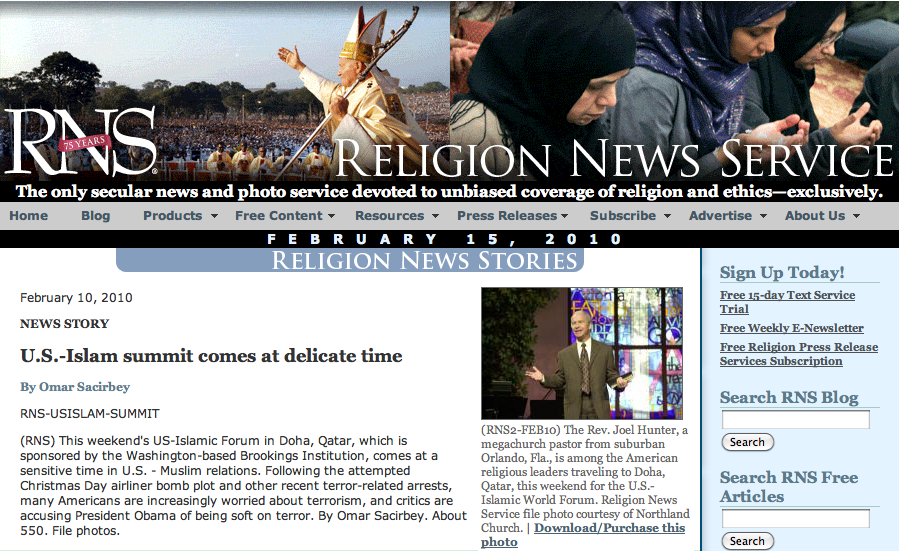
Screen shot 2010-02-15 at 5.32.19 PM This year’s U.S.-Islamic World Forum, held Feb. 13-15 in Doha, Qatar, comes at sensitive time in U.S.-Muslim relations.
In a report for Religion News Service (RNS), journalist Omar Sacirbey wrote: “Following the attempted Christmas Day airliner bombing and other recent terror-related arrests, many Americans are increasingly worried about terrorism, and critics are accusing President Obama of being soft on Muslim extremists.”

He added that in the Muslim world, “many people are angry about the war in Afghanistan, U.S. drone attacks in Pakistan, the Israeli-Palestinian conflict, their own economic problems, and expect [President] Obama to deliver remedies faster than his administration may be able to.”

Now in its seventh year, the Forum has become the foremost meeting for positive cross-cultural engagement among leaders from the United States and the Muslim world—bringing together key leaders in the fields of politics, business, media, academia and civil society. It seeks to address the critical issues dividing the United States and the Muslim world by providing a unique platform for frank dialogue, learning and the development of positive partnerships between key leaders and opinion shapers from both sides.

American religious figures who attended this year’s conference said the sensitive state of U.S.-Islamic relations requires increased religious involvement in diplomacy.

Episcopal Bishop John Chane of Washington D.C., who has attended two previous forums, said: “When you have 1.5 billion Muslims, 2 billion Christians, and 13 million Jews, from an Abrahamic perspective, you have a lot of influence. Twentieth-century diplomacy has failed so far, and we have to recognize that you need religion in the mix.”

Dr. Joel C. Hunter, who has attended three forums, agreed: “In the Muslim world ... their faith is a very integral part of their foreign policy. They want to hear secular and religious ideas.”

Despite current tensions, observers say U.S.-Islamic relations are improving under President Obama.

“A lot of the Islamic world is more anxious to engage because we have a president who wants to restart relations with Muslims,” Dr. Hunter explained. “We’ve gone from a defensive mode to a development and diplomatic mode.”

Al-Husein Madhany, a Muslim-American scholar and technology activist who convened a conference workshop on how to use new media to build grassroots organizations and civic institutions, added: “We have a moment in history where there’s been a promise made by the leader of the free world for a new beginning. There’s an excitement in people’s voices about America that I didn’t hear during the previous administration.”

View Post

  •   Culture Wars   •  

Come Let Us Reason Together: A Guide for Busy Pastors

pastor_guide_thumbIn early 2007, the Come Let Us Reason Together initiative was launched. It was an undertaking that few thought could be successful: finding common ground between centrist evangelicals and progressives on the most divisive cultural issues of our times. The heart of Come Let Us Reason Together is a Governing Agenda, released in January 2009. It represents the fruit of these labors and maps a joint path forward to heal a nation torn apart by the culture wars.

The most recent product of the Come Let Us Reason Together initiative is Come Let Us Reason Together: A Guide for Busy Pastors (developed with assistance from Pastor Hunter and other leaders). This user-friendly guide describes how pastors can embody this approach at the local church level and join a growing chorus of Christian leaders who are committed to finding a path beyond the culture wars to common ground.

CLICK HERE TO DOWNLOAD THE GUIDE.

View Post

  •   Public Square   •  

NAE: For the Health of the Nation

Screen shot 2010-02-01 at 11.48.07 AM Dr. Hunter is on the Board of Directors (and Northland is a member) of the National Association of Evangelicals. With a membership of 30 million, it is the most influential evangelical voice in the United States of America. You can visit the Public Affairs page of the NAE website and read “For the Health of the Nation,” our signature statement on participation in the public square.

http://www.nae.net/government-affairs

View Post

  •   Justice, Poverty   •  

USA Today: Activists who redefine "evangelical" call for Haiti debt relief

Screen shot 2010-02-01 at 11.23.25 AM The crisis of biblical proportions in Haiti has brought out the full spectrum of the faithful to offer emergency aid. Now, a start-up group of progressive Protestants is launching itself with a campaign to erase Haiti's debts so the crippled nation can focus on rebuilding.

The New Evangelical Partnership for the Common Good -- led by marquee activists, academics, seminar profs and pastors such as Rev. Richard Cizik -- was originally going to launch later this month but stepped up to the publicity megaphone to call attention to Haiti's need beyond emergency relief. Their release says, "We believe that Jesus calls us to work together to set free those who are held captive by debt."

You remember Cizik from headlines in 2008, when the long-time head of governmental affairs for the National Association of Evangelicals resigned under fire for hinting support for gay unions in a radio interview.

Evidently, Jesus doesn't call people who disagree about the Bible to work together on issues. Cizik's outspoken concern for global climate change issues had already made him a target with big name conservatives such as Focus on the Family founder James Dobson. But, in recent years, the e-word (evangelical) banner, once owned by Christians with conservative views on politics, economics and biblical morality, has become a flag flown by any Protestant with a social justice focus and a contemporary focus on the Gospel.

Partnership executive director Rev. Steven Martin, formerly with Partnership co-founder David Gushee's group, Evangelicals for Human Rights, says they didn't want to wait to campaign for debt forgiveness. Although two thirds of Haiti's debt, held by other governments and major institutions such as the World Bank and the International Monetary Fund, has been forgiven already, the remaining billions could cost Haiti as much as $50 million a year to service. That's money Haiti needs for rebuilding, says Martin.

Their release quotes Gushee calling the Partnership, "a new way to bear witness to the love of God in Jesus Christ. We have yearned to offer a better model for how Christians address public issues; to be known for always standing up for those whom God loves but the world or the church often mistreat or neglect."

Don't look for Dobson or any other megawatt megachurch conservatives (with the exception of Rev. Joel Hunter, of Northland Church in Orlando, who also serves on President Obama's Council for Faith-based and Neighborhood Partnerships) on the list of signators.

The Partnership's website's includes its stands -- often written with highly nuanced phrasing -- on hot issues such reproductive rights, gay marriage and environmentalism. For example:

We stand against the collapse of marriage and for stronger family life. We are involved in efforts to strengthen the fading institution of marriage and thereby protecting and enhancing the well-being of children. We do not believe that denigrating the dignity and denying the human rights of gays and lesbians is a legitimate part of a "pro-family" Christian agenda, and will work to reform Christian attitudes and treatment of lesbian and gay people.

This time, no one's going to shove Cizik out the door for saying so.

Find this article at: http://www.usatoday.com/topics/post/Events+and+Awards/In-depth+Coverage/Haiti+Earthquake/16364.blog/1

View Post

  •   Culture Wars   •  

What Would Jesus Do?

Screen shot 2010-01-29 at 12.05.39 PM By Bill Schneider, Distinguished Senior Fellow and Resident Scholar at Third Way

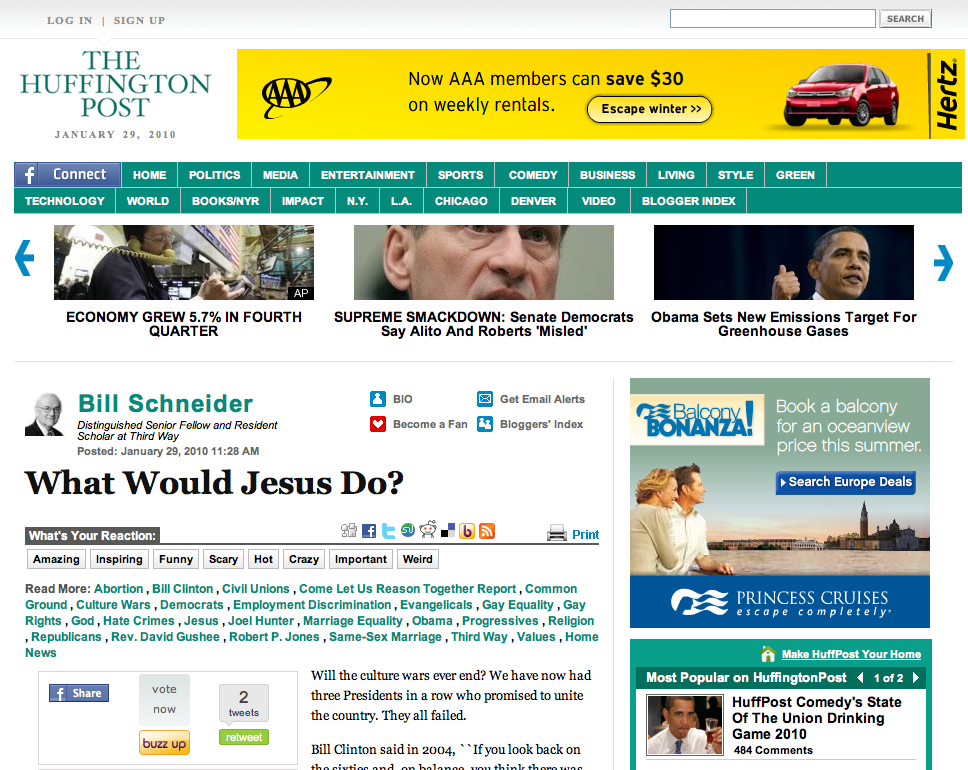
Will the culture wars ever end? We have now had three Presidents in a row who promised to unite the country. They all failed.

Bill Clinton said in 2004, ``If you look back on the sixties and, on balance, you think there was more good than harm in it, you're probably a Democrat. And if you think there's more harm than good, then you're probably a Republican.''

The sixties were a long time ago. That was when China had a Great Proletarian Cultural Revolution and the United States had a Great American Cultural Revolution. China got over its trauma. The U.S. never did.

Why not? One word: religion. The United States experienced a ferocious backlash to the cultural changes of the 1960s. It's a backlash that happened nowhere else. It happened because of the uniquely powerful role of religion in American public life. Religious observance is now the defining political difference between Democrats and Republicans. Regular churchgoers vote Republican (55 percent for John McCain in 2008). Irregular churchgoers vote Democratic (60 percent for Barack Obama).

Can anyone heal the divide? A group of centrist evangelicals and progressives is trying. Their project is called ``Come Let Us Reason Together.''

A group of moderate evangelicals has joined forces with Third Way, a Washington think tank, (I should note here I am a Distinguished Senior Fellow & Resident Scholar at Third Way) ``trying to change the nature of our engagement in public debate in the United States,'' according to David P. Gushee, professor of Christian Ethics at Mercer University and president of Evangelicals for Human Rights.

``There's a real weariness of the politics of division,'' Robert P. Jones, president of Public Religion Research says. ``This project is about trying to find a politics of common ground.'' Jones estimates that 54 percent of white evangelicals in the U.S. can be described as ``centrist" (40 percent) or ``modernist'' (14 percent). Among younger white evangelicals, the total rises to 61 percent. These are churchgoing Americans who, Jones says, ``have increasingly found that the most loud and public voices in evangelical life are not speaking for them.''

In the past leaders who have tried to heal the cultural divide have taken two paths: either compromise or avoidance. But cultural issues are not easy to compromise. They're about values, not interests. Interests can be compromised. Values -- matters of right and wrong -- can not. In 1992, Bill Clinton said abortion should be ``safe, legal and rare.'' Anti-abortion forces believe abortion is murder. Should murder be ``safe, legal and rare''?

Barack Obama has followed the path of avoidance for the most part. In his first year, Obama hasn't said much about God, guns and gays, although his supporters believe he will eventually deliver. Same with immigration reform. The President says he will deal with it -- eventually.

``Come Let Us Reason Together'' recommends a different approach: common ground. According to Rev. Joel Hunter, senior pastor at Northland Church in Florida, ``There's a world of difference between compromise and cooperation. On the one hand, you are somehow giving up your agenda. On the other hand, you are even more likely to achieve your agenda through things that you can still do together. Each side is getting part of what they always wanted.''

Jones argues that what makes this effort unique is that ``it has put the more difficult issues front and center and tried to see what kind of conversations we can have about those, rather than pretending they're not in the room.''

Is there really common ground on abortion? The project's guide for pastors talks about reducing the number of abortions by preventing unwanted pregnancies and by supporting pregnant women who want to give birth. Surely progressives and evangelicals can agree on that.

Is there common ground on gay rights? The guide talks about protecting gays and lesbians from employment discrimination and hate crimes. Nothing about same-sex marriage. In Dr. Gushee's view, ``Civil unions don't seem to be a solution that is satisfying to a lot of people in either the gay community or the Christian community, but to me, it seems like it could be a space for common ground.''

The project is not looking for dramatic breakthroughs. It's promoting the experience of working together for shared values. Maybe they'll like it. Maybe they'll learn to trust each other a little more. ``We now have entire industries and organizations that profit from polarization,'' Dr. Hunter observed.

Can evangelicals be drawn away from the path of militancy? Dr. Gushee thinks they can because of the nature of their faith. He calls militancy ``a violation of our own values . . . where commitment to a certain position on an issue has overridden core teachings of our faith and the example of Jesus.'' Rev. Hunter says, ``I would like to build into the evangelical part of the church a broader approach to controversial or divisive issues so that we can both be peacemakers and advance those values that we think are biblical values.''

Doesn't the Bible say, ``Blessed are the peacemakers, for they shall be called the children of God''?

Find this article at: http://www.huffingtonpost.com/bill-schneider/what-would-jesus-do_b_441944.html

View Post

  •   Poverty   •  

New evangelical group calls for cancellation of Haiti's debt

Screen shot 2010-01-29 at 11.28.43 AM

WASHINGTON (ABP) -- A new organization of progressive evangelicals has formed, calling for complete cancellation of Haiti's foreign debt in order to aid an already-fragile economy devastated by a Jan. 12 earthquake.

The Jan. 22 announcement of the New Evangelical Partnership for Common Good marks the full return into public life of Rich Cizik, former vice president for governmental affairs of the National Association of Evangelicals.

Cizik, who resigned the post in 2008 following an outcry after he said on National Public Radio that he no longer opposed civil unions for gays, is one of three founding leaders of the new religious non-profit.

Cizik will work with David Gushee, a professor at Mercer University and regular columnist for Associated Baptist Press, and Steven Martin, a minister, filmmaker and activist who previously worked with Gushee as executive vice president of Evangelicals for Human Rights.

"We have founded this organization to bear witness to the love of God in Jesus Christ," Gushee said in a statement. "We have yearned to offer a better model for how Christians address public issues; to be known for always standing up for those whom God loves but the world or the church often mistreat or neglect."

Gushee said the trio did not plan to launch the organization so soon, but after the earthquake they decided "that now is precisely the right time to get started, and this is the right issue."

The founders said Haiti has been saddled with crippling debt since its beginning as a nation founded by former slaves who overthrew their French masters during Napoleonic times. Corrupt former heads of state -- like "Papa Doc" and "Baby Doc" Duvalier -- racked up huge national debts, lining their own pockets while leaving little to help Haiti's people.

In 2009 the International Monetary Fund and the World Bank forgave $1.2 billion of Haiti's $1.9 billion in aggregate debt. With the earthquake piled on top of everything else, the New Evangelical Partnership says it is time to finish the job.

In the newest effort, 66 Christian leaders signed a petition urging "all nations and institutions that have made loans to the Haitian government to quickly and completely forgive these debts."

The petition calls for disaster-assistance and reconstruction payments to come to Haiti in the form of aid and not loans, "so the cycle of borrowing and repayment that has so crippled the nation of Haiti since its independence will not begin anew."

Official signers include Joel Hunter, senior pastor of Northland Church in Longwood, Fla.; author, speaker and activist Brian McLaren; and Jim Wallis, president and CEO of Sojourners.

Several Baptist clergy and academicians added their names to the list. They include Charles Foster Johnson, interim pastor at First Baptist Church in Brownwood, Texas; Bill Leonard, dean and professor of church history at Wake Forest Divinity School; Larry McSwain, an associate dean and professor at McAfee School of Theology; Jonathan Merritt, a Southern Baptist author and activist from Georgia; Elizabeth Newman, a professor at Baptist Theological Seminary at Richmond; Roger Paynter, pastor of First Baptist Church in Austin, Texas; Julie Pennington-Russell, pastor of First Baptist Church in Decatur, Ga.; Guy Sayles, pastor of First Baptist Church in Asheville, N.C.; Glenn Stassen, a professor at Fuller Theological Seminary who taught previously at Southern Baptist Theological Seminary; Joe Trull, editor of Christian Ethics Today; and Brett Younger, a professor at McAfee School of Theology.

Bob Allen is senior writer for Associated Baptist Press. Find this article at: http://www.abpnews.com/content/view/4761/53/

View Post