•   Public Square   •  

For Obama, Religion Remains an Issue
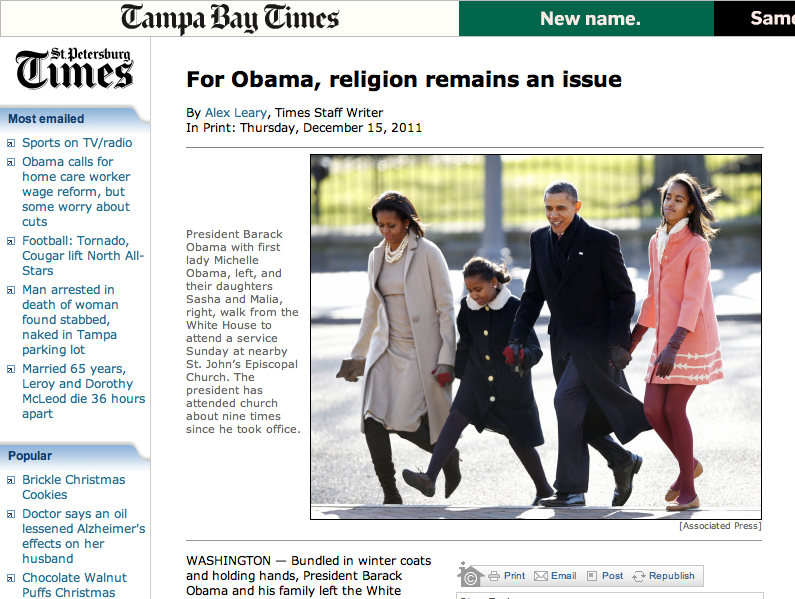
Screen Shot 2011-12-16 at 10.50.35 AM WASHINGTON - Bundled in winter coats and holding hands, President Barack Obama and his family left the White House last Sunday and strolled through a park to St. John's Episcopal Church.

Inside, a pastor preached about John the Baptist and not giving up when things don't work out. He connected the message to Obama, saying people viewed the president as a savior but the nation's problems are not easily solved.

Obama's church visit got attention because it was rare. The last time the president attended Sunday services in Washington was in July. And the family outing came days after a campaign ad by Republican candidate Rick Perry asserted Obama has been waging "war on religion."

Religion is "not always the most important reason people vote, but it never completely goes away," said John Green, a political scientist at the University of Akron who studies the issue.

"I think Obama goes into his re-election period with an opportunity to re-emphasize his faith and the connections of his faith to his policies, partly because he hasn't done it very much," Green said.

But it also presents an opening for critics to question the devotion of a president who as a candidate in 2008 had to go out of his way to refute claims, spread on the Internet and in emails, that he was Muslim. Even now, many Americans seem unaware of Obama's religious background.

...

Obama, who the White House says is a "committed Christian" and prays daily, has followed a winding path.

His Kenyan-born father was brought up Muslim but was a "nonbeliever" according to Obama's telling. He said his mother was skeptical of religion, and when she moved them to Indonesia, he attended a Catholic school and a secular school where Muslims were the majority. While living in Hawaii with his grandparents, Obama went to a Unitarian Universalist church.

As a rising political figure, Obama spoke how he overcame his own reservations and was baptized after college. "I felt God's spirit beckoning me. I submitted myself to his will, and dedicated myself to discovering his truth," he wrote in his book, The Audacity of Hope.

Then came a roiling controversy that threatened to upend his presidential campaign: the publicity around sermons by his pastor, the Rev. Jeremiah Wright of Trinity United Church of Christ in Chicago.

Wright said U.S. leaders caused the 9/11 terrorist attacks by supporting terrorism abroad and claimed the government tried to wipe out African-Americans with drugs and AIDS. God bless America? Wright said it should be "God d-- America."

Obama severed ties with Wright and his campaign recovered. On Inauguration Day, he invited two noted pastors to pray: Rick Warren, the evangelical megachurch leader, and Joseph Lowery, a leader in the civil rights movement.

Since then, Obama's religious life has been little discussed - partly because the economy has dominated talk in Washington, and partly because Obama practices more privately.

Obama has been to church in Washington about nine times, according to a count by Mark Knoller, a CBS News White House correspondent who keeps statistics on presidents. Michelle Obama and her children are not known to attend services on their own, but the first lady has visited churches around the country as part of her effort to combat childhood obesity.

President George W. Bush attended church more frequently but, like Obama, did not join a church in Washington and preferred to worship at the more private Evergreen Chapel at Camp David, where the Obamas sometimes attend. Jimmy Carter continued to teach Sunday school while in the White House. Ronald Reagan took a lower key approach.

Presidential outings are always a heavy affair. Streets are cleared. Traffic is disrupted. Churchgoers must pass through security.

"He regrets causing such a distraction that other people can't worship," said the Rev. Joel Hunter of Northland church in Longwood near Orlando, who writes weekly devotionals for Obama.

But the lack of visibility has clouded public perception. A 2010 Pew Research Center poll found that 18 percent of adults think Obama is Muslim, up from 11 percent in 2009. Thirty-four percent correctly identified him as Christian while 43 percent said they did not know Obama's religion.

"That is the dilemma," Hunter said. "If you are more private in your personal development, then it creates a vacuum. People fill it in with the latest email," a reference to attacks preying on fears of Muslims.

The White House said Obama prays daily and has a circle of pastors, Hunter included, who provide spiritual advice. "The president's Christian faith is a part of who he is, but not a part of what the public or the media is focused on every day," read a statement.

Obama has invoked religion during ceremonies and faith-based events. He said he called an Easter prayer breakfast this spring because "as busy as we are, as many tasks as pile up, during this season, we are reminded that there's something about the resurrection - something about the resurrection of our savior, Jesus Christ, that puts everything else in perspective."

...

As the election approaches, religion will return as an issue. Mitt Romney, one of the top Republican candidates, faces potential problems in the primary because he is Mormon, which some other Christians view with suspicion. Newt Gingrich became a Catholic in 2009 but carries the baggage of two divorces and infidelity. Perry is trying to regain his footing in the race by playing up his faith.

"I'm not ashamed to admit that I'm a Christian," the Texas governor says in his new TV ad. "But you don't have to be in the pew every Sunday to know that there's something wrong in this country when gays can serve openly in the military, but our kids can't openly celebrate Christmas or pray in school. As president, I'll end Obama's war on religion, and I'll fight against liberal attacks on our religious heritage."

Perry was wrong about school prayer. Schools cannot hold Christmas events or prayers that focus on one religion, but children are allowed to pray and openly celebrate Christmas.

The Perry campaign says the "war" extends to Obama's decision not to defend the federal ban on gay marriage in court.

Religious conservatives have found reason to disagree with Obama over some policies, including the insurance mandate under the health care law, which some say violates the rights of those to forgo coverage because they think God is their protector. The law includes religious exemptions that critics say are vague.

At the same time, Obama has been praised for strengthening faith-based government outreach.

"When Michelle and I hear our faith questioned from time to time, we are reminded that ultimately what matters is not what other people say about us but whether we're being true to our conscience and true to our God," Obama said during the February National Prayer Breakfast. "Seek first his kingdom and his righteousness and all these things will be given to you as well."

FIND THIS ARTICLE AT: http://www.tampabay.com/news/politics/national/for-obama-religion-remains-an-issue/1206260
View Post

  •   Creation Care   •  

Caring for the Environment Is a Mandate From God

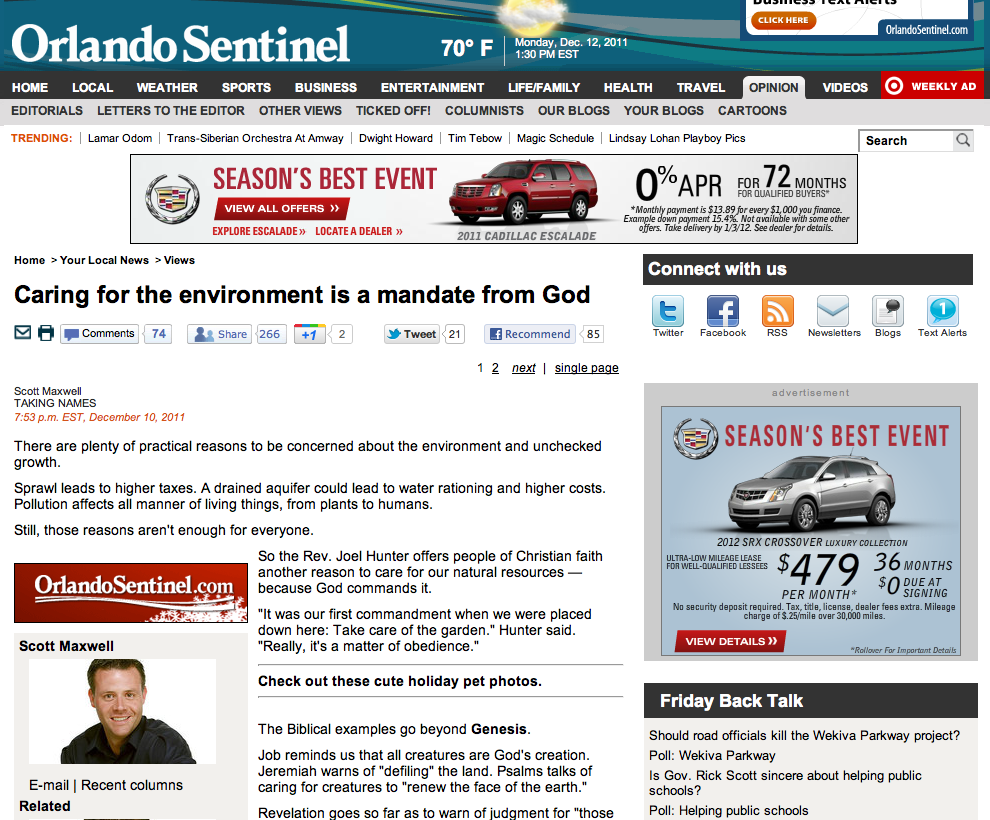
Screen Shot 2011-12-12 at 1.30.11 PM There are plenty of practical reasons to be concerned about the environment and unchecked growth. Sprawl leads to higher taxes. A drained aquifer could lead to water rationing and higher costs. Pollution affects all manner of living things, from plants to humans.

Still, those reasons aren't enough for everyone.

So the Rev. Joel Hunter offers people of Christian faith another reason to care for our natural resources — because God commands it. "It was our first commandment when we were placed down here: Take care of the garden." Hunter said. "Really, it's a matter of obedience." READ MORE

View Post

  •   Public Square   •  

Thomas Jefferson's Biblical Revisions

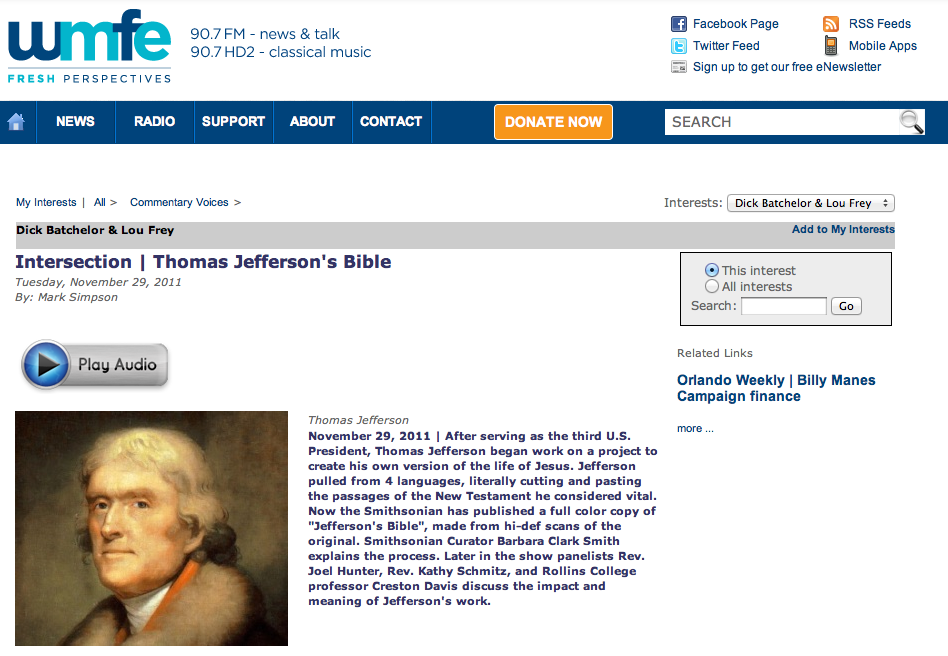
Screen Shot 2011-12-01 at 5.13.49 PM A decade after Thomas Jefferson left office, the nation's third President started working on a project compiling the four gospels of the Bible's New Testament into a book that removed supernatural parts Jesus' life. It came to be known as "The Jefferson Bible." The work was recently published by the Smithsonian Institution. NPR affiliate WMFE invited a panel of religious leaders and scholars to discuss the meaning and impact of Jefferson's biblical revisions. Here, Pastor Joel Hunter talks about what happens to Christianity if miracles like the Virgin Birth and the Resurrection are removed from the faith. CLICK TO LISTEN.

View Post

  •   Public Square   •  

Monster-in-law? Not in this family

Screen Shot 2011-11-15 at 7.25.46 PM As a pastor's wife, Becky Hunter has heard many lamentations over mothers-in-law — particularly as it applies to the relationship with a daughter-in-law.

As her three boys grew up and married, she never wanted to be the reason for any such grief. So Hunter, the wife of Joel C. Hunter, spiritual adviser to President Barack Obama and pastor of Northland, A Church Distributed, outside Orlando, Fla., took what she learned from confidences shared and Scriptures read, and kept this cardinal truth in mind: The primary relationship is the one between son and wife.

"If the mother-in-law or son is not willing to see the primary relationship as the one between son and wife, the relationship between mother-in-law and daughter-in-law will be messed up," she said. "The mother-in-law will constantly be feeling she's playing second fiddle."

And, she added: "Bottom line is, she is second fiddle."

Hunter and her daughters-in-law have gathered the lessons learned in a book, "Why Her? You, Your Mother-in-Law/Daughter-in-Law and the Big Picture" (Northland, A Church Distributed). Half of it is by Hunter, the second half by her daughters-in-law, Lisa, Rhonda and Elizabeth.

Hunter does not think of their book as a how-to as much as a why-to. It's never easy when two women love the same man, she acknowledged, albeit in different ways. The wife often sees her husband as protector; the mother thinks she is supposed to protect him. Being aware of those differences can make all the difference in the two women's relationship.

She offers some counsel for mothers-in-law, most of which daughters-in-law could follow too — not to mention sons-in-law and fathers-in-law:

Do not take sides — your child's or your spouse's. "You need to take the marriage's side," Hunter said.

Pray for your daughter-in-law and not about her. "There's the image of the mother-in-law praying, 'Please fix her. You know what she's like. I just want you to make her better.' As opposed to 'Lord, help her be her best. Help her move forward as a strong partner to her husband.'"

Phrase requests as invitations, not obligations. For example, a mother-in-law may be disappointed when her son's family declines to spend a holiday with her. Rather than pile on the guilt, she said, "You may build a closer family by just letting it go with no strings or grudges. That may set a tone that makes them want to be with you the next time."

Don't force a buddy-buddy relationship too soon. Instead, be willing to invest in the relationship in ways that the other woman would appreciate, and on her terms, not yours.

Relate to her as an equal. Avoid the temptation on either side to adopt a child or parent role.

Avoid setting her up for failure, intentionally or unintentionally. You wish she had a job? Or were home raising the kids? "It isn't like (they're) doing something wrong," Hunter said, "but there is an impression that they're failing" based on the mother-in-law's expectations.

wdonahue@tribune.com

Daughter-in-law offers some advice

Pressed for any momentary lapse of bliss, Elizabeth Hunter, who is married to Joel Hunter Jr., shared an initial struggle she had in relation to her mother-in-law.

"Early in my marriage, I noticed my husband turning to Becky a lot for encouragement. It was hard for me … and I had to take a step back and say, 'It's not her pulling him away from me. It's something I need to do in our marriage.'" So she worked on being more supportive of her husband. "I didn't want to allow any resentment to creep in."

— W.D.

View Post

  •   Poverty   •  

Children That Are Hurting

“Children that are hurting” is a phrase the Seminole county public school district’s board chair Dede Schaffner speaks to describe more than 1,700 homeless students served by the district. Joined by Brenda Carey, chairman of the board of Seminole county government, and Dr. Joel C. Hunter, they have formed a collaboration of faith-based organizations in the county to work side-by-side with the district to confront student homelessness, decrease it and, perhaps, if successful, apply that strategy in the future to address other categories of homeless people in Seminole county. This is the story of their first steps.

Produced, reported and edited by Stephen McKenney Steck at http://cmfmedia.org/2011/11/children-that-are-hurting/

View Post

  •   Creation Care   •  

Whatever Happened to the Evangelical-Environmental Alliance?

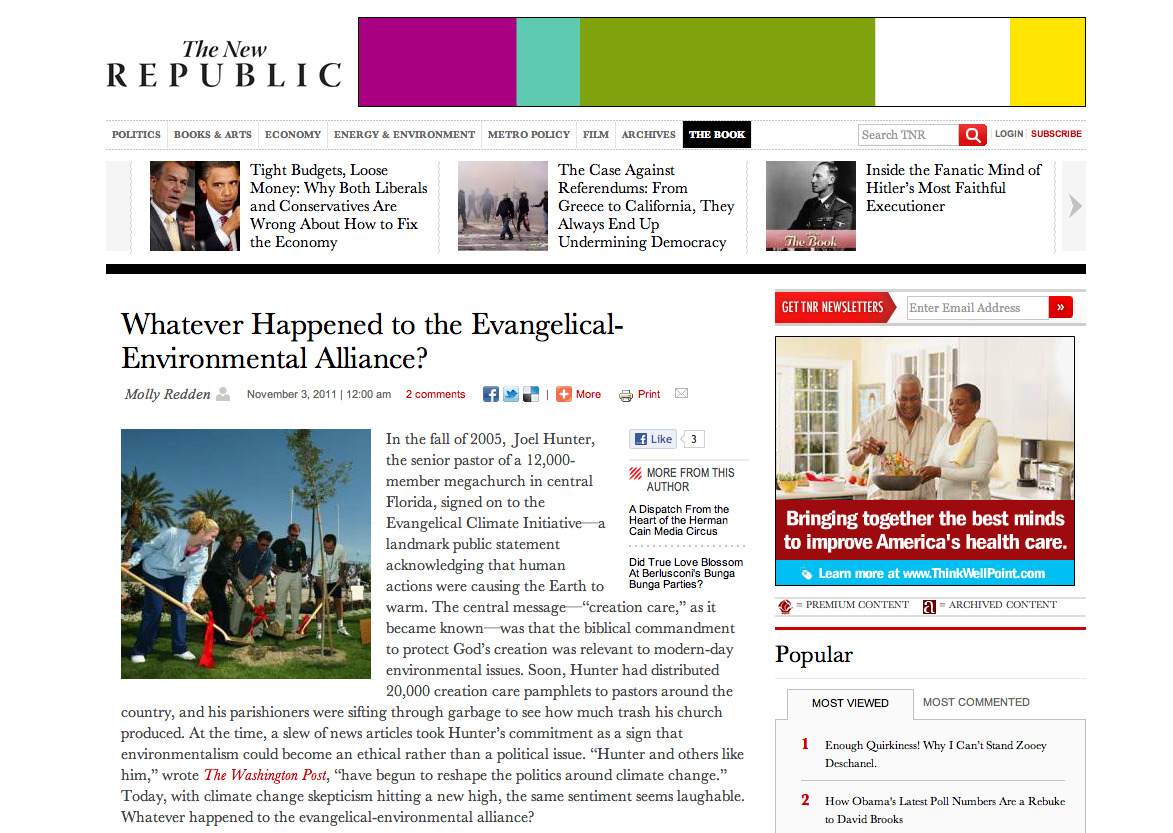
Screen Shot 2011-11-03 at 11.02.36 AM In the fall of 2005, Joel Hunter, the senior pastor of a 12,000-member megachurch in central Florida, signed on to the Evangelical Climate Initiative—a landmark public statement acknowledging that human actions were causing the Earth to warm. The central message—“creation care,” as it became known—was that the biblical commandment to protect God’s creation was relevant to modern-day environmental issues. Soon, Hunter had distributed 20,000 creation care pamphlets to pastors around the country, and his parishioners were sifting through garbage to see how much trash his church produced. At the time, a slew of news articles took Hunter’s commitment as a sign that environmentalism could become an ethical rather than a political issue. “Hunter and others like him,” wrote The Washington Post, “have begun to reshape the politics around climate change.” Today, with climate change skepticism hitting a new high, the same sentiment seems laughable. Whatever happened to the evangelical-environmental alliance?

Between 2006 to 2008, creation care seemed poised to transform evangelical politics. 86 evangelical leaders initially signed the Climate Initiative in 2006—it had more than 100 endorsers by the next year. Rod Dreher, a conservative columnist for The Dallas Morning News and a frequent National Review contributor, published a widely discussed book called Crunchy Cons in 2006; its lengthy subtitle celebrated “evangelical free-range farmers” among other conservative environmental types. In 2008, 45 members of the Southern Baptist Convention signed a statement saying they had been “too timid” on the issue of climate change, Pat Robertson appeared in a commercial about environmental issues with Al Sharpton, and Mike Huckabee—initially the favorite candidate of middle-America evangelicals in 2008—spoke openly about his global warming concerns.

The popularity of creation care was also taken as a sign that evangelicals cared about the environment andthat the GOP’s stranglehold on the evangelical vote might be loosening. Amy Sullivan argued this for The New Republic in 2006, and E.J. Dionne opined in 2007 that creation care was part of a larger reformation “disentangling a great religious movement from a partisan political machine.” In The New Yorker, Frances Fitzgerald argued that creation care advocates might change the GOP “beyond the recognition of Karl Rove.” When Obama captured five points more than John Kerry of the white evangelical vote, it was seen as an additional sign of shifting allegiances.

However, in late 2008, creation care’s momentum slowed, and the evangelical-GOP alliance grew stronger. Perhaps the first sign that creation care was sputtering was the abrupt departure from the National Association of Evangelicals (NAE) of its chief lobbyist, Richard Cizik, the leading force behind the Evangelical Climate Initiative. Cizik was forced out after he voiced support for civil unions between gays and lesbians, but he and his critics both traced the roots of his ouster to his strident support of environmental issues. At the time, Cizik’s departure was regarded as a mere hiccup. But, in fact, it was a sign of a backlash that would be bolstered by the rise of the Tea Party, increased scientific skepticism, and the faltering economy.

The rise of the Tea Party after 2008 was detrimental to evangelical environmentalism for two main reasons: It commanded the attention of the Republican Partyand it made room for climate change skeptics. Although it’s impossible to say if politicians instigated or reacted to the increased climate change skepticism associated with the rise of the Tea Party, by late 2009 evangelical climate skeptics were out in full force—climate change denier Senator Jim Inhofe called it “the year of the skeptic.” Tea Party senate candidates Marco Rubio, Joe Miller, Ken Buck, Christine O’Donnell, Ron Johnson, and Sharron Angle—who called manmade climate change the “mantra of the left”—all proudly advertised their climate change skepticism in the 2010 GOP primaries. Meanwhile, moderate Republican candidates, such as Illinois’s Mark Kirk, renounced their votes for cap-and-trade or were booed by Tea Party throngs for defending them. Today, polls show Tea Partiers are markedly less likely than any voter group to believe that humans were causing global warming—or that the Earth is warming at all.

A new bout of skepticism over the actual science of climate change reinforced these political positions. Creationism and a “God is in charge” belief became prominent again, along with a sense that any attempt to take climate change seriously was somehow unfaithful—even unjust. At a December 2009 Heritage Foundation event, Craig Mitchell, a Southern Baptist theologian, derided cap-and-trade as “immoral,” while other evangelical leaders blasted the evidence for climate change. Measures to address climate change were disfavored for supposedly placing burdens on poorer nations. (Ironically, concern for poorer nations at risk due to climate change had been one of the main selling points for creation care.) The Cornwall Alliance (an influential evangelical group that bills its mission as “the Stewardship of Creation”) released a declaration that claimed the “Earth and its ecosystems … are robust, resilient, self-regulating. … Earth’s climate system is no exception.” A year later, the group put out “Resisting the Green Dragon,” a 12-part DVD series decrying the environmental movement. Scientific skepticism bled into cultural skepticism. Even among moderate evangelicals, creation care struggled against general ambivalence toward environment issues—rooted in opposition to the countercultural identity that American environmentalism gained in the 1970s. As David P. Gushee, one of the authors of the Evangelical Climate Initiative, put it: To them, “it’s Pocahontas talking to spirits in the trees,” and “flower-power.”

Finally, there was the economy. Once it nosedived, it became hard for anyone to talk about policy changes with significant up-front costs. Hunter points to it as one of the main reasons why his message didn’t take among members of his own church—parishioners were just too distracted by the downturn. The circa-2006 hope that pro-business evangelicals might get behind the cost-saving appeal of conservation disappeared in the face of arguments that environmental regulations would freeze economic growth. A recent Nature article points out that the Heartland Institute, a think tank that has spent millions of dollars on coordinated attacks on climate change science, mostly focuses on the economic costs of environmentalism. “I would argue that conservation … is not a luxury, but a moral imperative,” Rod Dreher, the Crunchy Cons author, wrote to me in an e-mail. “I would also get exactly nowhere with that argument among conservatives in this economy.”

It’s true that today the optimism of 2005 is nowhere to be found. The mood has shifted so far that GOP candidates must not only renounce any environmentally friendly policies, they must also explain their past support for them. As Grover Norquist recently put it, formerly environmentally-minded GOP candidates “better have an explanation, an excuse, or a mea culpa.” Despite all the theories that environmentalism might untie the GOP-evangelical alliance, most of the white evangelical vote, for now, remains inextricably linked to the Republican Party. A glum Hunter told me that he holds out hope for the next generation, conceding that his generation probably won’t be shaking up the climate change debate like they’d hoped. The old fault lines, which Cizik told The New Republic in 2006 were “no more,” are still very much alive.

Molly Redden is a reporter-researcher at The New Republic.

Source URL: http://www.tnr.com/article/politics/97007/evangelical-climate-initiative-creation-care

View Post

  •   Public Square   •  

Evangelical Leaders Meet President at White House

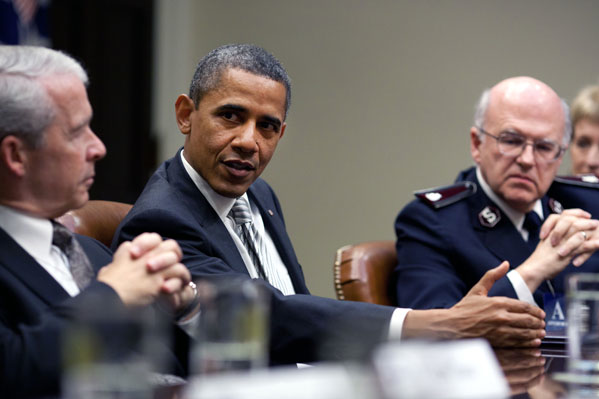
Screen Shot 2011-10-13 at 12.11.11 PM Christian leaders at the first Evangelical Summit held at the White House Wednesday prayed for President Barack Obama and encouraged him to continue talking about his faith, said Joel C. Hunter, a spiritual adviser to the president.

Obama met with the executive committee of the National Association of Evangelicals, which represents 45,000 churches from 40 denominations across the United States, in the Roosevelt Room.

Religious freedom and the Christian stance on traditional marriage took center stage among the topics discussed, Hunter said. Immigration reform and global poverty were also presented as issues during the 30-minute meeting.

Hunter, who sat next to Obama during the meeting, told The Christian Post that the president also talked about his own faith. Although he did not want to quote the president's conversation on the matter, he said Obama “did bring up his faith and spoke from that perspective.”

At the conclusion of the meeting, Leith Anderson, the president of NAE, asked Obama if he would like the members present to pray for him, Hunter said.

“We prayed for him. Leith commended him on his expression of his faith in the Easter prayer gathering and at other times. We told him that we really do appreciate his being clear about his Christian faith at different events. So we just wanted to encourage him in that,” Hunter said.

Hunter, of Northland, A Church Distributed, near Orlando, Fla., was a member of the White House’s Advisory Council on Faith-Based and Neighborhood Partnerships. He told CP that he presently has a pastoral relationship with Obama.

“It was a very constructive meeting. Very honest,” Hunter described. “The president is very good at stuff like that. He wanted to hear our concerns and priorities, and he listened and responded to each one of them.”

The Rev. Samuel Rodriguez, president of the National Hispanic Christian Leadership Conference and a member of the contingent, told Charisma News that the meeting was "very much a conversation among friends. We had about 19 evangelical leaders – all an integral part and members of the NAE – and we had a great conversation with the president."

According to Rodriguez, "Although we may disagree with the president on certain issues, we did it with great deference and civility. Not only was the meeting cordial, it sounded like a conversation amongst believers. The meeting was edifying, to say the least."

Hunter said that members of the NAE wanted to make sure Obama was clear on their views on religious freedom and marriage.

“Certainly, the president’s attention was drawn to religious freedom and our strong advocacy for that. There is a bill in the Senate right now to extend the commission on international freedom,” he said. “We wanted to advocate that we continue that commission because it’s so important.”

Although it is not always clear cut, there appears to be a divide between Obama and many evangelicals on the issue of same-sex marriage. NAE leaders articulated a desire for military chaplains to be able to express opposition to homosexuality, coming on the heels of the repeal of “don’t ask, don’t tell.”

“I think the president was reminded how important the issue of marriage is to us,” Hunter said. “That we don’t ever want to be in a position that we feel like we are having to compromise what we believe because of federal policies.”

Hunter also said the NAE wanted to make sure that there is future cooperation with the White House in regards to immigration laws and that funding for international aid is not cut.

By Alex Murashko Christian Post Reporter

FIND THIS ARTICLE AT: http://www.christianpost.com/news/white-house-summit-christian-leaders-encourage-obama-to-share-faith-58133/

View Post