Faith in the Public Square: It's Personal
Part 1 in a series of teachings from Dr. Joel C. Hunter about how to approach today’s issues biblically, respectfully and effectively.
• Public Square •
Part 1 in a series of teachings from Dr. Joel C. Hunter about how to approach today’s issues biblically, respectfully and effectively.
CMF Public Media (cmfmedia.org) presents a 3-minute commentary by "a voice that matters on an issue that voice believes matters."
• Public Square •
• Public Square •
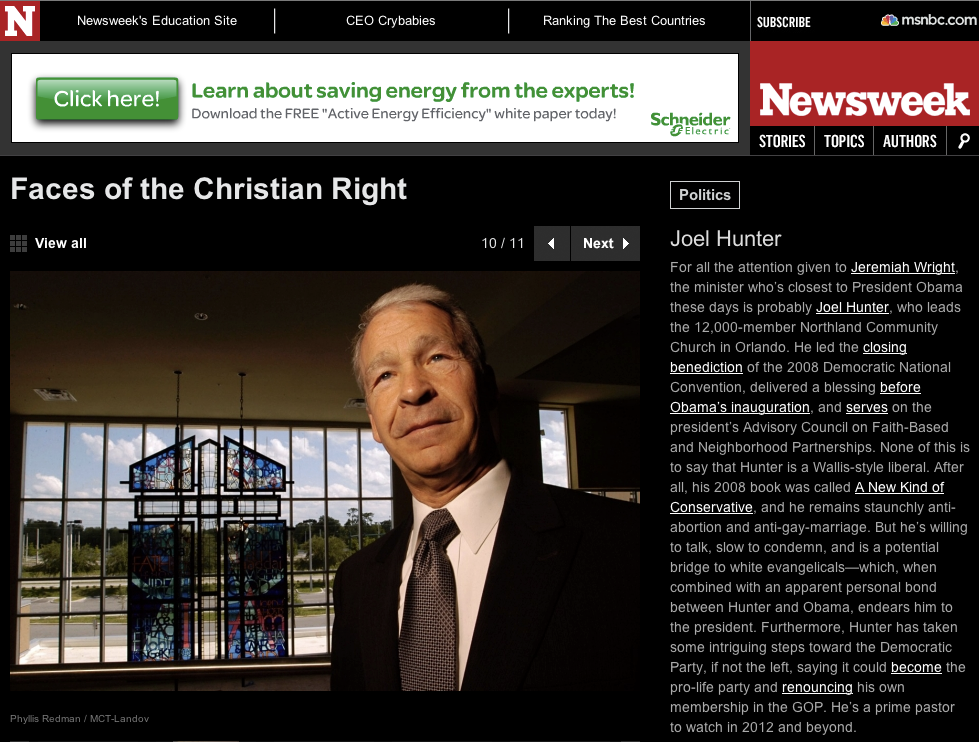 Newsweek writes: "For all the attention given to Jeremiah Wright, the minister who’s closest to President Obama these days is probably Joel Hunter, who leads the 12,000-member Northland Community Church in Orlando. He led the closing benediction of the 2008 Democratic National Convention, delivered a blessing before Obama’s inauguration, and serves on the president’s Advisory Council on Faith-Based and Neighborhood Partnerships. None of this is to say that Hunter is a Wallis-style liberal. After all, his 2008 book was called A New Kind of Conservative, and he remains staunchly anti-abortion and anti-gay-marriage. But he’s willing to talk, slow to condemn, and is a potential bridge to white evangelicals—which, when combined with an apparent personal bond between Hunter and Obama, endears him to the president ... He’s a prime pastor to watch in 2012 and beyond."
• Interfaith Dialogue, Public Square •
The Christmas story sounds strangely familiar, not just because it is well known history but because it is in part our story, too. Who of us has not experienced shocking interruptions of what we had hoped would be a predictable course of events?
More than 2,000 years ago, no one was prepared for God to actually do what had been long predicted by the prophets. It was easier to believe that a Messiah, a Savior, would come some day than to think that it could happen in their lifetime.
A baby? Did the angel say "child?" Was that an angel? Who was ready for a baby?
Reactions to surprise varies between believing it is from God and immediately submitting, like Mary, or deciding to quickly dispense with the discomfort, assuming someone has done something wrong, like Joseph's first reaction to Mary's condition.
Part of the surprise was the original cast of characters God chose. Mary was an unwed teenager who had "never known a man." She likely thought of herself as a poor prospect for motherhood. Joseph was a descendant of religious leaders, surely expecting the propriety of a traditional marriage before fatherhood. Herod was a paranoid political figure. The Magi were foreigners, educated scientists of the day, who were not a part of the Jewish faith. The shepherds were just regular working folk, unlikely to be esteemed in religious circles because they could not keep all the ceremonial laws. Who out of that cast would expect to be chosen?
And circumstances were just as inconvenient. A pregnant woman traveled 80 miles walking or on a donkey to give birth in a stable for animals because the government had passed a decree demanding a census. An angel, then a host of angels, announced the arrival of the baby who would be God's presence on earth. In this story, God does not come in the form of a conquering hero. In fact, His answer to our hopes and fears is a baby that needs human care and patient attention before He saves us from our own destructive ways. How odd it is to demand that humans expend energy to help God.
No one in the Christmas story can receive Him without some adjustment to their regular lives. In fact, as they receive Him, their lives are not just regular anymore. Now they will live in adjoining worlds -- the baby who will become a great teacher, and give his life as a sacrifice, is the door to heaven. Those who receive him experience an access to heaven while living on earth because heaven came to earth in him.
Of course learning to bridge two worlds is a risky and uncomfortable business. Joseph and Mary become refugees to escape the political figure's attack. The Magi return to their home by a way that will avoid contact with those who demand destruction of the competition. The shepherds return to the field, praising God but wondering how what they have seen relates to their everyday lives.
God came in a way that would reconcile the differences and distances between groups. If shepherds and Magi, if a poor couple and the Roman Caesar, if stars and animals and crowds unaware can be combined in the story of God's special arrival, then cooperation among different groups for the good of all would seem to be God's way.
Once upon a time, God interrupted the lives of people to make them part of a special story. Those of us who commemorate the story are also part of it. During Advent we prepare for Christmas not merely as a ritual but as a hoped-for divine interruption. We look to recognize in the interruption of our routines a chance to see God's arrival again. We are hoping that He will use us with groups that would ordinarily not be in the same story. We are hoping that as our families get together, as we personally ponder in our hearts (as Mary did) all the facets of the Christmas story, God will use us to do something extraordinary in the world again.
The "Glory to God in the highest [is] on earth peace among men [as in male and female humankind] with whom He is pleased" (Luke 2:14).
During this solemn season of Advent, the preparation to re-live the birth of Jesus, we have a choice: We can focus on decorations and gifts and food, some of it fun and bonding. Or we can focus on the door, once a baby, adjoining heaven and earth. We can get ready to worship God in such a way that we will be ongoing agents of reconciliation. We can long for and work for a world where different and distant groups are all a part of the same story -- His.
FIND THIS ARTICLE AT: http://www.huffingtonpost.com/joel-c-hunter/advent-preparation-after-_b_788157.html
• Interfaith Dialogue, Religious Freedom •
 MURFREESBORO, Tenn. -- Islam is suddenly on trial in a booming Nashville suburb, where opponents of a new mosque have spent six days in court trying to link it to what they claim is a conspiracy to take over America by imposing restrictive religious rule.
The hearing is supposed to be about whether Rutherford County officials violated Tennessee's open meetings law when they approved the mosque's site plan. Instead, plaintiff's attorney Joe Brandon Jr. has used it as a forum to question whether the world's second-biggest faith even qualifies as a religion, and to push a theory that American Muslims want to replace the Constitution with extremist Islamic law.
"Do you want to know about a direct connection between the Islamic Center and Shariah law, a.k.a. terrorism?" Brandon asked one witness in a typical line of questioning.
Brandon has repeatedly conflated a moderate version of Shariah with its most extreme manifestations, suggesting that all Muslims must adhere to those interpretations.
At one point, he asked whether Rutherford County Commissioner Gary Farley supported hanging a whip in his house as a warning to his wife and then beating her with it, something Brandon claimed was part of "Shariah religion."
The commissioner protested that he would never beat his wife.
County attorney Jim Cope objected to the question, saying, "This is a circus." The rhetoric has conjured up comparisons to another culture clash that played out in a Tennessee courtroom a hundred miles and nearly a century away from Murfreesboro, a college city of 100,000 that is among the fastest-growing communities in the country. In 1925, the world watched as evolution came under attack at the Scopes monkey trial in Dayton, Tenn.
Chancellor Robert Corlew has consistently given the plaintiffs leeway to present testimony by nonexperts and documents that they cannot prove are legitimate, saying he reserves the right to strike things from the record later.
Corlew, who holds an elected office, has given little explanation for why he has allowed the testimony to stray so far afield.
Since it is not a jury trial, the judge can ultimately disregard anything he deems irrelevant. Several attorneys suggested he may want the plaintiffs, three residents who object to how the mosque came about, to feel they were able to have their say.
That could explain why Corlew has allowed Brandon to repeatedly question witnesses about whether Islam is a legitimate religion - even after the Department of Justicestepped in with a brief stating that it was.
When Farley, the commissioner, told Brandon the federal government defined Islam as a religion, Brandon responded, "Are you one of those people who believes everything the government says? Are you aware the government once said it was OK to own slaves?"
Other faiths have risen to the defense of the Islamic Center of Murfreesboro. The newly formed Interfaith Coalition on Mosques, which is composed of prominent Catholics, Jews, Muslims, and Southern Baptists and other Protestants, has filed a brief in the case.
It's good for the mosque's opponents to get their day in court - testimony is to resume Friday - said the Rev. Joel Hunter, an evanglical megachurch pastor and coalition member.
But it's "really out there" to question whether Islam is a religion, said Hunter, who leads a Longwood, Fla., congregation called Northland, A Church Distributed.
Seeking to prove that the mosque has terrorist leanings, witnesses have pointed out that board member Mosaad Rowash previously had pro-Hamas postings on his MySpace page, something the mosque's leaders have not denied. The U.S. government considers Hamas, a Palestinian Islamic political party with an armed wing that has attacked Israel, a terrorist organization.
The political views of Rowash - who hasn't been called to testify and hasn't commented publicly - and other board members are "totally irrelevant," said Deborah Lauter, the director of civil rights for the Jewish Anti-Defamation League, which sponsors the interfaith coalition.
If all of the members of the Islamic Center of Murfreesboro were public cheerleaders for Hamas, it would still be illegal to discriminate against them because the First Amendment protects freedom of worship, she said.
Even the group that provided the information on Rowash, the Washington-based Investigative Project on Terrorism, doesn't claim that the MySpace postings prove anything about the Islamic Center of Murfreesboro or its members.
Managing director Ray Locker said the Washington group provided the information about Rowash to a Tennessee resident who sent an inquiry about the mosque. He said how such information is used is beyond his group's control.
"We don't consider all Muslims to be terrorists," he said. "The vast majority of American Muslims just want to worship freely, just like members of other religions."
That wasn't the message of witness Frank Gaffney, the president and founder of the Washington-based Center for Security Policy and a former deputy assistant secretary of defense in the Reagan administration.
While acknowledging he was not an expert on Shariah law, Gaffney testified that Shariah, and by extension the new mosque, poses a threat to America.
Shariah isn't really law, at least not law as a universally recognized, codified body of rules and rights, the way Americans have come to know it. Shariah is a set of core principles that most Muslims recognize as well as a series of rulings from religious scholars.
It's some of those rulings, such as stoning a woman to death for committing adultery, that many non-Muslim Americans find reprehensible. But many Muslims, in America and around the world, are equally horrified by them, said Mohammad Fadel, an assistant professor of law at the University of Toronto Faculty of Law and an expert on Islamic law.
The mosque project has had problems outside court as well. A sign at the construction site was spray-painted with the words "Not Welcome" and torn in half, and federal investigators have offered a $20,000 reward for information leading to an arrest in what they say was the arson of a dump truck on the grounds.
Hunter, the Florida pastor, said he studied American history in college and knows that what is happening to Muslims today has happened to other groups in the past.
"Every minority - and Islam is very much a minority in this country right now - has had to struggle for equal rights," he said. "Islam is facing that now and we will not rest until they have equal rights with other religions."
FIND THIS ARTICLE AT: http://www.forbes.com/feeds/ap/2010/11/11/general-us-rel-islam-on-trial_8098629.html?boxes=Homepagebusinessnews
• Public Square •

President Barack Obama was forced to open up about his Christian faith on Tuesday when an woman asked him why he was a Christian.
"I'm a Christian by choice," he responded.
It was a "hot topic question," the woman said during an informal conversation on the economy. Obama was meeting with families in the front garden of the home of Andy and Etta Cavalier in Albuquerque, New Mexico, when the question was posed.
Providing a brief account of how he grew up, Obama said his family members "weren't folks who went to church every week."
"My mother was one of the most spiritual people I knew, but she didn't raise me in the church," he said.
Obama became a Christian later in life.
What drew him to Christianity were "the precepts of Jesus Christ" which spoke to him in terms of the kind of life he wanted to lead, he explained.
These precepts included "being my brothers' and sisters' keeper; treating others as they would treat me."
He continued, "I think also understanding that ... Jesus Christ dying for my sins spoke to the humility that we all have to have as human beings – that we're sinful and we're flawed and we make mistakes; we achieve salvation through the grace of God."
In terms of how he's living out his Christian faith, he said he strives and prays to "see God in other people" and "help them find their own grace."
"I think my public service is part of that effort to express my Christian faith," he said.
Only about a third of Americans believe the president is a Christian, a Pew Forum on Religion and Public Life revealed last month. Last year, nearly half held that perception. Meanwhile, some 18 per cent say Obama is a Muslim and the rest do not know his religion.
Following the release of the poll, the White House and several pastors who advise Obama defended the president's faith and assured the public that he is committed to Christ. Florida pastor Joel C Hunter recommended that the White House be more public about what Obama does to be an active Christian.
A few weeks later, Obama and his family made a rare appearance at church for Sunday worship. They attended St John's Church near the White House.
After responding to the question about his faith on Tuesday, Obama added that as the president of the United States, he also believes that "part of the bedrock strength of this country is that it embraces people of many faiths and of no faith."
"Their own path to grace is one that we have to revere and respect as much as our own and that's part of what makes this country what it is," he highlighted.
"We were founded on freedom ... the freedom of religion. That's how this country got started. That's why people came here. We have to constantly, I think, reaffirm that tradition even when it sometimes makes us uncomfortable."
Briefly addressing another "hot topic question" asked by the same woman, Obama reiterated his stance on abortion.
Abortion should be "safe, legal and rare", he said.
The decision should be made by the families and the women involved and not the government, he said.
Regarding late-term abortions, he noted that there are "a whole host of laws on the books" in which the interests shift after a certain period so that there are some restrictions, and "appropriately so."
Host Mark Simpson speaks with Central Florida Imam Muhammad Musri, who was at the center of negotiations with the Gainesville pastor who planned to burn copies of the Koran on last weekend's anniversary of the 9/11 attacks. He's joined by Dr. Joel Hunter for a discussion of religious fundamentalism. The two men share their surprising views on how this event will affect Christian-Muslim relations.
• Public Square •
 President Barack Obama has long sought to open a dialogue between his administration and evangelical religious leaders, and he has even found common ground on some issues with conservative groups like the Southern Baptist Convention and the National Association of Evangelicals.
But even though Obama may have won over some religious leaders, he’s losing the battle to win over their congregants.
Though several moderate to conservative evangelical pastors support the president, polls show that a significant percentage of conservative Christians remain skeptical about Obama’s sincerity when it comes to the values that he says they share, and many say they doubt his faith.
Joel Hunter, one of Obama’s religious advisers, who has served on the President’s Advisory Council on Faith-Based and Neighborhood Partnerships, blames a coordinated campaign to spread disinformation about the president, undermining his efforts at outreach to evangelicals. That, he said, leads to suspicions among average conservative churchgoers who suspect Obama is trying “to enlist good people for their sinister causes.”
For every instance of religious moderate leaders supporting Obama on certain issues, “there is this other equal and opposite reaction [from the congregation] that says, ‘Well, it’s all a trick,’” said Hunter, the pastor of Northland, A Church Distributed in Longwood, Fla., and author of “A New Kind of Conservative.”
The growing doubt among evangelical voters comes despite the president’s record of relatively moderate faith positions, such as his decision to invite Pastor Rick Warren of Saddleback Church in California to speak at his inauguration. During the campaign, some conservatives believed Obama was downplaying his party’s long-standing position on abortion rights in favor of more emphasis on reducing abortions.
And his opposition to gay marriage in favor of civil unions drew in moderate and some conservative evangelicals, although Obama insisted that it’s a matter of religious principle, not conventional political wisdom.
Joshua DuBois, the director of the White House Office of Faith-based and Neighborhood Partnership, said the White House has made a “historic” effort to reach voters of faith, and Obama “is proud of his continued and strong support from people of faith at the leadership level and in grass roots.” DuBois insisted that the president “will continue to work with religious communities to move our nation forward."
During the 2008 presidential election, voting patterns show Obama won modest but significant swaths of religious voters, winning a higher percentage of Protestant, Catholic and Jewish voters than John Kerry did in 2004.
But according to a recent Pew Research poll, more white evangelicals erroneously believe that Obama is Muslim than those who believe he is Christian, and 42 percent say they don’t know what religion he practices at all.
“Every day I read a poll [about Obama’s religion] I think it’s odd,” said Leith Anderson, president of the National Association of Evangelicals. “I read all these polls and my mind always flashes back to Jay Leno and ‘Jaywalking,’” referring to the comedian’s routine that pokes fun at Americans’ ignorance of seemingly basic facts.
Groups like the National Association of Evangelicals, who represents some 30 million members and dozens of Christian denominations across the country, have found room to agree with the president on issues like gay marriage and immigration reform — an issue Obama has pledged to tackle during his term.
“I’m not aware of an issue of significant public policy that has so united the evangelical community as immigration reform,” said Rich Nathan, pastor of Vineyard Church of Columbus, Ohio. But Nathan said that support for action on immigration has not filtered down to lay members of evangelical communities, due to “a relative absence of communication — most laypeople have never heard a sermon or teaching on immigration from the pulpit,” Nathan said.
At the same time, some evangelical Christian voters are sticking close to more traditional, conservative political roots. Last month, tens of thousands of Christians rallied on the National Mall, in response to Fox news host Glenn Beck’s call for a return to America’s religious values.
Some religious observers say that Obama must address the potent combination of faith and fear that has only increased since he took office. And he can do that by returning to the rhetoric of hope that he used during the presidential campaign.
“And a whole lot of little things can happen right, but it doesn’t remove the fear,” Hunter said. “You’ve got to address the fear if you’re going to create unity and create a movement.”
FIND THIS ARTICLE AT: http://www.politico.com/news/stories/0910/42028.html
• Public Square •
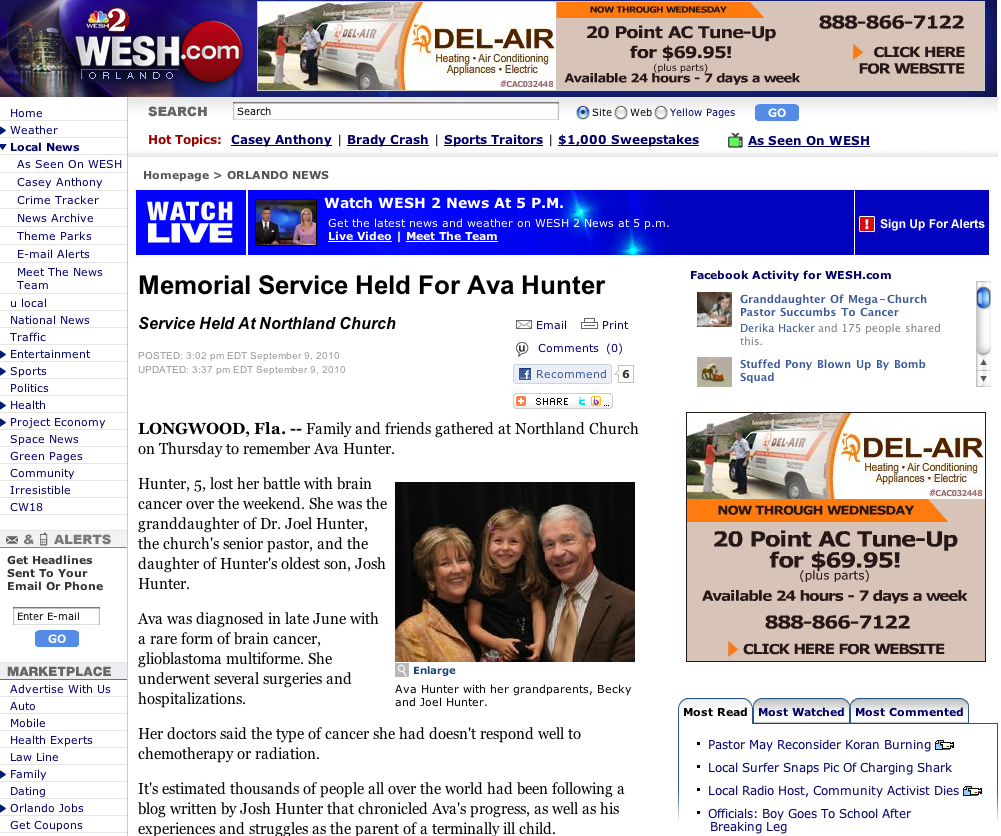 LONGWOOD, Fla. -- Family and friends gathered at Northland Church on Thursday to remember Ava Hunter.
Hunter, 5, lost her battle with brain cancer over the weekend. She was the granddaughter of Dr. Joel Hunter, the church's senior pastor, and the daughter of Hunter's oldest son, Josh Hunter.
Ava was diagnosed in late June with a rare form of brain cancer, glioblastoma multiforme. She underwent several surgeries and hospitalizations.
Her doctors said the type of cancer she had doesn't respond well to chemotherapy or radiation.
It's estimated thousands of people all over the world had been following a blog written by Josh Hunter that chronicled Ava's progress, as well as his experiences and struggles as the parent of a terminally ill child.
Joel Hunter leads a congregation of 12,000 at Northland and serves on an advisory council to President Barack Obama.
Dr. Joel C. Hunter is the Pastor of Community Benefit at Action Church, a multi-site congregation based in Winter Park and his one-minute daily devotionals can be heard worldwide on Z88 radio. He is the Chairman of the Central Florida Pledge campaign; a call to action for residents of Central Florida who are tired of hateful discourse and want to create a safe and inclusive community for all. The pledge asks residents to commit to treating all people with kindness and respect, especially those with whom they disagree. To learn more: https://www.centralfloridapledge.com/
He is a nationally and internationally known advocate for the poor, the marginalized, and those dealing with disabilities. He served a three-year term as the Chairman of Central Florida’s Commission on Homelessness. And, after 32 years as the senior pastor of Longwood, Florida’s Northland Church’s congregation of 20,000, he spent five years leading a non-profit in networking with churches and local charities to locate available resources and benefit the struggling in our community. Orlando Magazine highlighted his efforts naming him as the #1 most powerful voice for philanthropy and community engagement. And listed him among “Orlando’s 50 Most Powerful” six years in a row.
Approaching today’s challenges in a biblical and balanced manner, Dr. Hunter is neither partisan nor politically oriented, but often relates to public officials in a pastoral role; he served as a spiritual advisor to President Obama during his eight years in office.
Dr. Hunter has served in leadership roles of the World Evangelical Alliance, serving more than 600 million evangelicals, and the National Association of Evangelicals, serving more than 40 denominations and thousands of churches.
Married in 1972 to his wife, Becky, he is the father of three sons, grandfather of seven, and great-grandfather of two.

